
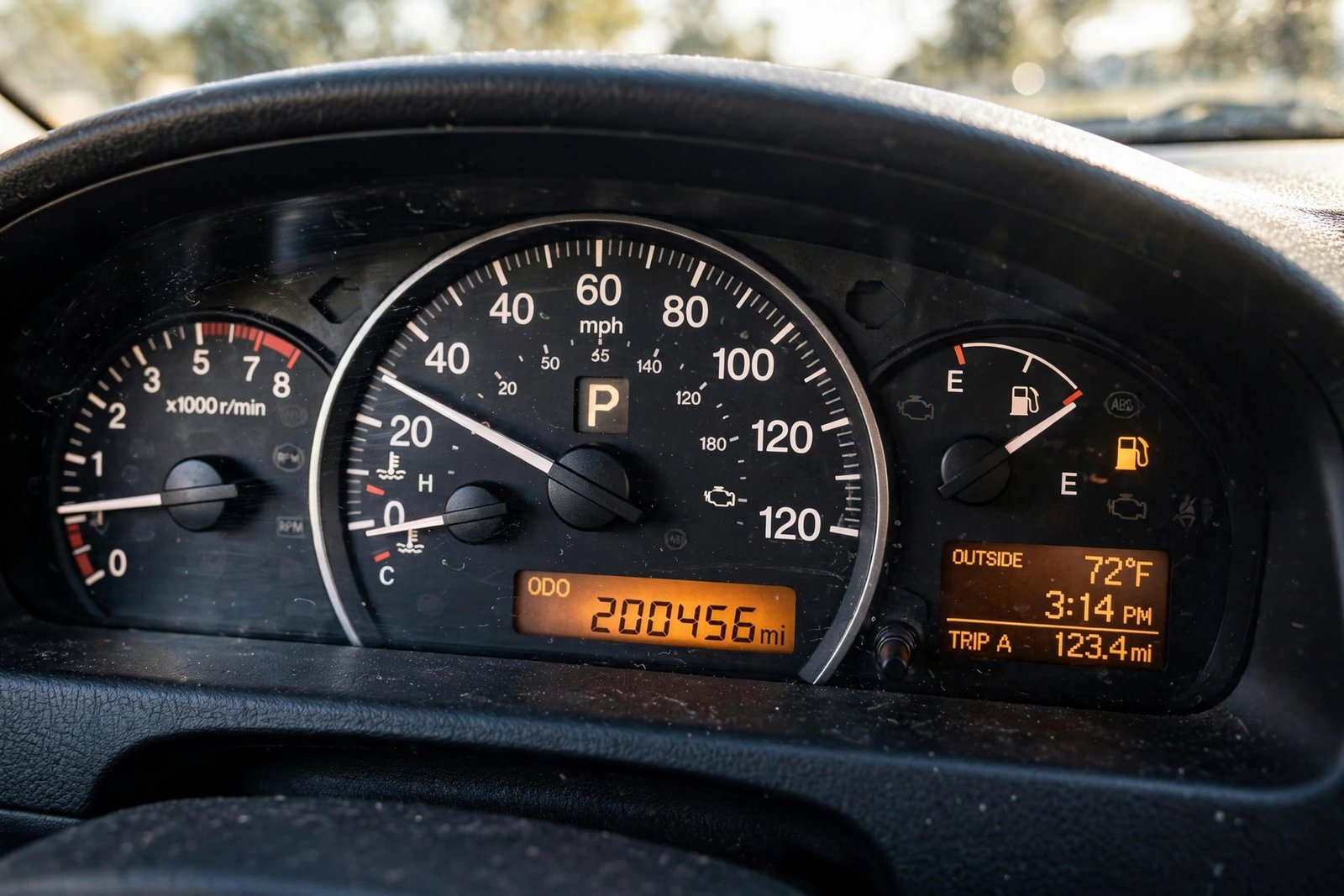
The average car on American roads is now over 12 years old, and a growing community of drivers is pushing well past 200,000 miles — some past 300,000 or even 500,000. A car that lasts 200,000+ miles instead of dying at 120,000 saves you $20,000–$40,000 in replacement costs, which makes longevity one of the highest-ROI skills in personal finance. The secret is not luck or a magic brand — it is disciplined maintenance, smart driving habits, and addressing small problems before they become big ones. Here is the complete playbook.
The foundation: maintenance by the book (not by the shop)
Your owner’s manual contains a maintenance schedule engineered by the people who built your car. Follow it — specifically the severe service schedule if you do mostly city driving, short trips, or stop-and-go traffic (which describes most NYC-area driving). The non-negotiables:
Oil changes: the lifeblood. Modern synthetics last 5,000–10,000 miles, but time matters too — change at least annually even with low mileage. Skipping oil changes is the number-one engine killer, full stop.
Transmission fluid: the most neglected fluid in the car. Many manufacturers claim “lifetime” fluid — transmission specialists disagree. Drain-and-fill (not flush) every 30,000–60,000 miles prevents the $3,500–$5,000 rebuild that totals older cars.
Coolant: every 5 years or 100,000 miles. Old coolant loses corrosion protection, and internal corrosion kills engines and radiators silently.
Brake fluid: every 2–3 years. It absorbs moisture, lowering its boiling point and corroding ABS components — a $1,500+ repair from a $100 service.
Filters and spark plugs: air filter every 15,000–30,000 miles, cabin filter annually, spark plugs per the manual (often 100,000 miles with iridium). Cheap parts, real consequences when ignored.
Consumer Reports’ reliability ratings show which models most often reach high mileage — useful if you are buying a keeper. Keep a maintenance log — dates, mileage, what was done. It prevents duplicate work, catches missed intervals, and adds hundreds at resale. Maintenance discipline is a habit, like any other — our guide to common home maintenance tasks people forget shows how the same “small things compound” principle applies to houses.
Driving habits that add 50,000 miles
How you drive matters as much as how you maintain. Warm up gently: modern cars need 30 seconds of idle, then gentle driving until the temperature gauge reaches normal — hard acceleration on a cold engine accelerates wear dramatically. Avoid short trips when possible: engines never reaching operating temperature accumulate moisture and fuel contamination in the oil — combine errands into one longer drive. Drive smoothly: jackrabbit starts and panic stops wear brakes, tires, transmission, and engine mounts; smooth inputs extend everything. Do not ignore warm-up in winter: cold is brutal — allow extra gentle-driving time below freezing. Lighten the load: every 100 pounds of junk in the trunk costs fuel and wears suspension; roof racks and boxes add drag and stress. Use the parking brake: on hills, it saves the transmission’s parking pawl from holding the car’s weight — a free habit that prevents expensive damage.
The 100,000-mile service: the inflection point
Around 100,000 miles, cars need a wave of age-related service that owners often skip — and skipping it is why most cars die at 120,000–140,000 instead of reaching 200,000:
Timing belt (if equipped): interference engines destroy themselves if the belt snaps — $800–$1,200 of prevention versus a $4,000+ engine replacement. Timing chains last longer but their tensioners and guides wear; listen for rattles on cold start.
Water pump, thermostat, hoses: cooling system components have finite lives. Replace them proactively with the timing belt (the labor overlaps, saving hundreds).
Suspension: struts, shocks, control arm bushings, and ball joints wear gradually — you adapt to the degradation without noticing. Fresh suspension at 100k–120k transforms the car and prevents uneven tire wear that costs more long-term.
Second transmission service, second coolant change, new spark plugs: the 100k milestone service is real — budget $1,500–$2,500 for the full wave. It is the cheapest $2,000 you will ever spend on a car.
Rust: the silent killer (especially in New York)
In the Northeast, rust — not mechanical failure — retires most cars. Road salt eats subframes, brake lines, fuel lines, and rocker panels. The defense: wash the undercarriage regularly in winter (monthly at minimum — the $15 underbody wash pays for itself); fix paint chips immediately (a $10 touch-up pen prevents a $500 rust repair); oil-based undercoating (Fluid Film or similar, ~$150–$300 annually — the single best rust investment for salt-belt cars); and garage it when possible (keeping the car dry between drives dramatically slows corrosion). Inspect brake and fuel lines annually after year 8 — rusted brake lines fail catastrophically, and this inspection is non-negotiable for high-mileage safety. Like HVAC systems, cars reward scheduled attention — how often to service your HVAC makes the same case for houses: the schedule exists because the physics demands it.
Fix small problems immediately (the $200 rule)
High-mileage success comes down to one principle: no small problem stays small. That $200 weeping gasket becomes a $2,000 engine repair when the oil runs low. The check-engine light for a $30 sensor becomes a $1,200 catalytic converter when ignored. The slight vibration becomes destroyed tires and wheel bearings. Budget $100–$150/month into a car maintenance fund from day one — when the $800 repair arrives, it is planned, not a crisis. And learn which repairs are DIY-friendly (brakes, filters, batteries, sensors — YouTube and basic tools handle these) versus pro-only (transmission internals, AC refrigerant, airbag systems). The AAA approved repair network is a good source for honest shops when you need professional help.
Know when to let go (the math of the end)
Even perfect maintenance cannot beat economics forever. The rule: when a single repair exceeds the car’s value, or annual repairs exceed ~50% of a replacement’s yearly cost, it is time. A $3,000 transmission on a $2,500 car is the end — unless the car has exceptional sentimental or practical value. Also consider: safety (a 2008 car lacks modern crash structures and driver aids — your family’s safety has a price), reliability needs (a car that strands you regularly has failed its primary job), and rust beyond economic repair (structural rust is the one truly terminal diagnosis). Letting go at the right time is as much a skill as maintaining — sentimentality has cost many owners thousands in good-money-after-bad. Technology lifecycles work the same way — how often to upgrade your smartphone applies the same replace-versus-repair calculus.
Conclusion
Getting a car past 200,000 miles is not mysterious: follow the severe-service maintenance schedule religiously, service the transmission and cooling system on time, do the full 100,000-mile wave, fight rust aggressively (critical in New York), drive smoothly with proper warm-ups, fix small problems the week they appear, and fund it all with a monthly maintenance budget. Do this, and 200,000 miles is not an achievement — it is the midpoint. The most reliable car in the world is a maintained one, and the cheapest car you will ever own is the one already in your driveway.
Frequently Asked Questions
What mileage is considered high for a car?
Traditionally 100,000+ miles, but modern cars routinely reach 200,000 with proper maintenance. Condition and maintenance history matter far more than the odometer number.
How often should I change transmission fluid?
Every 30,000–60,000 miles with a drain-and-fill (not a flush), despite “lifetime fluid” claims. This single service prevents the $3,500–$5,000 rebuild that totals most older cars.
Is it worth fixing a car with 200,000 miles?
If the car is otherwise sound and the repair costs less than the car’s value, usually yes — $1,500 in repairs beats $25,000 for a replacement. Walk away when repairs exceed the car’s value or structural rust appears.
What kills cars in New York the fastest?
Rust from road salt — it retires more Northeast cars than mechanical failure. Regular undercarriage washes and annual oil-based undercoating are the best defenses.
Should I follow the normal or severe maintenance schedule?
Severe, if you do mostly city driving, short trips, or stop-and-go traffic — which describes most New York-area driving. The severe schedule’s shorter intervals reflect real-world wear.