How to Stop Doomscrolling Before Bed in New York City
How to stop doomscrolling before bed: the brain science of the scroll loop, phone settings that break it, and a 30-minute wind-down routine that actually works.
Written by admin
Published November 4, 2026
Reading time 6 minutes
It is 1:47 AM. You told yourself “just five more minutes” at 11:30. Now you have absorbed forty-seven videos about a topic you will never think about again, your eyes burn, and tomorrow’s 7 AM alarm feels like a threat. Doomscrolling before bed is the defining bad habit of the smartphone era — and in a city that never sleeps, where the phone is also the alarm, the news, and the social lifeline, it is brutally hard to break.
But it is breakable. The science of why you scroll — and the specific interventions that stop it — is well understood. Here is the full playbook.
Why Your Brain Cannot Stop Scrolling
Doomscrolling is not a willpower failure; it is your neurochemistry being expertly exploited. Infinite scroll removes all stopping cues — there is no “end of page” telling your brain the session is over. Variable rewards (the next post might be amazing) trigger dopamine the same way slot machines do — intermittent reinforcement is the most addictive reward schedule known to psychology. And at night, your prefrontal cortex (impulse control) is fatigued while your emotional brain is wide awake — the worst possible combination for self-regulation.
The content itself matters too. Outrage, disaster, and conflict dominate feeds because negative emotions drive engagement — “doom” is not accidental, it is algorithmic. Your tired brain, seeking stimulation, gets exactly the wrong kind. Understanding this is liberating: you are not weak, you are up against billion-dollar attention engineering. Which means willpower alone was never going to be enough — you need structural defenses.
The Phone Setup That Breaks the Loop
Your first interventions should be environmental, not motivational. Redesign the phone so the loop cannot start:
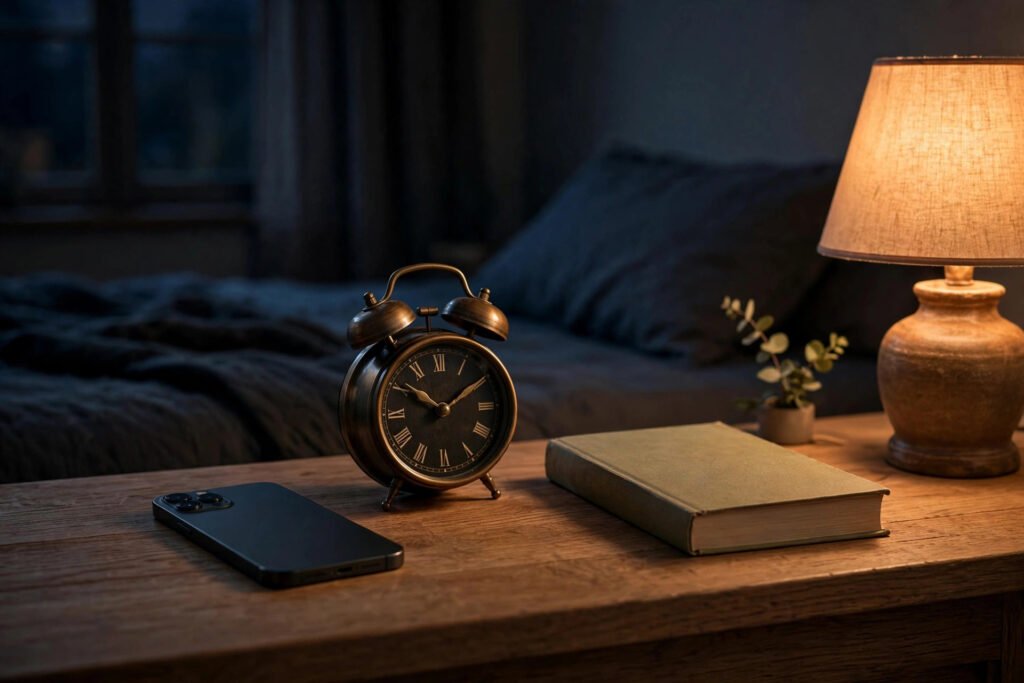
Charge outside the bedroom. This is the single highest-impact change. Buy a $10 alarm clock. When the phone is not the alarm, not the bedside companion, the 1 AM scroll becomes physically impossible. Everything else is optimization; this is the cure.
Grayscale mode after 9 PM. Color is a major engagement driver — apps are designed in vivid hues to hold attention. Grayscale makes the phone dramatically less appealing; most users report the urge to scroll drops within days. (iOS: Accessibility → Display → Color Filters; Android: Digital Wellbeing → Bedtime Mode.)
Delete or bury the worst apps. Remove infinite-scroll apps from your phone entirely, or at minimum move them off the home screen and disable notifications. Friction works: every extra tap between impulse and scroll gives your prefrontal cortex a chance to intervene.
Set app timers. Both iOS Screen Time and Android Digital Wellbeing let you cap daily usage per app. When the timer hits, the friction of overriding it breaks the trance for many users.
These changes address the mechanism, not the symptom — which is why they outperform “just try harder.” The NIH’s digital wellness research increasingly supports environmental design over willpower for screen habits.
The 30-Minute Wind-Down Routine
Your brain needs a runway to sleep — scrolling is the opposite of a runway. Replace the last 30 minutes with a routine that actually prepares you for rest:
Minutes 30–20: Transition. Dim lights, phone to its charger (outside the bedroom), change into sleep clothes. Signal to your brain that the day is ending.
Minutes 20–10: Analog activity. Read a physical book, stretch, journal, or do a puzzle — something engaging enough to satisfy the “I need stimulation” urge without a screen. This is the slot scrolling used to fill; it needs a real replacement, not just absence.
Minutes 10–0: Sleep preparation. Follow your bedtime routine for better sleep — hygiene, room prep, relaxation. By the time your head hits the pillow, your brain has had 30 minutes of wind-down instead of 30 minutes of outrage.
The routine matters less than its consistency — the ritual itself becomes the sleep cue. And if falling asleep is still hard, our guide to falling asleep faster at night covers the techniques.
Handling the Underlying Anxiety
Be honest: some doomscrolling is anxiety management disguised as information gathering. “I need to stay informed” at 1 AM is rarely true — it is the anxious brain seeking control through information. Recognize the pattern and address the anxiety directly:
Schedule worry time. Give yourself 15 minutes earlier in the evening to read news and process it — deliberately, with a clear end. When the urge hits at midnight, remind yourself: “I already did my news. This is anxiety, not information.”
Write the worry down. Keep a notepad by the bed. When a worry surfaces, write it down for tomorrow. Externalizing it tells your brain the concern is captured, reducing the compulsion to “research” it at 1 AM.
Address daytime stress. Nighttime scrolling often compensates for an overstimulated day with no decompression. How too much screen time affects sleep covers the broader relationship — but the fix includes daytime boundaries, not just nighttime ones. The Sleep Foundation and CDC’s sleep guidance both emphasize that sleep problems are 24-hour problems, not just bedtime ones.
The NYC-Specific Challenges
New York makes this harder in specific ways: the city runs late (the temptation to stay “in the loop” is real), apartments are small (the bed is also the couch, the office, and the entertainment center — no physical separation between “scroll zone” and “sleep zone”), and FOMO is a civic religion. Counter these structurally: create a “phone parking spot” by the front door, use the city’s late-night energy as a reason to go out rather than scroll (a walk beats a feed), and remember that nothing happening at 1 AM on social media requires your immediate attention. It will all be there tomorrow. It always is.
Conclusion
Stopping doomscrolling before bed is not about discipline — it is about design. Charge the phone outside the bedroom, grayscale the screen at night, add friction to the worst apps, build a 30-minute analog wind-down, and address the anxiety underneath. Start with the charger move tonight; add the rest over the week. Within two weeks, most people report falling asleep faster, sleeping deeper, and — the real prize — waking up without the specific shame of a 2 AM screen-time report. Your sleep is worth more than the feed.
Frequently Asked Questions
Why can’t I stop scrolling before bed?
Infinite scroll, variable rewards, and nighttime fatigue of your impulse-control brain create a perfect trap — engineered by design, not a personal failing. Environmental changes (phone out of bedroom) beat willpower.
Does grayscale mode really help?
Yes, significantly for most users. Color is a major engagement driver; removing it makes apps noticeably less appealing. It is one of the highest-effort-to-impact ratios in digital wellness.
What should I do instead of scrolling in bed?
Read a physical book, journal, stretch, listen to a podcast or audiobook (with a sleep timer), or do a puzzle. The replacement needs to be engaging enough to satisfy the stimulation urge.
How does doomscrolling affect sleep quality?
Blue light suppresses melatonin, emotional content raises arousal, and the activity delays sleep onset — a triple hit. It reduces both sleep duration and sleep quality.
Is it bad to use my phone as an alarm?
It is the gateway habit — the phone by the bed enables the entire scroll cycle. A $10 alarm clock is the cheapest, most effective sleep investment you can make.