How to Raise Alkalinity in Pool: Step-by-Step Guide (2026)
Low pool alkalinity causing pH swings? Learn how to raise alkalinity with baking soda: dosage chart, step-by-step method, testing tips, and mistakes to avoid.
Written by admin
Published October 21, 2026
Reading time 5 minutes
How to Raise Alkalinity in Pool: Step-by-Step Guide (2026)
If your pool’s pH keeps bouncing around no matter how much chemical you add, low total alkalinity is almost certainly the culprit. Here’s the short answer: to raise alkalinity in a pool, add baking soda (sodium bicarbonate) directly to the water with the pump running. The ideal total alkalinity (TA) range for most pools is 80–120 parts per million (ppm), and as a rule of thumb, about 1.5 pounds of baking soda per 10,000 gallons of water raises TA by roughly 10 ppm.
Dose it wrong, though, and you’ll overshoot your target or send pH climbing. Here’s how to test, calculate the right dose, and add it correctly — plus the mistakes that trip up most pool owners.
What Is Total Alkalinity and Why Does It Matter?
Total alkalinity measures the water’s ability to resist changes in pH — think of it as a buffer or shock absorber. When TA is in range, your pH stays stable for days or weeks. When TA is too low, your pH swings wildly with every bit of rain, sunscreen, or chlorine you add, a problem pool pros call “pH bounce.”
Low TA also makes water corrosive: it etches plaster and grout, corrodes metal ladders and heater elements, fades vinyl liners, and leaves swimmers with stinging eyes and itchy skin.
What Is the Ideal Alkalinity Level for a Pool?
For most residential pools — whether vinyl, fiberglass, or gunite — the target total alkalinity range is 80–120 ppm. Saltwater pools do best at the lower end of that range, around 60–80 ppm, because salt systems naturally push pH upward.
Below 80 ppm brings pH bounce and corrosion; above 120 ppm brings constantly high pH, cloudy water, and scale buildup. If your reading is under 80, it’s time to act.
Signs Your Pool Alkalinity Is Too Low
- pH that won’t stay put: you adjust pH on Monday and it’s off again by Wednesday.
- Etched or rough plaster: low TA water literally dissolves calcium out of pool surfaces.
- Corroded metal: rust stains around ladders, light fixtures, or heater parts.
- Burning eyes and itchy skin even when chlorine levels look normal.
- Green or cloudy water after rain, since rainwater is naturally low in alkalinity and dilutes your buffer further.
What You’ll Need
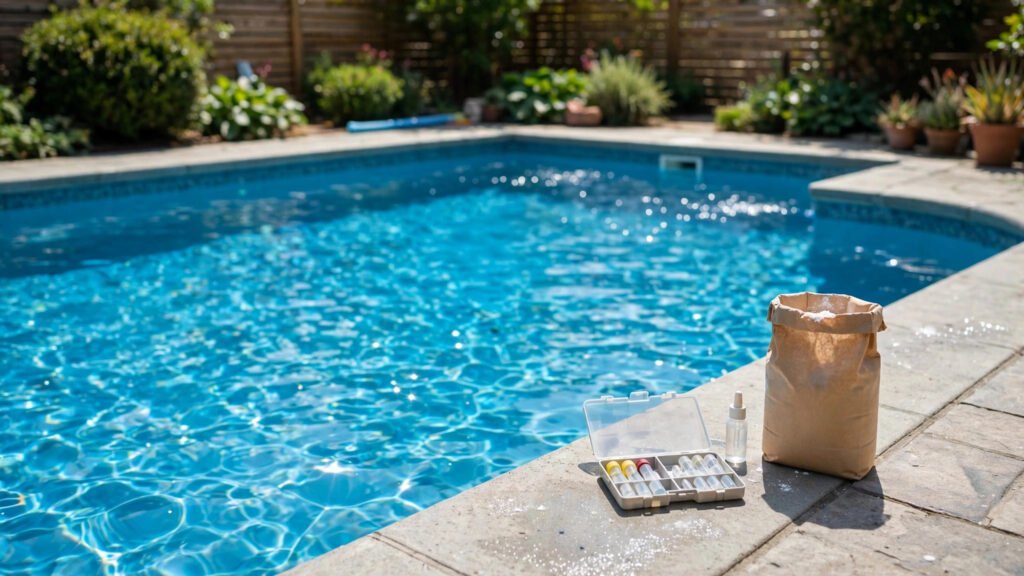
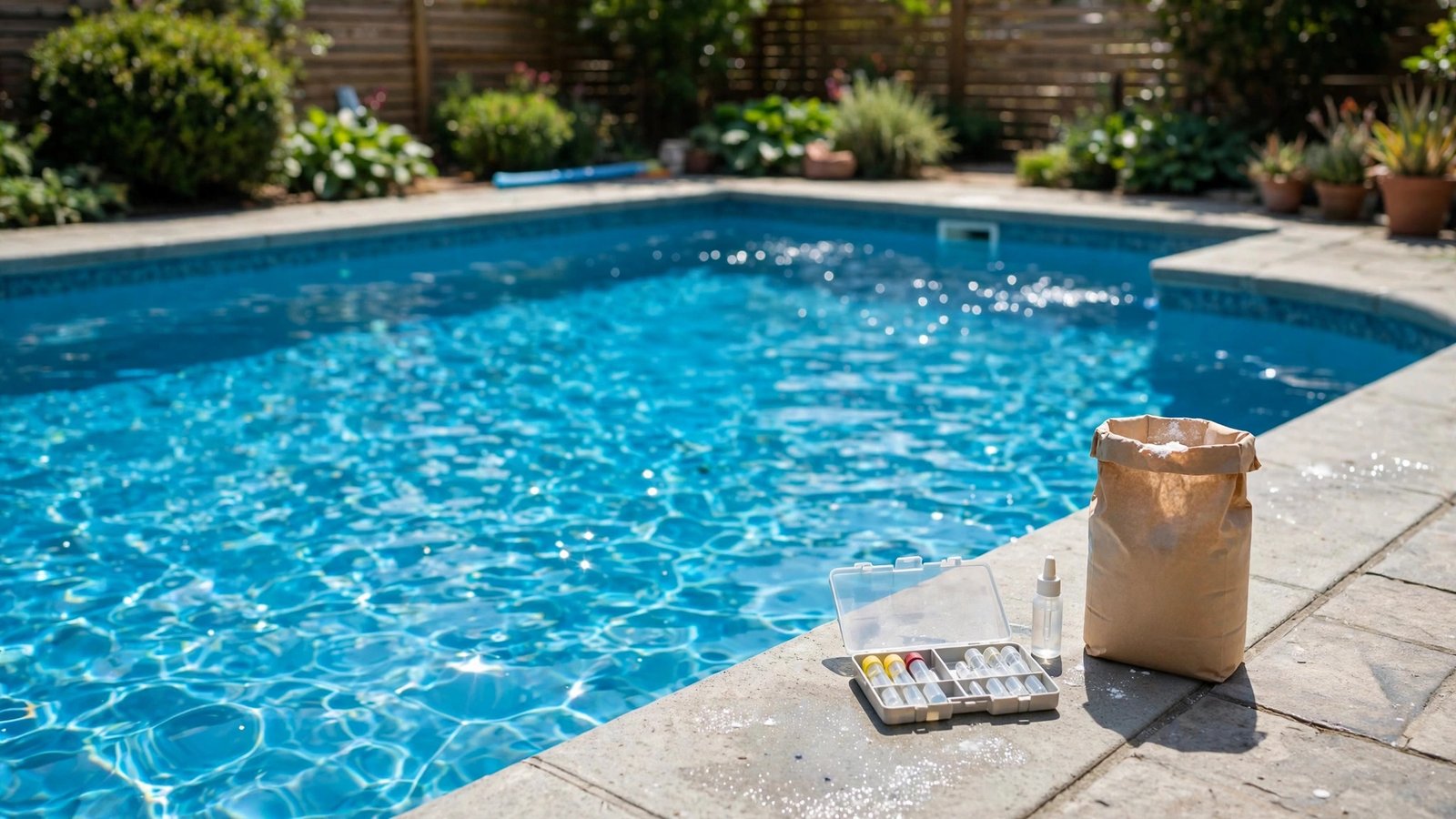
- A reliable test kit or test strips that measure total alkalinity (liquid drop kits are more accurate than strips)
- Plain baking soda (sodium bicarbonate) — the same stuff from the grocery store
- A kitchen or bathroom scale to weigh the dose
- A clean bucket of pool water for pre-dissolving (optional but helpful)
- Your pool pump running
How to Raise Alkalinity in a Pool: Step-by-Step
Step 1: Test your water accurately
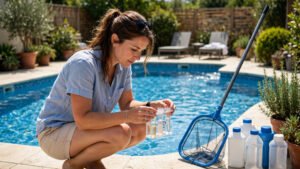
Test TA first thing, before adding anything. Dip a test strip or run a liquid drop test according to the kit’s instructions. Write down the number — you’ll need it for the dosage math. If your test also shows pH, note that too, since you’ll recheck it afterward.
Step 2: Calculate how much baking soda you need
Use this formula: 1.5 pounds of baking soda per 10,000 gallons raises TA by about 10 ppm. Example: a 20,000-gallon pool testing at 60 ppm needs a 40 ppm rise to reach 100 ppm — that’s 1.5 × 2 × 4 = 12 pounds of baking soda.
Step 3: Add it with the pump running
With the pump on and water circulating, sprinkle the baking soda across the surface of the deep end, or pre-dissolve it in a bucket of pool water and pour it in slowly around the perimeter. Never dump it in one clump — it can settle and leave white residue on the pool floor.
Step 4: Let it circulate
Run the pump for at least 6 hours (overnight is ideal) so the baking soda fully dissolves and mixes evenly through the water.
Step 5: Retest and adjust
Test TA again. If you’re still below 80 ppm, repeat with a smaller dose. It’s always better to creep up on your target in two rounds than to overshoot in one. Once TA is in the 80–120 ppm range, check your pH and adjust it separately if needed.
Baking Soda Dosage Quick Reference
For a 10,000-gallon pool:
- To raise TA by 10 ppm: add ~1.5 lbs of baking soda
- To raise TA by 20 ppm: add ~3 lbs of baking soda
- To raise TA by 30 ppm: add ~4.5 lbs of baking soda
Scale the amounts proportionally for your pool’s volume. For a rectangular pool: length × width × average depth × 7.5 = gallons.
Baking Soda vs. “Alkalinity Increaser”: Is There a Difference?
No. “Alkalinity increaser” products are just sodium bicarbonate — baking soda — in pricier packaging. Grocery-store baking soda does the exact same job, so save your money.
Mistakes to Avoid
- Adding it with the pump off. Without circulation, baking soda sinks and cakes onto the pool floor instead of mixing.
- Raising TA and pH at the same time. Fix alkalinity first, then retest pH and adjust it separately. Baking soda nudges pH up slightly on its own.
- Confusing baking soda with soda ash. Soda ash (sodium carbonate) raises pH dramatically with only a small effect on TA — the wrong tool for this job.
- Testing too soon. Give it the full 6 hours of circulation before retesting, or you’ll chase your tail with extra doses.
- Overshooting. If TA climbs above 120 ppm, you’ll need muriatic acid to bring it back down — an avoidable hassle.
A Note for NYC Pool Owners
If you use a shared pool in an NYC apartment building, co-op, or gym, check with building management before adding chemicals yourself — most buildings use a contracted pool service. And after heavy summer storms, retest: downpours dilute alkalinity fast.
FAQs
How soon can I swim after adding baking soda?
Once it’s fully dissolved and circulated — usually after about 6 hours of pump run time — the water is safe to swim in. Baking soda is non-toxic, so there’s no harsh chemical wait time like with shock treatments.
Will baking soda raise my pH too much?
Baking soda has only a mild effect on pH. It may nudge pH up slightly, but its main job is raising total alkalinity. That’s exactly why it’s the right product: it fixes the buffer without throwing pH out of whack the way soda ash would.
How often should I test total alkalinity?
Test TA at least once a week during swim season, and always after heavy rain, a pool party, or adding large amounts of other chemicals. Stable pools may only need small maintenance doses every few weeks.
Can I use washing soda instead of baking soda?
No — washing soda is sodium carbonate (like soda ash), which spikes pH far more than it raises alkalinity. Stick with plain baking soda, which is sodium bicarbonate.
What if my alkalinity is too high?
If TA climbs above 120 ppm, lower it with muriatic acid added carefully per label directions, then aerate the water (run waterfalls or point return jets upward) to bring pH back up without raising TA again.