
How Much Chlorine to Add to Pool? Complete Answer
For a typical residential pool, add enough chlorine to maintain 1–3 ppm (parts per million) of free chlorine, which for a standard 20,000-gallon pool usually means about 2–4 ounces of chlorine tablets per day via a feeder, or 52–104 ounces of liquid chlorine (10–12.5%) per week depending on sun, heat, and bather load. Test your water first — the right dose depends on your current chlorine level and pool size, not a fixed scoop.
Getting chlorine right is the single most important pool maintenance task. Too little and you get algae, cloudy water, and unsafe swimming conditions. Too much and you get bleached swimsuits, stinging eyes, and damaged equipment. Here’s exactly how to dose it correctly.
The Quick Answer by Pool Size
These are starting doses of liquid chlorine (sodium hypochlorite, 10–12.5%) to raise free chlorine by about 2 ppm — the typical daily-to-weekly maintenance need for an average backyard pool:
| Pool Size | Liquid Chlorine per Week (approx.) | Tablets (3″ trichlor) per Week |
|---|---|---|
| 10,000 gallons | 26–52 oz | 1–2 tablets |
| 15,000 gallons | 39–78 oz | 2–3 tablets |
| 20,000 gallons | 52–104 oz | 2–4 tablets |
| 30,000 gallons | 78–156 oz | 3–5 tablets |
These are estimates — always confirm with a test kit and adjust.
Step 1: Test Your Water First
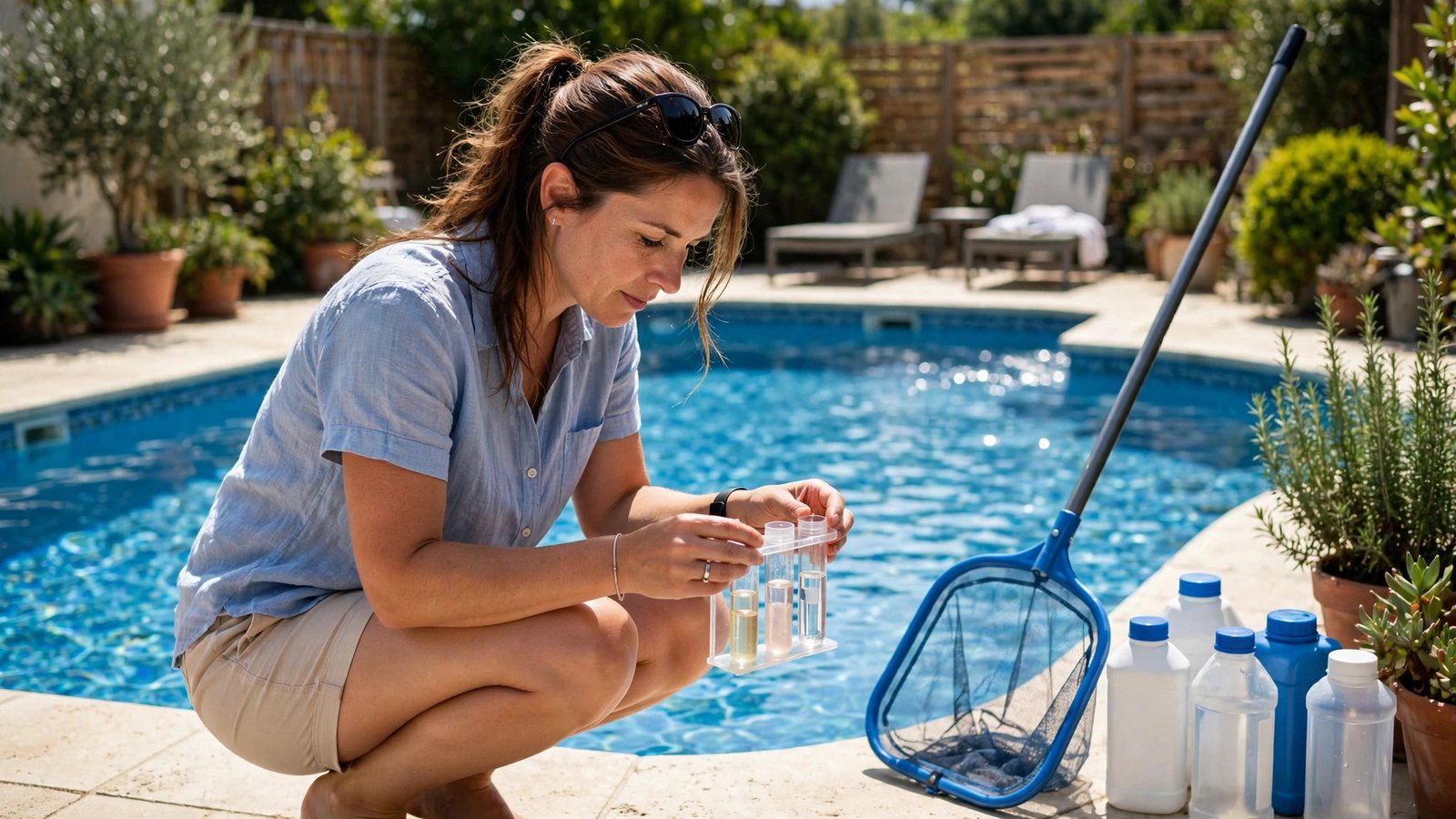
Never dose blindly. Use a test kit or test strips to check:
- Free chlorine: target 1–3 ppm (up to 4 ppm is acceptable)
- pH: target 7.2–7.8 — chlorine works poorly outside this range
- Cyanuric acid (CYA/stabilizer): target 30–50 ppm for outdoor pools — it shields chlorine from sunlight
If your pH is high (above 7.8), chlorine becomes dramatically less effective — you’ll need far more of it. Fix pH first, then chlorinate.
Types of Chlorine and How Much to Use
Liquid Chlorine (Sodium Hypochlorite, 10–12.5%)
The workhorse of pool care. Add about 10 oz per 10,000 gallons to raise free chlorine by roughly 1 ppm. Pour slowly in front of a return jet with the pump running, preferably in the evening. It’s cheap, fast-acting, and adds no stabilizer — ideal for daily or weekly dosing.
Chlorine Tablets (Trichlor, 3″)
Slow-dissolving pucks for feeders or floaters. Each 3-inch tablet (8 oz) treats roughly 5,000 gallons for about a week. A 20,000-gallon pool typically needs 2–4 tablets per week in a feeder. Convenient, but they add CYA with every tablet — watch your stabilizer level.
Granular Shock (Calcium Hypochlorite, 65–73%)
Used for weekly shocking or algae treatment, not daily dosing. To shock, add about 1 pound per 10,000 gallons to reach 5–10 ppm. Dissolve in a bucket first, add at dusk, and don’t swim until free chlorine drops below 5 ppm.
Dichlor Granules
Fast-dissolving stabilized chlorine, good for small pools and spas. Adds CYA quickly, so rotate with unstabilized chlorine.
How Often Should You Add Chlorine?
- Tablets in a feeder/floater: refill weekly; they dissolve continuously.
- Liquid chlorine: add 2–3 times per week in summer, weekly in cooler weather.
- Shock: once a week during swim season, after heavy use, after rain, or when water looks dull.
Hot NYC-area summers with heavy bather loads burn through chlorine fast — test twice a week in July and August rather than guessing.
Signs You’re Using Too Much or Too Little
Too little chlorine:
- Cloudy or green-tinged water
- Slippery walls (early algae)
- Strong “chlorine smell” — ironically, this often means too little free chlorine and too many chloramines
- Free chlorine reading below 1 ppm
Too much chlorine:
- Free chlorine above 5 ppm
- Stinging eyes and itchy skin after swimming
- Bleached or faded swimsuits and liners
- Strong chemical odor right at the water surface
Common Mistakes to Avoid
- Dosing without testing. Guessing leads to the algae-bloom-to-chemical-soup cycle.
- Adding chlorine during peak sun. UV burns off unstabilized chlorine in hours — dose in the evening.
- Ignoring CYA levels. High stabilizer (above 80–100 ppm) “locks” chlorine, making it ineffective no matter how much you add. The fix is partial draining, not more chlorine.
- Mixing chlorine types together. Never mix different chlorine products in the same container — some combinations release toxic gas or explode.
- Shocking and swimming too soon. Wait until free chlorine falls below 5 ppm.
- Forgetting pH. Chlorine at pH 8.0 is a fraction as effective as at pH 7.4.
FAQs
How much chlorine do I add to a 20,000-gallon pool?
For maintenance, about 52–104 ounces of liquid chlorine (10–12.5%) per week, or 2–4 three-inch tablets per week in a feeder. Test first and adjust to hold 1–3 ppm free chlorine.
Can I just add chlorine without testing?
You can in a pinch, but it’s a bad habit. Without testing you can’t know your pH or CYA, and both determine whether your chlorine actually works. Test strips take 30 seconds.
What happens if I add too much chlorine to my pool?
Short-term: irritated eyes and skin, bleached swimwear, and possible liner or equipment damage. Stop adding chlorine, leave the cover off in sunlight to burn it off, and don’t swim until levels fall below 5 ppm.
Should I add chlorine in the morning or evening?
Evening. Sunlight destroys unstabilized chlorine rapidly, so dosing at dusk gives it the whole night to work.
How long after adding chlorine can you swim?
After regular dosing, about 30 minutes with the pump running. After shocking, wait until free chlorine is below 5 ppm and pH is in range — usually 8–24 hours.