How to Buy Bitcoin for the First Time in New York (2026 Guide)
New York's BitLicense rules make buying Bitcoin different. This step-by-step 2026 guide covers licensed exchanges, fees, taxes, and beginner mistakes to avoid.
Written by admin
Published October 21, 2026
Reading time 8 minutes
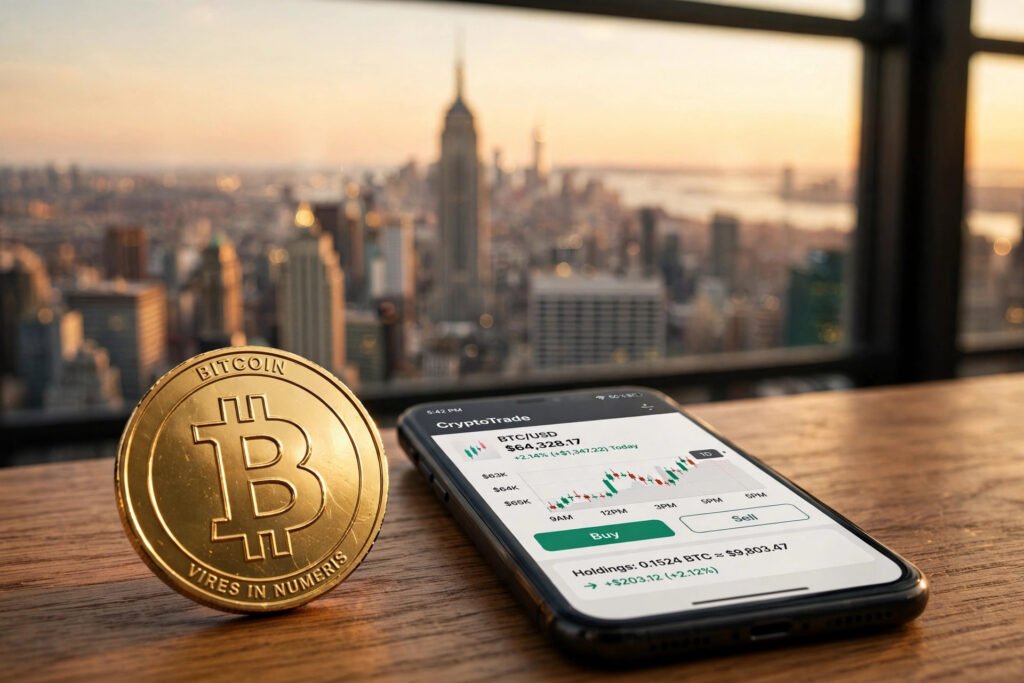
Standing on a downtown 6 train at rush hour, you will overhear at least three separate conversations about Bitcoin before you hit Bleecker. The barista with the tattoo sleeve. The guy in the Patagonia vest refreshing an app between stops. The retiree from Queens who quietly bought a fraction of a coin back in 2021 and has not touched it since. New York is arguably the crypto capital of America — and yet buying your first Bitcoin here works a little differently than it does in, say, Texas or Florida. This guide walks you through the whole thing, step by step, so your first purchase is boring in the best possible way: smooth, legal, and cheap on fees.
Why New York Is Different: The BitLicense Rule
Here is the thing most national “how to buy Bitcoin” guides never mention: New York has its own crypto licensing regime. Since 2015, any company that wants to let New Yorkers buy and sell virtual currency needs a BitLicense from the New York Department of Financial Services (NYDFS) — or a limited-purpose trust charter. Plenty of big-name exchanges simply do not operate here because they never bothered to get one.
That is actually good news for you. It means the platforms available to you as a New Yorker have passed one of the toughest regulatory screens in the country. When you sign up, you will notice the difference during identity verification — New York exchanges are strict about know-your-customer checks, and that is the BitLicense talking. If an app lets you buy crypto in New York without verifying your identity, run the other way; it is not licensed, and your money is not protected. You can confirm any company’s status on the NYDFS list of licensed virtual currency entities, which the department keeps current on its regulated virtual currency entities page.
Step 1: Choose a Licensed Exchange
For a first-time buyer in New York, the shortlist of household names that hold a BitLicense includes Coinbase, Gemini (headquartered right here in New York, founded by the Winklevoss twins), and Kraken. All three are legitimate; they differ mostly in fees and interface.
- Coinbase is the friendliest for absolute beginners. The app holds your hand through every step.
- Gemini tends to appeal to people who like a clean, professional dashboard and slightly more competitive fee schedules.
- Kraken is the choice of people who plan to trade more actively later — its fee tiers reward volume.
Pick one. Just one, for now. Opening three accounts on day one is how people end up confused about where their money actually sits.
What to look for before you sign up
Check three things: the BitLicense (or NYDFS trust charter), insurance on custodied assets, and transparent fees. Reputable exchanges publish their fee schedules openly. If you have to dig for the fee page, consider that a red flag. Also worth knowing: the SEC’s enforcement actions in recent years have centered on whether certain crypto products are unregistered securities — another reason to stick with licensed, well-lit platforms rather than a random app your cousin found on social media.
Step 2: Verify Your Identity
This is the part that surprises people. You will need a government-issued photo ID (driver’s license, state ID, or passport), your Social Security number, and proof of your New York address — a utility bill or bank statement usually works. You will take a selfie or a short video for liveness checks.
On Coinbase or Gemini, verification typically takes minutes to a few hours. Occasionally it stretches to a day or two if the documents need manual review. It feels like a lot for buying something digital, but remember: this same process is what keeps someone from opening an account in your name. New York’s rules are deliberately strict here, and as someone living under them, you benefit.
Step 3: Fund Your Account the Smart Way
You have three main funding options, and the fee difference between them is not small:
- ACH bank transfer (recommended): Link your checking account. Transfers are usually free or nearly free, though the first one can take 3–5 business days to clear. Plan ahead — you cannot time a dip if your money is still in transit.
- Wire transfer: Faster (often same-day), but your bank may charge $15–$30 for the wire itself.
- Debit card: Instant, but expect to pay roughly 2–4% in fees. On a $500 purchase, that is $10–$20 evaporating before you own a single satoshi.
For a first purchase, ACH is the move. The money arrives, the fees stay near zero, and you learn the rhythm of how the system works. A useful habit from day one: only ever fund crypto purchases from money you can afford to leave alone for years. Seasoned investors treat an emergency fund as the non-negotiable first step before any investing — crypto included.
Step 4: Place Your First Bitcoin Order
Here is where beginners overthink. You do not need to buy a whole Bitcoin. At recent prices, one Bitcoin costs more than a nice co-op in Jackson Heights — nobody expects you to buy a whole one. Bitcoin divides into 100 million satoshis, and every major exchange lets you buy a fraction. A $100 order gets you $100 worth of Bitcoin, minus fees. Simple as that.
You will see two order types:
- Market order: buys instantly at the current price. Easiest. Fine for small first purchases.
- Limit order: buys only if the price drops to a level you set. Useful once you know what you are doing; unnecessary on day one.
Start with a market order for a small amount — $50 to $200 is a perfectly respectable first purchase. Watch how the fee is itemized on the preview screen before you confirm. That preview screen is your friend; read it every single time, even when you are experienced.
Step 5: Decide Where Your Bitcoin Lives
After purchase, your Bitcoin sits in your exchange account by default. For a small starter amount, that is fine. But the standard advice in the crypto world — “not your keys, not your coins” — exists for a reason: if the exchange has problems, your coins are entangled in them.
Once your holdings grow past “money I would not cry over,” move them to a wallet you control. A hardware wallet (a small physical device, roughly $80–$170 for the popular models) keeps your private keys offline. For a deeper walkthrough of choosing one, see our guide on the safest crypto wallets for beginners. You do not need to do this on day one — but know that the option exists, and plan to graduate to it.
What It Really Costs: Fees and Taxes
Fees are the silent budget-killer for beginners. Between the spread (the small markup baked into the quoted price) and the transaction fee, expect to pay somewhere around 0.5% to 4% per purchase depending on the platform and payment method. On $200, that is $1 to $8. Not tragic — unless you trade in and out repeatedly, in which case it compounds fast. Buy-and-hold beginners barely feel it.
Then there is the part New Yorkers forget: taxes. The IRS treats Bitcoin as property, not currency. Every sale, trade, or purchase made with Bitcoin is a taxable event, and you owe capital gains tax on any profit. New York State piles its own taxes on top. Keep records from day one — every buy, every sell, dates and dollar amounts. Exchanges issue tax documents, but the ultimate responsibility is yours. Our primer on handling taxes for a freelance business covers the record-keeping mindset that applies here too, and the IRS virtual currency FAQ is the authoritative source on what counts as a taxable event.
Five Mistakes First-Timers in New York Make
- Using an unlicensed platform because a friend recommended it. If it is not on the NYDFS list, skip it.
- Buying with a credit card. Most issuers treat it as a cash advance — instant fees plus high interest. Debit or bank transfer only.
- Investing the rent money. Bitcoin can drop 10% in a day. Never buy with money you need this month. Understanding why Bitcoin’s price swings so much before you buy will save you a panic attack later.
- Falling for “double your Bitcoin” scams. Anyone promising guaranteed returns, celebrity-endorsed giveaways, or secret trading bots is lying. The FTC tracks these schemes constantly.
- Losing login credentials. Enable two-factor authentication with an authenticator app (not SMS) the moment your account is open.
The Bottom Line
Buying your first Bitcoin in New York is a five-step errand: pick a BitLicense-licensed exchange, verify your identity, fund via bank transfer, place a small market order, and decide on storage. The whole process takes under an hour of active effort, plus a few days for the first bank transfer to clear. Start small, keep records, secure your account properly, and treat your first purchase as tuition — the cheapest investing education you will ever buy. The 6 train conversations will make a lot more sense once you have some skin in the game.
Frequently Asked Questions
Is it legal to buy Bitcoin in New York?
Yes — completely legal, as long as you use a platform licensed by the NYDFS under the BitLicense regime or holding a limited-purpose trust charter. Coinbase, Gemini, and Kraken all serve New York customers.
How much money do I need to start?
Most exchanges let you start with as little as $10–$25. You buy a fraction of a Bitcoin. A $50–$200 first purchase is sensible while you learn the ropes.
Do I have to pay taxes on Bitcoin in New York?
Yes. The IRS treats crypto as property, so selling at a profit triggers capital gains tax, and New York State taxes apply as well. Keep records of every transaction from your very first purchase.
Can I buy Bitcoin with cash in NYC?
Bitcoin ATMs exist around the city, but they typically charge steep fees — often 7–12% or more. A licensed exchange funded by bank transfer is far cheaper for a first purchase.
How long does the first purchase take?
Account verification takes minutes to a couple of days. Your first ACH transfer can take 3–5 business days to clear. The actual Bitcoin purchase, once funds are available, executes in seconds.