How to Build Muscle Without Going to a Gym (Full Plan)
How to build muscle without going to a gym: the 6 movement patterns, a 3-day program, the $100 setup that changes everything, and the nutrition to grow.
Written by admin
Published October 21, 2026
Reading time 6 minutes
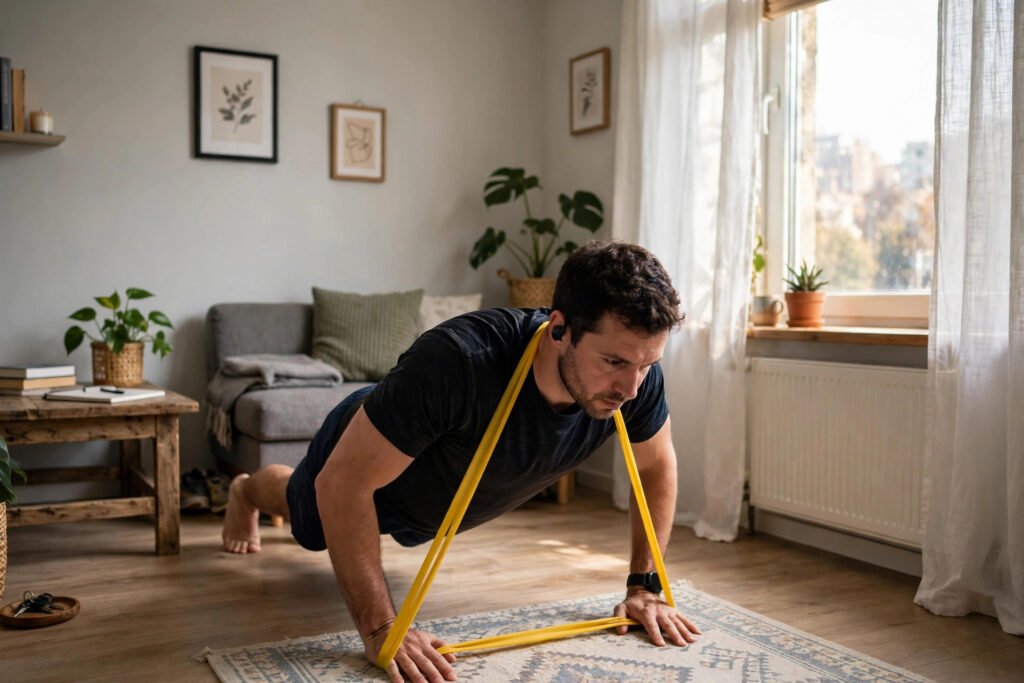
You do not need a gym membership, a squat rack, or a wall of dumbbells to build real, visible muscle. What you need is progressive overload — gradually asking your muscles to do more than they did last time — and that principle works just as well in a 400-square-foot studio apartment as it does in an Equinox. Bodyweight training, done with intention and a smart progression scheme, can build impressive strength and size for years. This guide covers the exercises, the programming, and the nutrition that make no-gym muscle building actually work.
Why bodyweight training works (the science in plain English)
Muscles do not know whether resistance comes from a barbell or your own body — they only know tension. Research comparing push-up progressions to bench press training has found similar muscle growth when sets are taken close to failure, a finding summarized in the American Council on Exercise’s research library. The catch is that bodyweight exercises get easy fast, so you must progress them deliberately: elevate your feet on push-ups, move to archer push-ups, then to one-arm progressions. That is progressive overload without equipment. For a deeper dive into the movement library, see our guide on the best exercises for beginners at home, which covers the foundational patterns you will build on here.
The only six movements you need
Every effective no-gym program is built on these patterns. Master the basic version, then climb the progression ladder:
1. Push (chest, shoulders, triceps)
Standard push-ups → feet-elevated push-ups → archer push-ups → pseudo-planche push-ups → one-arm push-up progressions. Three to five sets of 5–15 reps, stopping 1–2 reps shy of failure.
2. Pull (back, biceps)
This is the one pattern that genuinely benefits from equipment — a $30 doorway pull-up bar is the single best purchase a home trainee can make. Dead hangs → assisted pull-ups (chair assist) → full pull-ups → weighted pull-ups (backpack with books). No bar at all? Inverted rows under a sturdy table work surprisingly well.
3. Squat (quads, glutes)
Bodyweight squats → Bulgarian split squats (rear foot on a chair) → shrimp squats → pistol squat progressions. Single-leg work is the secret weapon: a Bulgarian split squat with a loaded backpack can challenge even strong lifters.
4. Hinge (hamstrings, glutes, lower back)
Glute bridges → single-leg glute bridges → Nordic curl negatives (feet hooked under a couch) → full Nordic curls. Hamstrings are the hardest muscle to load without weights, so prioritize this pattern.
5. Core (abs, obliques)
Dead bugs → planks → hanging knee raises (from the pull-up bar) → ab wheel rollouts (a $15 wheel). Skip the hundred-crunch routines; train the core like any other muscle with progressive, loaded movements.
6. Carry and conditioning
Farmer’s carries with heavy grocery bags or a loaded backpack build grip, traps, and work capacity. Finish two sessions a week with 10 minutes of carries or step-ups.
A simple 3-day weekly program
Train Monday, Wednesday, Friday (or any three non-consecutive days) — the CDC recommends muscle-strengthening activities for all major muscle groups at least twice weekly, and this program exceeds that. Alternate two full-body sessions:
Workout A: Push-up progression 4×8–12, Bulgarian split squats 3×10/leg, inverted rows or pull-up progression 4×5–10, glute bridges 3×15, dead bugs 3×10/side.
Workout B: Pike push-ups (shoulders) 4×8–12, shrimp squat progression 3×8/leg, pull-up progression 4×5–10, Nordic curl negatives 3×5, ab wheel 3×8.
Rest 90 seconds to 2 minutes between sets. When you can hit the top of the rep range on all sets with 1–2 reps in reserve, move to the harder progression. Add one set per exercise every two weeks until you reach five sets, then progress the movement. This slow, systematic climb is what separates people who “do push-ups at home” from people who visibly transform. If you are deciding between bodyweight work and other home options, our comparison of the best time of day to exercise can help you slot sessions where your energy is highest.
The $100 home setup that changes everything
Strictly bodyweight works, but a tiny investment removes the biggest limitations. Priority order: (1) a doorway pull-up bar (~$30) — unlocks the entire pulling pattern; (2) a pair of adjustable resistance bands (~$30) — adds loading to squats, presses, and rows; (3) an ab wheel (~$15); (4) a sturdy backpack you load with books or water bottles (~$0) — your adjustable “weight vest.” That is it. No bench, no dumbbell set, no subscription. Everything stores in a closet, which matters when your “gym” is also your living room.
Eating to grow without a meal-prep obsession
Training provides the stimulus; food provides the building material. Two numbers matter most:
Protein: aim for roughly 0.7–1 gram per pound of bodyweight daily (a 160-pound person targets 115–160g). That is a palm-and-a-half of protein at three meals plus a snack — chicken, eggs, Greek yogurt, lentils, canned tuna. You do not need six Tupperware containers; you need consistent protein at every meal.
Calories: to build muscle you need a small surplus — roughly 200–300 calories above maintenance. Track for two weeks with a free app, watch the scale trend (aim for +0.5 lb/week), and adjust. Gaining faster than that mostly adds fat; the scale barely moving means eat a bit more. For nutrition specifics around training, read what to eat before and after a workout.
The mistakes that stall home muscle building
Never progressing the movement. Doing 3×15 regular push-ups for six months maintains fitness; it does not build new muscle. The progression ladder is the program.
Training to failure every set. Grinding every set to absolute failure trashes recovery. Stop 1–2 reps short on most sets; save true failure for the last set of isolation-style work.
Skipping legs. Upper-body calisthenics are fun; single-leg squats are humbling. An imbalanced program builds an imbalanced physique — and skipping the biggest muscles leaves the most growth on the table.
Program hopping. Switching routines every three weeks because of boredom or a new YouTube video guarantees you never accumulate enough stimulus in one pattern to force adaptation. Run the program above for 12 weeks minimum before judging it.
Conclusion
Building muscle without a gym is not a compromise — it is a different, equally legitimate path that trades equipment for creativity and discipline. Learn the six movement patterns, climb their progressions systematically, train three days a week, eat enough protein in a slight surplus, and give it twelve consistent weeks. The guys doing pistol squats and one-arm push-up negatives in their apartments are not “making do.” They are training smart. Your living room is enough — the program is what matters.
Frequently Asked Questions
Can you really build muscle with only bodyweight exercises?
Yes. Studies show comparable hypertrophy between push-up and bench-press programs when sets are taken near failure. The key is progressive overload — making movements harder over time through leverage progressions, added load (backpacks), and volume.
How long until I see results training at home?
Strength improves within 2–3 weeks (mostly neurological). Visible muscle changes typically appear around 8–12 weeks of consistent training with adequate protein and a slight calorie surplus.
Do I need protein powder to build muscle at home?
No. Powder is convenient but not magical — total daily protein from any complete sources is what matters. Whole foods work identically if you hit your target.
What is the hardest muscle to build without weights?
Hamstrings and back thickness are the trickiest, because they are hard to load with bodyweight alone. Nordic curl progressions and pull-up variations (a doorway bar helps enormously) close most of the gap.
How many days a week should I train at home?
Three full-body days is the sweet spot for most beginners and intermediates — enough stimulus to grow, enough recovery to adapt. Advanced trainees can add a fourth day once progress stalls.