
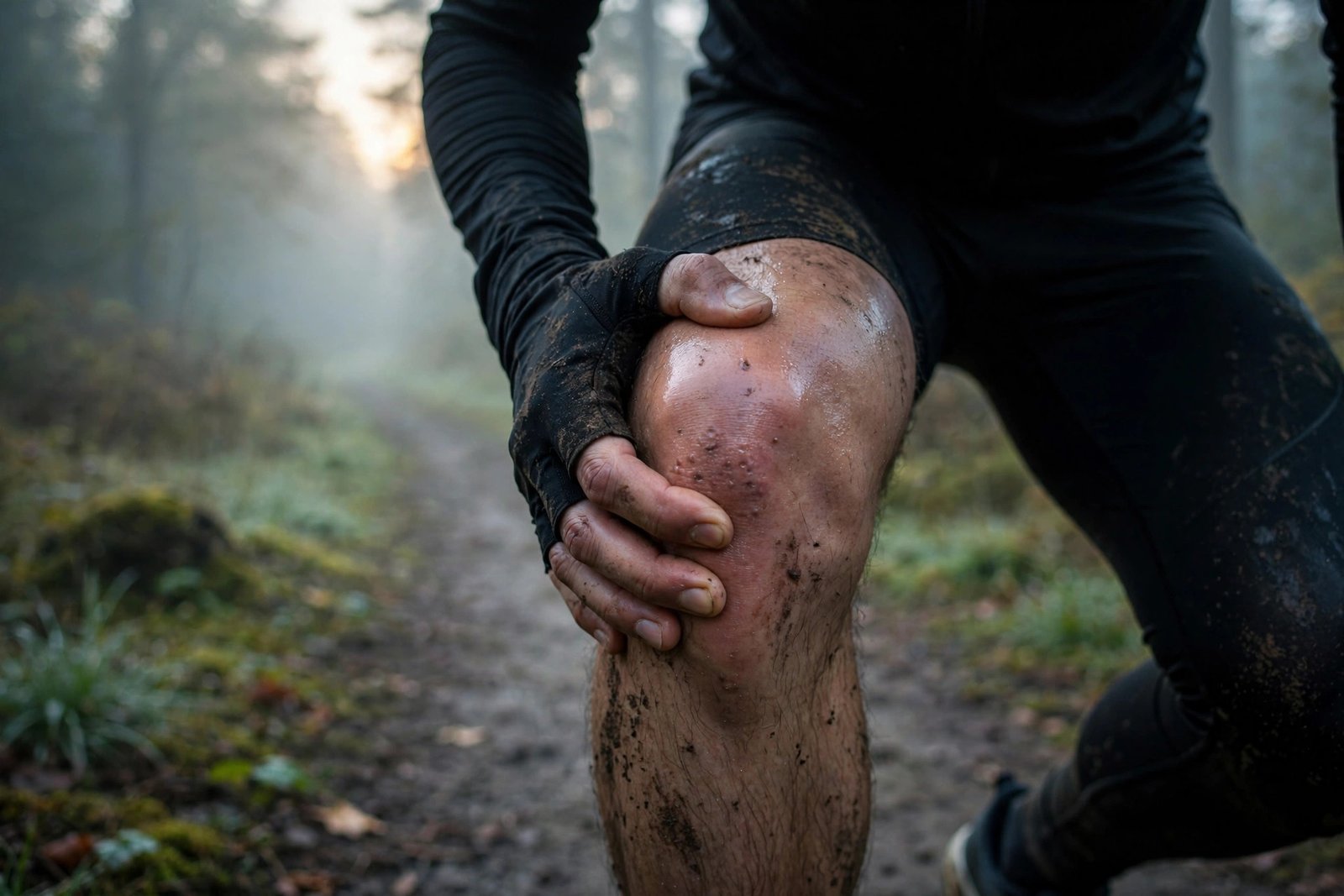
Mile two, and there’s that familiar ache — just below or around your kneecap, dull at first, then insistent enough to ruin the run. Runner’s knee sidelines more beginners than any other complaint, and it’s maddening because rest helps, then the pain returns the moment you ramp back up. Your knees aren’t “bad.” They’re complaining about something specific — and it’s almost always fixable.
Here are the real reasons knees hurt when you run, how to tell which one is yours, and the fixes that actually work.
First: Running Doesn’t Ruin Healthy Knees
Let’s clear the biggest misconception. Large studies — including long-term research on marathoners — find recreational runners have lower rates of knee osteoarthritis than sedentary people. Running strengthens the cartilage, thickens it, and builds the muscles that protect the joint. Knee pain in runners is nearly always a training error, a strength imbalance, or a mechanics issue — not the running itself. Your knees are designed for this; they’re protesting how you’re doing it.
Cause 1: Too Much, Too Soon (The #1 Culprit)
Beginners’ cardiovascular fitness improves faster than their joints’ tolerance. Your lungs say “keep going” while your patellar tendon whispers “please stop.” The fix is the 10% rule: increase weekly mileage by no more than 10%, and never increase distance and intensity in the same week. If pain appears, drop back to your last pain-free mileage for two weeks before progressing. Most runner’s knee is simply impatience made physical — which is why easing back into running safely with a walk-run plan prevents it in the first place.
Cause 2: Weak Hips and Glutes
This surprises everyone: knee pain is often a hip problem. Weak gluteus medius muscles let the knee cave inward with each stride (knee valgus), grinding the patella against the femur. The fix isn’t knee exercises — it’s hip exercises: clamshells, lateral band walks, glute bridges, single-leg squats, 2–3x weekly. Studies show hip-strengthening resolves patellofemoral pain as effectively as knee-focused rehab. Your knees are the victims; your hips are the criminals.
Cause 3: Worn-Out or Wrong Shoes
Running shoes lose cushioning after 300–500 miles — long before they look worn. Dead shoes transfer impact straight to your joints. Also, the wrong shoe type matters: severe overpronators in neutral shoes, or anyone in shoes that don’t fit their gait, load the knee abnormally. Get fitted at a running store, track your mileage, and rotate two pairs if you run frequently. This is the cheapest fix on the list.
Cause 4: Hard Surfaces and Downhills
Concrete is roughly 10x harder than asphalt, which is harder than tracks or trails. If all your miles are on sidewalks, your knees absorb the difference. Mix in softer surfaces — tracks, packed dirt, treadmills — for at least some weekly mileage. Downhill running multiplies impact forces dramatically; shorten your stride and increase cadence on descents rather than braking with your quads.
Cause 5: Overstriding
Landing with your foot far ahead of your body creates a braking force that shoots up through the knee. The fix: increase cadence to ~170–180 steps per minute (most beginners are at 150–160), which naturally shortens the stride and lands the foot under the hips. Think “quick, light steps” rather than long powerful ones — Healthline’s cadence guide explains the drills. A metronome app for two weeks can permanently rewire your stride.
Cause 6: Old Injuries and Structural Issues
Previous ACL/meniscus injuries, arthritis, or IT band syndrome change the equation — these need professional diagnosis, not internet articles. Red flags that warrant a sports-medicine doctor or physical therapist: swelling that doesn’t resolve in 48 hours, locking or catching, pain at rest or at night, or pain that worsens over two weeks despite rest. Don’t “run through” these; Mayo Clinic’s patellofemoral pain guide details when self-care stops being enough.
Strength Exercises for Knee-Proof Running
The research is unambiguous: stronger hips and quads mean happier knees. This 15-minute routine, done 2–3x weekly, is the single best investment a runner can make — no gym required. Clamshells (2×15 each side): lie on your side, knees bent, and open the top knee like a book while keeping feet together — targets the gluteus medius, the key knee-stabilizer. Glute bridges (3×12): squeeze your glutes to lift hips, hold 2 seconds at the top — builds the posterior chain that powers your stride. Lateral band walks (2×12 steps each direction): mini-band around knees, stay low, step sideways — bulletproofs the hip abductors. Single-leg squats to a chair (2×8 each leg): balance plus quad strength in one move; use a chair for safety. Calf raises (3×15): strong calves absorb impact before it reaches the knee. Side-lying leg raises (2×15): more glute medius work — you can never have too much. Start with bodyweight, add a resistance band after 3–4 weeks, and progress to single-leg deadlifts when these feel easy. Runners who strength-train consistently report dramatically fewer knee issues, and it takes less time than one Netflix episode.
The Recovery Protocol
For typical overuse knee pain: relative rest (not total — low-impact walking and cycling maintain fitness while knees calm down), ice 15 minutes after activity, anti-inflammatories short-term if tolerated, and the hip/glute strengthening above. Return with a walk-run program at half your previous mileage, increasing 10% weekly. Most cases resolve in 2–6 weeks. If pain alters your gait — limping — stop running entirely until you can move normally; limping just injures something else.
Conclusion
Knees hurt when you run because of training errors, weak hips, dead shoes, hard surfaces, or overstriding — not because running is bad for knees. The evidence is clear that runners’ knees are generally healthier than non-runners’ knees; pain is a signal about load management, not a verdict on the sport. Strengthen your hips, respect the 10% rule, replace your shoes on schedule, shorten your stride, add the 15-minute strength routine twice weekly, and see a professional for the red flags. Your knees aren’t fragile — they’re just asking for smarter training.
Frequently Asked Questions
Should I run through knee pain?
Mild ache (1–3/10) that doesn’t worsen during the run or alter your stride is often okay to run through cautiously. Sharp pain, swelling, limping, or pain above 4/10 means stop — running through it risks turning a 3-week problem into a 3-month one.
Are knee braces helpful for runner’s knee?
Patellar straps and compression sleeves can reduce symptoms during activity, but they’re band-aids, not fixes. Use them to stay active while addressing the root cause (usually hips and training load).
Does running on a treadmill hurt knees less?
Treadmills are somewhat softer than concrete and let you control pace precisely, which helps. But the bigger factors remain training volume and strength — surface is secondary.
When should knee pain see a doctor?
Swelling lasting over 48 hours, locking/catching, inability to bear weight, pain at rest or night, or any pain worsening after two weeks of relative rest. Also any direct trauma — a fall or twist needs prompt evaluation.
Can cycling replace running while my knee heals?
Yes — cycling is excellent cross-training for injured runners. It’s low-impact, maintains cardiovascular fitness, and strengthens quads without pounding the joint. Keep resistance moderate and avoid standing climbs until the knee is fully and completely pain-free.