What Is the Best Way to Track Personal Habits in NYC?
What is the best way to track personal habits in NYC? Apps, journals, and analog systems compared, plus the habit-tracking method behavioral science says works best.
Written by admin
Published November 4, 2026
Reading time 6 minutes
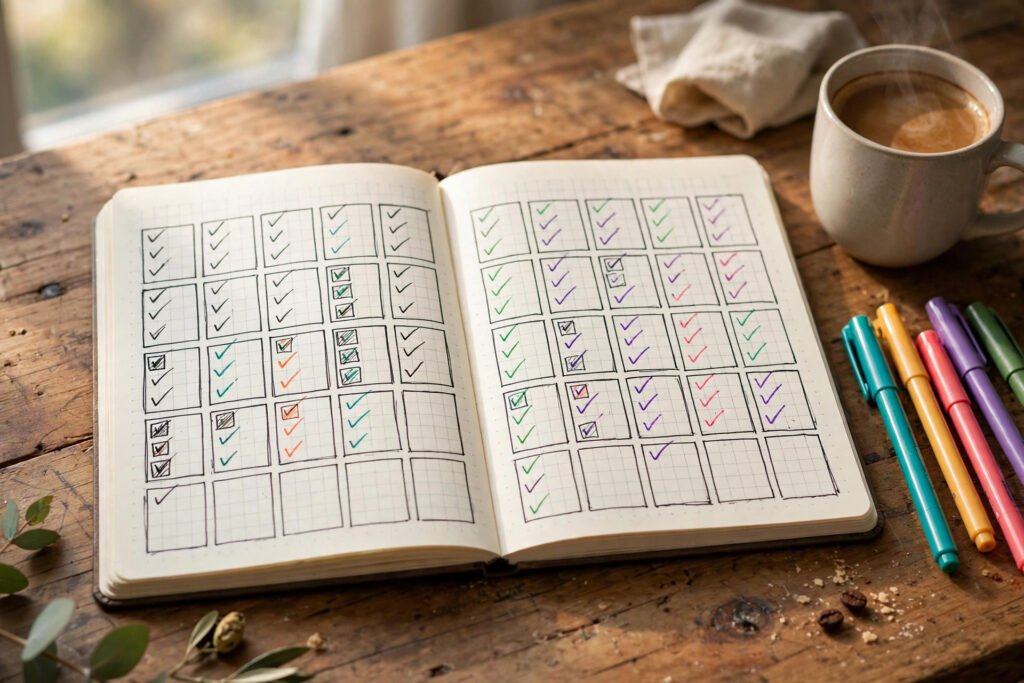
You want to read more, exercise regularly, save money, and stop doomscrolling — but by February, the resolutions have evaporated and you cannot even remember what you tracked, let alone why you stopped. The problem is rarely willpower. It is the tracking system: too complicated, too vague, or too disconnected from your actual life. In a city as chaotic as New York, your habit-tracking method has to survive subway delays, 60-hour weeks, and the general beautiful mess of NYC life.
Here is what behavioral science says actually works, and how to choose the system that fits you.
What Science Says About Tracking
The evidence for habit tracking is strong: a large body of research shows that self-monitoring — simply recording whether you did the behavior — is one of the most effective behavior-change techniques known. It works through several mechanisms: it makes the invisible visible (you cannot improve what you do not measure), it creates accountability (even to yourself), and it leverages the streak effect — the reluctance to break a chain of X’s on a calendar.
But the research also reveals what does not work: tracking too many habits at once (willpower and attention are finite), vague definitions (“exercise more” is untrackable; “walk 20 minutes” is trackable), and systems with high friction. The American Psychological Association and NIH behavior-change research converge on the same principles: make it specific, make it easy, make it visible.
The Contenders: Apps vs. Analog vs. Hybrid
Habit-tracking apps (Streaks, Habitica, Loop, Finch, and dozens more) offer reminders, statistics, streaks, and satisfying check-offs. Best for: data lovers, people who need reminders, and anyone motivated by gamification. Watch out for: notification fatigue, subscription creep, and the trap of managing the app instead of doing the habits. If you are already deep in digital overwhelm, another app may be the wrong prescription.
Paper systems — wall calendars with X’s (the “Seinfeld Strategy”), bullet journals, habit-tracker printables — offer zero friction, total privacy, and the physical satisfaction of marking progress. Best for: minimalists, the privacy-conscious, and people whose phones are part of the problem. The physical visibility (a calendar on the fridge) is a genuine advantage apps cannot replicate.
Spreadsheets are the dark horse: infinitely customizable, free, and oddly motivating for analytical types. A simple grid — habits as rows, days as columns, conditional formatting for streaks — takes ten minutes to build and lasts forever.
Hybrid systems often win in practice: an app for reminders plus a paper calendar for the visual streak, or a spreadsheet for weekly review plus daily phone check-offs. Match the tool to the function instead of forcing one tool to do everything. If tracking finances is among your habits, our guide to using AI to manage your personal budget covers the money side.
The NYC Survival Rules
Generic habit advice assumes a controlled life. NYC is not controlled. Adapt:
Design for your worst day, not your best. Your habit definition should be completable on a day with two delayed trains and a work crisis. “Meditate 20 minutes” fails; “sit quietly for 2 minutes” survives. You can always do more; the tracked minimum keeps the streak alive.
Anchor to existing routines. Habit stacking — attaching new habits to established ones — is NYC-proof because your anchors (morning coffee, commute, lunch) happen regardless of chaos. “After I start my coffee, I will write for 10 minutes” beats “I will write at 7am” (the 7am train had other plans).
Track weekly, not just daily. NYC weeks are lumpy — a brutal Tuesday followed by a calm Thursday. Weekly targets (“exercise 3x this week”) absorb daily chaos far better than rigid daily requirements, while still providing accountability.
Use the city. Walking commutes, park workouts, and the sheer walkability of New York are habit infrastructure. A “walk 8,000 steps” habit practically tracks itself here — which is why simple habits that improve daily life often work best when they piggyback on the city’s design.
How Many Habits, and Which Ones
Start with 1–3. This is the hardest advice to follow and the most important. Every additional habit dilutes focus; three well-chosen habits practiced for 90 days transform a life, while twelve tracked habits produce twelve abandoned streaks. Add new ones only when current ones feel automatic.
Choose by leverage, not aspiration. The best habits are keystone habits — ones that cascade into other improvements. Exercise improves sleep, mood, and focus simultaneously. A consistent sleep schedule stabilizes everything. Reading daily compounds knowledge. Pick habits that pull multiple areas of life upward, and good habits to start in your 30s offers a curated shortlist if you need inspiration.
Define the minimum viable version. For each habit, specify: the exact behavior, the minimum dose, the trigger, and the tracking method. “Read” becomes “read 10 pages after lunch, tracked with an X on the kitchen calendar.” Specificity is the difference between a wish and a system.
Review: The Step Everyone Skips
Tracking without reviewing is data collection without insight. Build in a weekly 10-minute review (Sunday evening works for most): Which habits held? Which broke, and why — what was the actual obstacle? What needs redesigning vs. what needs recommitment? Adjust the system, not just your effort. A habit that fails for three straight weeks is badly designed, not a character flaw — shrink it, re-anchor it, or replace it.
The CDC’s healthy-routine resources reinforce this: sustainable behavior change comes from systems that adapt, not from white-knuckling fixed plans.
When Tracking Becomes the Problem
Honesty requires a warning: habit tracking can curdle into its own pathology. The signs: anxiety about breaking streaks that exceeds the habit’s actual importance, tracking so many metrics that the system becomes a second job, “streak freezes” and loopholes that turn the tool into a game, and the peculiar guilt of a missed X outweighing the satisfaction of ninety kept ones. The streak is a servant, not a master — its job is to get you through the fragile early weeks until the behavior becomes identity (“I am a person who exercises”) rather than obligation. Deliberately break a streak once you are established, just to prove you can: miss a day intentionally, observe that nothing collapses, and resume. The habit that survives a broken streak is real; the one that dies with it was never yours — it belonged to the calendar. Track to build the identity, then let the identity carry the behavior.
Conclusion
The best way to track personal habits in NYC is the one you will actually maintain through the city’s chaos: specific and minimal definitions, a low-friction tool (app, paper, or spreadsheet — your call), habits anchored to unshakeable routines, weekly targets that absorb bad days, and a regular review to evolve the system. Start with one to three keystone habits, make the minimum dose embarrassingly small, and let streaks compound. In a city that never stops moving, your tracking system is the still point — build it to survive reality, and it will.
Frequently Asked Questions
What is the best habit tracker app?
There is no universal best — Streaks (iOS) and Loop (Android) are excellent minimal options; Habitica suits gamers; Finch adds self-care framing. The best app is the one with low enough friction that you open it daily.
How many habits should I track at once?
One to three. More than that dilutes attention and guarantees abandonment. Add new habits only after current ones feel automatic (typically 2–3 months).
Does the Seinfeld “don’t break the chain” method work?
Yes — it is one of the most research-supported techniques. The visual streak creates loss aversion that motivates consistency. Just define a realistic minimum so the chain survives bad days.
How long does it take to form a habit?
The popular “21 days” is a myth. Research (notably Phillippa Lally’s UCL study) found habit formation averages 66 days, ranging from 18 to 254 depending on complexity. Plan for two to three months.
Should I track habits daily or weekly?
Daily for the streak effect and visibility; weekly targets for flexibility. The combination — daily check-offs toward weekly goals — handles NYC’s unpredictability best.