
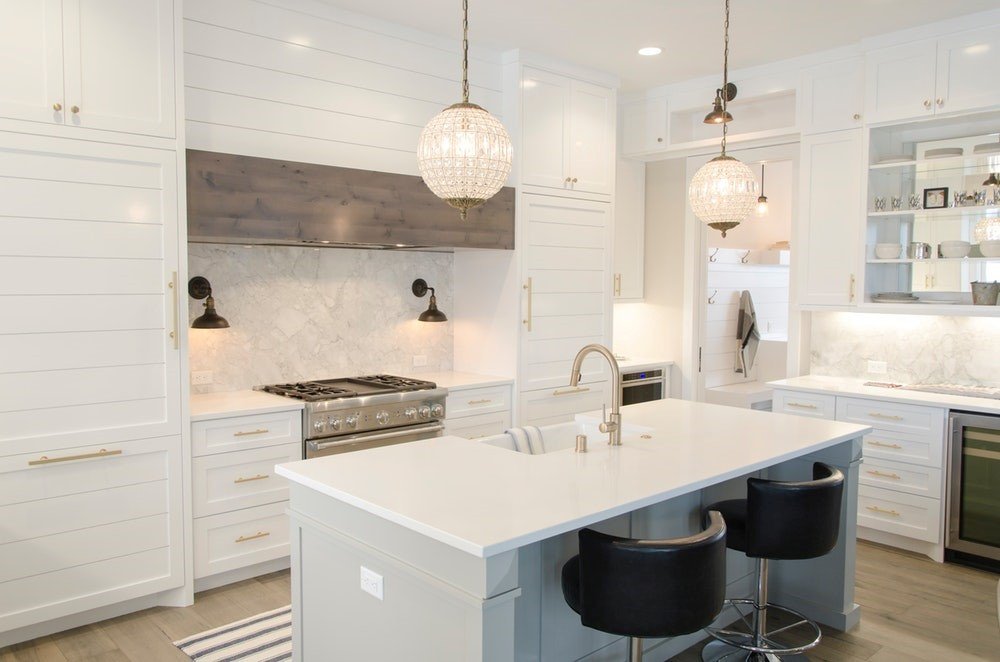
New kitchen cabinets cost $10,000–$25,000 installed. But here’s what the cabinet industry doesn’t advertise: if your cabinet boxes are structurally sound, you almost never need to replace them. So how can I update old kitchen cabinets without replacing them? From a $200 paint job to $5,000 professional refacing, there are options at every budget that make old cabinets look new. Here’s every method, ranked by cost.
Option 1: Paint Them ($150–$400 DIY)
The highest-impact, lowest-cost transformation in kitchen remodeling. The process:
- Remove doors, drawers, and hardware. Label everything (painter’s tape numbers) so reassembly isn’t a puzzle.
- Clean with degreaser. Kitchen cabinets accumulate invisible grease — TSP substitute, thorough wipe, rinse. This step determines adhesion.
- Sand lightly (120–150 grit) to scuff the surface. You’re not stripping to bare wood — just giving paint tooth.
- Prime with a bonding primer (essential over varnish/laminate).
- Paint two coats of cabinet-specific enamel — urethane-alkyd paints (Benjamin Moore Advance, Sherwin-Williams Emerald Urethane) level smoothly and cure to a hard, scrubbable finish. Apply with a foam roller or sprayer for the smoothest result.
- Let cure fully — 2–3 weeks before heavy use. This is the step people rush; cured paint is dramatically more durable.
Color strategy: white/cream brightens dark kitchens; deep green, navy, or black adds drama and hides wear; two-tone (dark lowers, light uppers) is the designer favorite. Family Handyman’s cabinet painting guides have excellent spray-technique tutorials.
How Can I Update Old Kitchen Cabinets Without Replacing Them? More Options
Option 2: New hardware ($50–$250)
Alone, hardware swaps modernize surprisingly well — dated knobs drag cabinets back decades. But combined with paint, new pulls and knobs are the finishing touch that sells the transformation. Measure existing hole spacing; consider filling old holes and drilling new for a completely different look.
Option 3: Reface them ($4,000–$9,000 professionally)
Refacing keeps your cabinet boxes and replaces doors, drawer fronts, and visible surfaces with new veneer. You get genuinely new-looking cabinets at 40–60% of replacement cost, in days instead of weeks, with no layout disruption. Best when: boxes are solid but you want a different door style (e.g., flat-panel modern vs. raised-panel traditional). Get multiple quotes — refacing prices vary wildly.
Option 4: Replace just the doors ($1,000–$3,000)
The DIY refacing: order new unfinished doors online (many suppliers cut to your exact measurements), paint or stain them, and hang on existing boxes. You get the refaced look at a fraction of pro refacing cost. Requires careful measuring — measure each opening twice.
Option 5: Add molding and trim ($100–$300)
Flat, boring cabinet doors? Apply thin molding strips to create a shaker-style look, then paint. Crown molding along the top of wall cabinets adds a custom, built-in appearance. This is the Pinterest-famous upgrade, and it genuinely works.
Option 6: Remove some doors for open shelving ($0–$100)
Take doors off one run of uppers, paint the interiors, and style with dishes. Adds airiness and a custom feel. Only for the tidy — open shelves display clutter mercilessly.
Option 7: Update the interiors ($50–$200)
Pull-out trays, drawer dividers, under-cabinet lighting, soft-close hinge adapters — the experience of the cabinets matters as much as the look. A 1990s cabinet with smooth soft-close drawers and LED lighting feels modern regardless of the door style. See small-kitchen storage ideas for interior upgrades.
Option 8: Gel stain over existing finish ($50–$150)
For wood cabinets you want darker (not lighter): gel stain applies over existing finish without stripping. Wipe on, wipe off, seal with polyurethane. Easier than paint for wood-look updates; doesn’t work for going lighter.
When Replacement Actually Makes Sense
- Boxes are water-damaged, warped, or structurally failing.
- The layout is fundamentally dysfunctional (and you’re remodeling anyway).
- Particle-board boxes are crumbling — they don’t take paint or new hardware well.
- You’ve priced refacing and it’s 70%+ of replacement — at that point, new boxes with warranties win.
Cabinet Hardware: The Jewelry That Makes It Work
After all the big decisions, hardware is the detail that makes updated cabinets look intentional instead of merely painted:
- Size matters more than style. The most common hardware mistake: pulls that are too small. For standard drawers, pulls should span roughly 1/3 the drawer width — a 24-inch drawer wants an 8-inch pull, not a 3-inch knob. Oversized hardware looks custom; undersized looks apologetic.
- Mix, don’t match. Knobs on doors + pulls on drawers is the classic combination (knobs for the small twist motion, pulls for the slide). Using one type everywhere is fine too — but the mix looks more designed.
- Finish coordination. Match hardware finish to faucet and lighting finishes for cohesion — matte black with matte black, brushed nickel with brushed nickel. Mixed metals can work but require confidence; matching never fails.
- Measure twice, drill once. Standard hole spacing is 3″ or 3.75″ (96mm) center-to-center. If changing spacing, fill old holes with wood filler, sand, and touch up paint before drilling new — don’t leave ghost holes.
- Buy one extra. Finishes get discontinued; having a spare pull in a drawer saves a future scavenger hunt when one loosens beyond repair.
- Installation order. Hardware goes on after paint fully cures (2–3 weeks for enamel). Installing early mars the finish. Use a drilling template ($10) — it guarantees consistent placement across 30 doors, which is what separates pro-looking from DIY-looking.
Budget reality: quality pulls run $4–$12 each; a typical kitchen needs 20–30 pieces ($100–$300). It’s the rare upgrade where spending a bit more is visibly worth it — cheap hardware feels cheap every single day, in every hand. And hardware is the final step of the sequence: paint first, then backsplash, then hardware last. Done in that order, a $500 cabinet update reads as a $5,000 kitchen refresh — which, when combined with the other budget kitchen updates, is exactly the point.
The Practical Takeaway
Updating old kitchen cabinets without replacing them works at every budget: paint + hardware ($200–$400 DIY) for the dramatic refresh, new doors or pro refacing ($1,000–$9,000) for a style change, and interior upgrades + lighting for the modern feel. The boxes are the expensive part — if they’re solid, keep them. Start with paint and hardware; it’s the 80/20 of cabinet updates and most kitchens don’t need more. Pair with other budget kitchen updates and the whole room transforms for under $1,000.


