
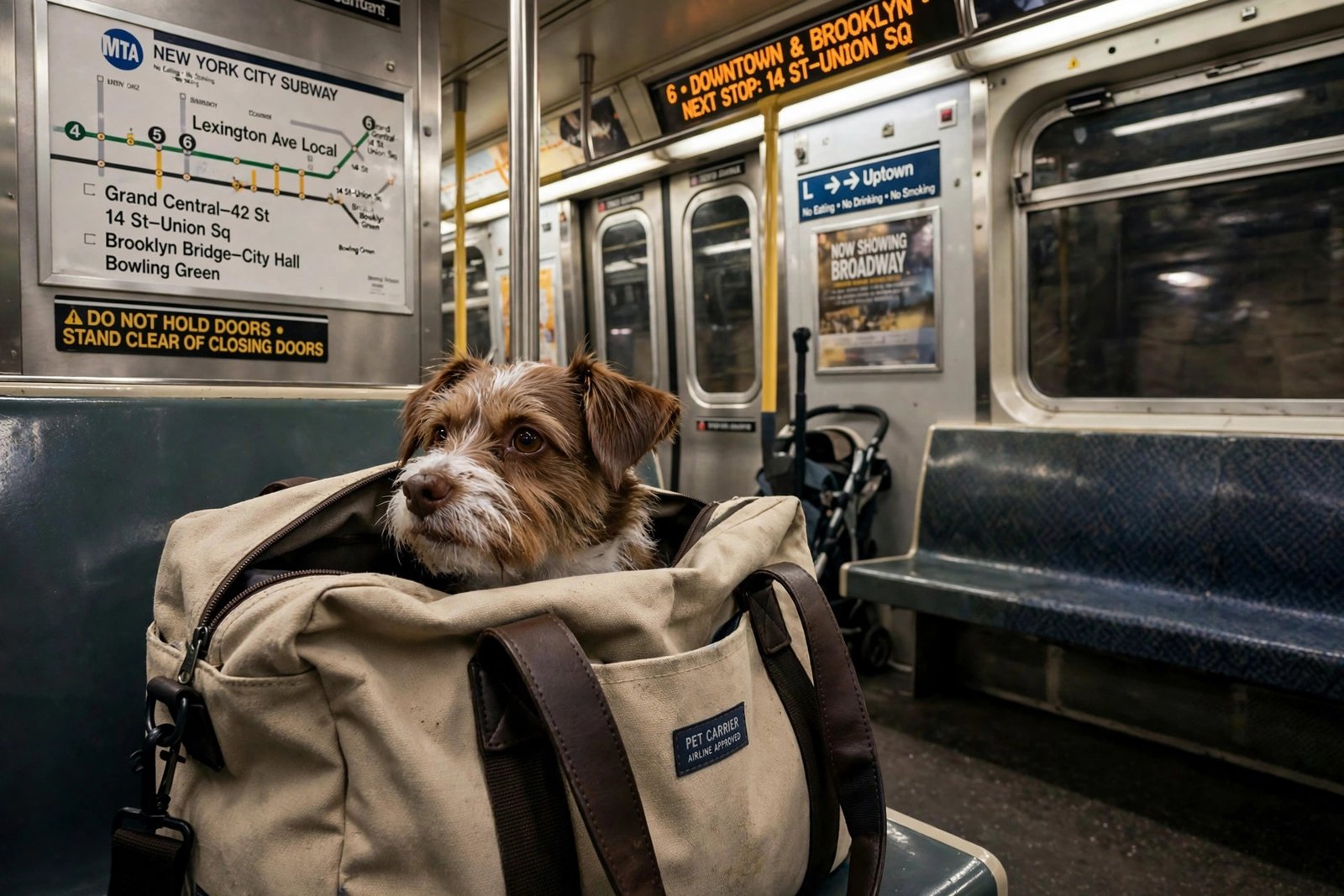
Taking your dog on the New York City subway is a rite of passage — and a logistical puzzle. The MTA’s official rule is simple but strict: dogs must be in a carrier, full stop. No leashed dogs, no matter how well-behaved. This has spawned a legendary workaround culture of oversized tote bags, IKEA shopping bags, and backpacks containing 80-pound “puppies.” This guide covers the actual rules, the enforcement reality, the best carriers for every dog size, and how to ride without drama.
The official rule (and what it actually says)
MTA rules state: “No person may bring any animal on or into any conveyance or facility unless enclosed in a container.” Enclosed in a container — that is the whole rule. Service animals are exempt (more below). There is no weight limit, no size limit, and no breed restriction in the written rule — only the container requirement. In practice, this means a Chihuahua in a purse is unambiguously fine, while a Labrador in a duffel bag with its head sticking out is technically non-compliant but widely tolerated. The MTA’s official rules of conduct contain the exact language. Knowing the rule precisely matters because it defines your rights: a fully containerized dog is unambiguously allowed, regardless of size.
Enforcement reality: what actually happens
Enforcement is inconsistent — which cuts both ways. Most conductors, station agents, and fellow riders ignore containerized dogs entirely; dogs on the subway are utterly normalized in 2026. Problems arise with: dogs on leashes (the clearest violation — some conductors will stop the train or call it in), aggressive or uncontrolled dogs (a lunging dog in a tote will draw intervention fast), and peak-hour crowding conflicts (a giant dog-container blocking doors at 8:30 a.m. invites complaints). NYPD transit officers have discretion — most exercise it sensibly, focusing on genuine safety issues rather than technical violations. The unwritten social contract: keep your dog fully contained, calm, and out of everyone’s way, and nobody cares. Break the social contract and the written rule becomes relevant. For the broader transit picture, our guide to the cheapest ways to get around New York City puts the subway in context — it remains the fastest way to move a dog across town.
Carriers for every dog size
Small dogs (under 15 lbs): easy mode. Purpose-built carrier bags, backpacks, and slings — dozens of good options $30–$80. Your dog is genuinely comfortable and you are unambiguously compliant.
Medium dogs (15–40 lbs): the sweet spot for backpack carriers (K9 Sport Sack and similar, $80–$120) — the dog rides on your back, paws out, surprisingly content. Also large tote-style carriers. This is the most common subway-dog setup in the city.
Large dogs (40–80 lbs): the famous IKEA-bag era. Oversized sturdy tote bags, large duffels with the top open, or purpose-built giant carriers. The dog must fit with the bag carriable — this is genuinely awkward but thousands do it daily. Practice at home first: a dog that panics in the bag on a moving train is a problem for everyone.
Giant dogs (80+ lbs): honestly difficult. Some owners use large rolling carts or wagons (technically containers on wheels). Others simply avoid the subway for giant breeds, using car services or walking. There is no shame in this — the rule was not written for Great Danes, and a stressed giant dog on a packed train serves nobody.
Carrier training matters more than the carrier: the AKC’s training resources include desensitization protocols that work well for subway training. desensitize at home first — treats in the bag, short sessions, then longer ones. A dog that loves its carrier is calm on the train; a dog stuffed into a strange bag for the first time at Times Square is a crisis. And make the commute pleasant for yourself too — making your daily commute more enjoyable applies double when you are managing a dog.
Riding smart: etiquette and tactics
Timing: avoid rush hours (7:30–9:30 a.m., 5–7 p.m.) when possible — crowded trains stress dogs and annoy humans. Midday and weekend trains are the golden hours. Positioning: stand or sit at the ends of cars, keep the carrier on your lap or between your feet — never blocking doors or aisles. Escalators: carry small dogs; for larger dogs in carriers, use elevators where available (many stations lack them — plan routes accordingly). Duration: keep trips as short as practical — a 20-minute ride is fine; a 90-minute multi-transfer odyssey tests any dog’s patience. Weather: hot days plus a crowded train plus an enclosed carrier equals overheating risk — bring water, watch for excessive panting. Other dogs: the subway concentrates reactive dogs in tight spaces — keep distance, do not let dogs greet nose-to-nose in a moving car. If your lifestyle involves frequent travel with your dog, traveling with special needs covers the planning mindset that applies to pets too.
Service animals: the actual law
Service animals (dogs trained to perform tasks for a person with a disability) are exempt from the container rule under the ADA — they may ride leashed. Emotional support animals are not service animals under the ADA and get no exemption — an ESA vest from the internet does not make your leashed dog legal on the subway. Misrepresenting a pet as a service animal is illegal in many contexts and genuinely harms disabled handlers who face increased skepticism. If you have a legitimate service dog, know your rights; if you do not, use a carrier like everyone else.
Alternatives when the subway does not work
Buses: same container rule as the subway, but more space and less crowding — often easier with dogs. Citi Bike: no (do not do this). Car services: Uber Pet and similar options allow dogs without carriers for a surcharge — worth it for vet emergencies or giant breeds. Walking: the underrated option — a 30-minute walk beats a stressful 15-minute train ride for many dogs. Dog shuttles: some daycare and walking services offer transport — ask yours.
Conclusion
Traveling with a dog on the NYC subway comes down to one rule (container required), one reality (calm, contained dogs are universally tolerated), and one skill (carrier training at home before the first ride). Get a carrier that fits your dog, practice until the dog loves it, ride off-peak, position considerately, and know the service-animal law. Thousands of New Yorkers move their dogs across the five boroughs daily without incident — with preparation, you and your dog will be two of them.
Frequently Asked Questions
Are dogs allowed on the NYC subway?
Yes — if enclosed in a container. The MTA rule requires animals to be in a carrier; there is no weight or size limit in the written rule. Service animals are exempt from the container requirement.
Can I bring a large dog on the subway without a carrier?
Not legally — the container rule applies regardless of size or behavior. In practice, enforcement focuses on safety, but a leashed large dog is the clearest violation and the most likely to draw intervention.
What is the best carrier for subway travel with a dog?
Backpack carriers (like the K9 Sport Sack) for medium dogs; sturdy tote-style carriers for small dogs; oversized duffels or purpose-built giant carriers for large dogs. Train the dog to love the carrier at home first.
Are emotional support animals allowed on the NYC subway?
Only in a container, like any pet. ESAs have no public-transit exemption under the ADA — only trained service animals do.
What should I do if my dog panics on the subway?
Exit at the next station, calm the dog outside, and reassess. Do not force it — go back to carrier training at home with shorter sessions. Consider buses (roomier) or car services as alternatives.