How to Take Care of a Guitar in NYC Humidity
How to take care of a guitar in NYC humidity: ideal humidity levels, humidifiers vs. dehumidifiers, seasonal setups, and the warning signs of moisture damage.
Written by admin
Published November 2, 2026
Reading time 6 minutes
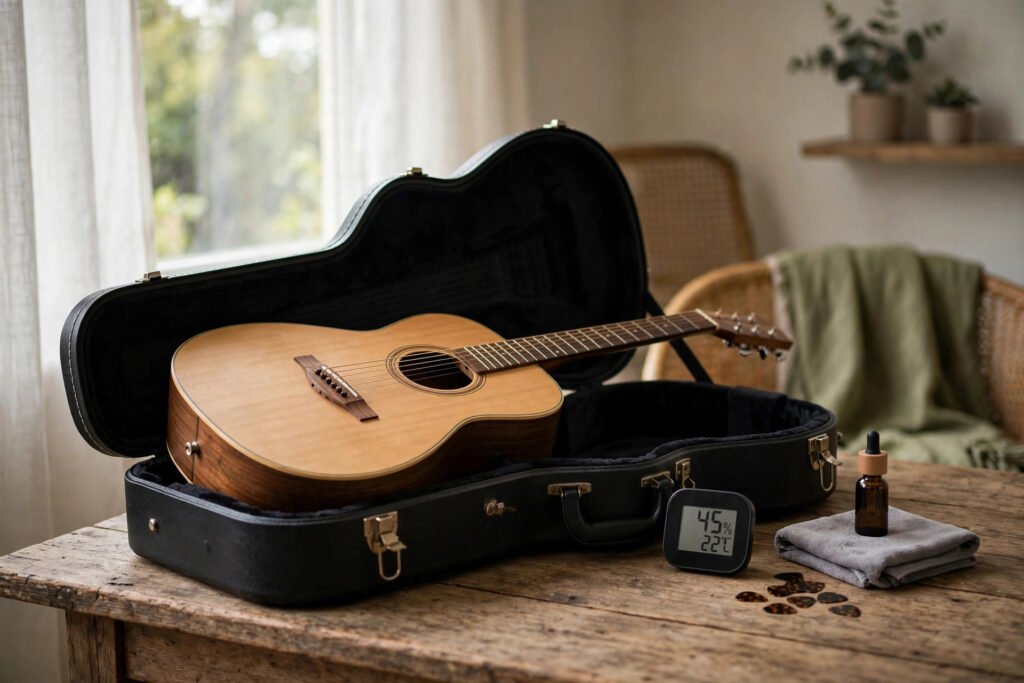
New York City summers are brutal on guitars. That sticky August air — 80% humidity, day after day — seeps into wood, swells tops, lifts bridges, and turns a sweet-sounding instrument into a buzzy, high-action mess. Then winter arrives, radiators blast dry heat, indoor humidity crashes to 20%, and the same guitar risks cracks, fret sprout, and a sinking top. NYC’s extreme seasonal swings make it one of America’s hardest cities on wooden instruments.
The good news: guitar care in humidity is a solved science. Understand the target range, control your environment, and watch for warning signs, and your guitar will outlive you.
Why Humidity Matters: The Wood Science
Guitars are built from thin pieces of wood glued under tension — typically around 45–50% relative humidity at the factory. Wood is hygroscopic: it absorbs moisture from humid air (swelling) and releases it into dry air (shrinking). Because a guitar’s parts are glued in fixed positions, this movement creates stress.
Too humid (above 60%): the top swells and bellies, raising string action; the neck can bow forward; glue joints soften; finish can cloud; and in extreme cases, mold grows inside the body. NYC summers routinely push un-air-conditioned apartments past 70%.
Too dry (below 40%): wood shrinks, the top sinks, fret ends protrude from the fingerboard (“fret sprout”), seams can open, and in the worst cases the top or back cracks — damage that costs hundreds to repair. NYC winter apartments with radiators are the danger zone.
The safe target, confirmed by every major manufacturer including Martin Guitar’s care guides, is 45–55% relative humidity, with temperature between 65–75°F. That narrow band is your guitar’s happy place year-round.
Measuring: The $15 Tool That Saves $500 Repairs
You cannot manage what you do not measure. A digital hygrometer in your guitar room (or inside the case) is the single most important guitar-care purchase — $10–20, and it tells you exactly what your instrument is experiencing. Check it seasonally at minimum; daily during extreme weather.
Place one hygrometer where the guitar lives, not across the room — microclimates vary enormously. The corner by the radiator can read 25% while the bedroom reads 45%. Measure at the guitar.
Summer Strategy: Fighting NYC Humidity
June through September is the high-humidity battle:
Air conditioning is your best dehumidifier. Running the AC naturally pulls indoor humidity into the 45–55% range. If you have AC, your guitars are probably fine — just keep them out of direct cold airflow.
No AC? Use a room dehumidifier. Small units handle a bedroom effectively. Empty the reservoir regularly or use a drain hose — a full, shut-off dehumidifier helps nobody.
Case storage with silica gel. When humidity spikes, keep the guitar cased with rechargeable silica gel packs, which absorb excess moisture. They are cheap, reusable (recharge in the oven), and effective for case microclimates.
Never store near bathrooms or kitchens. Steam sources create humidity spikes. And never leave a guitar in a car in summer — interior temperatures can hit 170°F, softening glue and destroying finishes in hours.
Winter Strategy: Fighting Dry Radiator Heat
October through April brings the opposite crisis. NYC’s steam radiators create desert-dry indoor air:
Case humidifiers are essential. Soundhole humidifiers (sponge-in-tube designs) or case humidifier packs maintain 45–50% inside the case regardless of room conditions. Check and refill weekly — a dried-out humidifier is just decoration. Sweetwater’s humidification guides compare the main systems clearly.
Room humidifiers for the practice space. If you keep guitars on stands (and you should play them, not entomb them), a room humidifier keeps the whole space safe. Cool-mist ultrasonic models are quiet and effective; clean them weekly to prevent mineral dust and mold.
Keep guitars away from radiators. Direct heat is worse than dry air alone — it creates rapid humidity and temperature cycling that stresses joints. A few feet of distance matters enormously.
Warning Signs: What Damage Looks Like
Catch problems early and they are cheap to fix; ignore them and they become structural:
High action and buzzing that appears in summer: classic humidity swelling. Usually resolves as humidity normalizes, but persistent issues need a setup.
Sharp fret ends in winter: the fingerboard shrank, exposing fret ends. Humidify immediately; a tech can file the ends smooth.
Sinking top or bulging bridge: structural movement from prolonged dryness or humidity. See a luthier promptly — this does not self-correct.
Cracks, open seams, loose braces: damage requiring professional repair. Do not attempt DIY glue repairs on structural cracks.
Musty smell from the soundhole: possible mold from excess humidity. Air the guitar out in normal conditions and consult a tech if it persists.
When in doubt, NYC has excellent luthiers and repair shops — a $75 setup and inspection once a year is cheap insurance. Many players combine this with learning from the best YouTube channels for learning guitar, several of which cover maintenance alongside technique.
Travel, Gigging, and Daily Habits
Daily habits compound: always store the guitar in its case when not in use (cases buffer humidity swings dramatically), wipe down strings and body after playing (sweat is corrosive), and let a cold guitar warm up gradually in its case when bringing it indoors in winter — rapid temperature change can crack finishes.
For gigging musicians hauling gear through NYC seasons, a hard case with humidification packs is non-negotiable, and Fender’s maintenance resources offer solid travel checklists. Also consider your home environment holistically — making your home smell good naturally often overlaps with the ventilation and moisture control that keeps instruments healthy.
Strings, Setup, and Seasonal Adjustments
Humidity control is the headline, but strings and setup are the supporting cast that makes the difference between a guitar that survives NYC and one that thrives. Change strings with the seasons: old, corroded strings are more vulnerable to humidity swings — fresh strings each season (or every 2–3 months for daily players) keep tension stable and tone bright. Get a seasonal setup: even with perfect humidity, NYC’s temperature swings move necks; a twice-yearly setup (spring and fall, ~$75 each at most shops) keeps action, intonation, and relief dialed in. Watch the fretboard: rosewood and ebony boards dry out in winter — a light application of fretboard oil once or twice per heating season prevents cracking and keeps the wood healthy (maple boards with finish need no oil). These small rituals take minutes and cost little, but they compound: the guitar that gets seasonal attention plays better, stays in tune longer, and avoids the slow accumulation of neglect that turns a $1,000 instrument into a $300 repair bill.
Conclusion
Taking care of a guitar in NYC humidity comes down to three habits: measure with a hygrometer, hold 45–55% humidity year-round (dehumidify in summer, humidify in winter), and watch for the early warning signs of trouble. The city’s climate is genuinely harsh on wooden instruments, but it is entirely manageable with basic, inexpensive tools. Your guitar is a precision wooden machine — treat its environment with the same care you give your playing, and it will sound better every year instead of slowly falling apart.
Frequently Asked Questions
What humidity level is safe for guitars?
45–55% relative humidity at 65–75°F. Below 40% risks cracks and fret sprout; above 60% risks swelling, high action, and mold.
Do I need a humidifier if I have air conditioning?
In summer, AC usually keeps humidity in range. In winter, radiators dry the air far below safe levels — that is when humidification becomes essential, AC or not.
Can humidity damage an electric guitar too?
Less dramatically than acoustics (thinner wood, less tension), but yes — neck movement, fret sprout, finish issues, and electronic corrosion all occur. The same 45–55% target applies.
How often should I check my guitar’s humidifier?
Weekly in winter, or whenever indoor humidity drops. Soundhole sponge humidifiers dry out in 5–10 days in radiator-heated apartments.
Is it safe to hang guitars on the wall in NYC?
Only if the room holds 45–55% humidity year-round. Wall hangers expose guitars to full room conditions with no case buffering — fine in a controlled room, risky in typical NYC seasonal swings.