How to Improve Your Singing Voice Without Lessons
How to improve your singing voice without lessons: breathing drills, pitch exercises, warm-ups, and a 4-week practice routine that delivers real, noticeable results.
Written by admin
Published November 1, 2026
Reading time 6 minutes
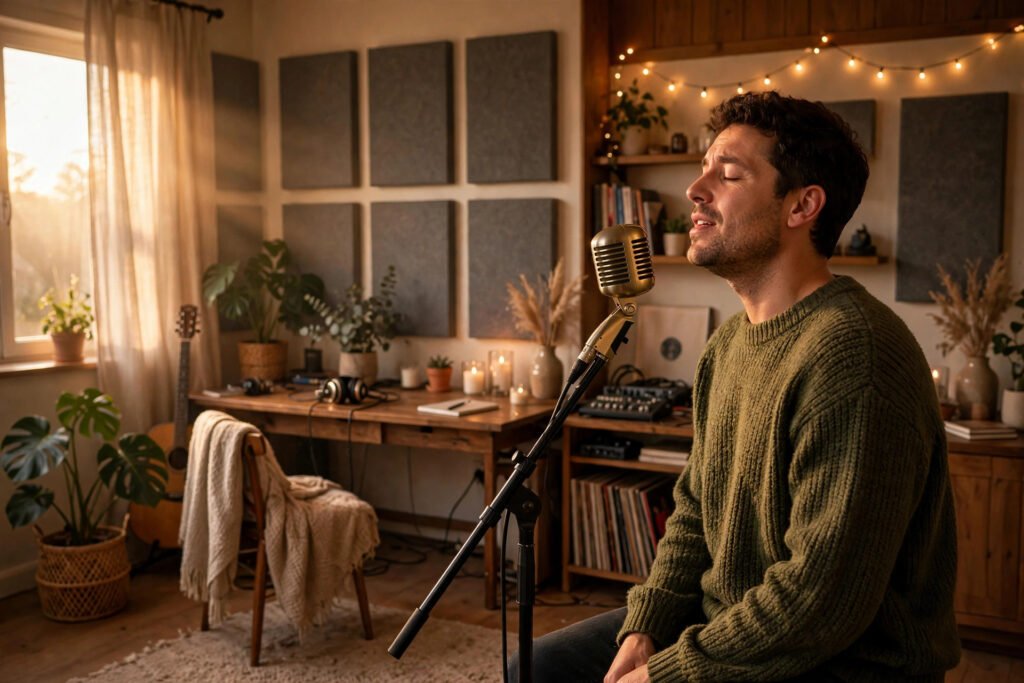
You do not need a vocal coach, expensive courses, or natural-born talent to sing noticeably better. What you need is an understanding of how the voice actually works and a consistent practice routine targeting the right things. Most “bad” singers are not tone-deaf — they are untrained in breath support, pitch matching, and resonance. All three are trainable, alone, for free.
This guide gives you the exercises and the 4-week plan. No lessons required — though we will be honest about where a coach eventually helps.
How Your Voice Actually Works
Your voice is a wind instrument. Air from your lungs passes through the vocal folds (two small bands of tissue in your larynx), which vibrate to create sound — then your throat, mouth, and nasal cavities shape that raw buzz into vowels, tone, and words. Three systems control everything: breath (the power), the vocal folds (the source), and resonance (the shaping).
Most beginners try to improve singing by pushing harder — more air, more effort, more volume. This is backwards. Good singing feels easier than bad singing, not harder. Tension is the enemy: tight throats, raised shoulders, and clenched jaws strangle the sound. The first skill is learning what relaxed, supported singing feels like.
Breath Support: The Foundation
Forget “sing from your diaphragm” as mysticism — here is the mechanics. Your diaphragm is a muscle below your lungs; when you inhale deeply, your belly and lower ribs expand. Good breath support means maintaining gentle engagement of your abdominal muscles as you exhale, giving you a steady, controlled airstream instead of a gusty blast.
The book exercise: Lie down with a book on your belly. Breathe so the book rises and falls; your chest should barely move. Do this for 5 minutes daily until belly breathing is automatic.
The hiss exercise: Inhale deeply, then exhale on a steady “ssss” for as long as possible, keeping the airflow even. Time yourself — progress from 15 seconds toward 30+ shows your support strengthening.
The lip trill: Blow air through loosely closed lips (the “brrr” motorboat sound) while sliding pitch up and down. This is the single best warm-up in existence: it relaxes the vocal folds while engaging breath support, and it is nearly impossible to do with a tense throat.
Pitch: Training Your Ear and Voice Together
“Tone-deafness” (true amusia) affects only about 4% of people. If you can tell when someone sings out of tune, your ear works — your voice just has not learned to match what your ear hears. The fix is pitch-matching drills:
Single-note matching: Play one note on a piano app, sing it back. Record yourself and compare honestly. Start in your comfortable range and expand gradually.
Slide to the target: Play a note, then slide your voice up or down until it “locks in” — you will feel the resonance click when you match. This trains the ear-voice connection directly.
Simple melodies: Sing nursery rhymes and folk songs slowly, checking yourself against a recording. Our roundup of the best karaoke songs for shy singers doubles as perfect pitch-practice repertoire — simple, familiar melodies in comfortable ranges.
Practice pitch for 10 minutes daily. Most people hear clear improvement within 2–3 weeks because the neural pathways for vocal pitch control respond fast to consistent training.
Resonance and Tone: Sounding Better, Not Just In-Tune
Singing in tune but sounding thin or harsh is a resonance problem. Try these:
The yawn-sigh: Yawn deeply, then sigh on a pitch sliding downward. The open throat position of a yawn is exactly the relaxed openness good singing needs. Memorize that feeling.
Humming: Hum scales with lips closed, feeling vibration in your face and lips (not your throat). This develops forward resonance — the bright, carrying quality that makes voices sound “good” to listeners.
Vowel shaping: Sing “ah-ay-ee-oh-oo” on one pitch, keeping the sound consistent. Notice how mouth shape changes tone; the goal is even, round vowels without throat tension.
Avoid the two classic tone-killers: singing too quietly (breathy, unsupported) and pushing for volume (tight, shouty). Healthy volume comes from resonance and support, not force. The NIH’s voice health resources explain why pushing through strain can cause real vocal fold damage — pain or hoarseness means stop.
The 4-Week Practice Plan
Week 1 — Breath and relaxation (15 min/day). Book exercise, hisses, lip trills. Learn what supported, relaxed airflow feels like. Do not worry about songs yet.
Week 2 — Add pitch matching (20 min/day). Keep the breathing warm-ups (5 min), add single-note matching and slides (10 min), then sing one simple song slowly (5 min).
Week 3 — Resonance and songs (25 min/day). Warm-ups (5 min), humming and yawn-sighs (5 min), then work on 2–3 songs, recording yourself and fixing problem spots (15 min).
Week 4 — Performance practice (25 min/day). Full warm-up, then sing complete songs start to finish without stopping. Perform for a friend, record video, or try an open mic. Performing is a skill itself — start building it now.
Supplement with structured video lessons — the best YouTube channels for learning guitar roundup mindset applies to voice too: free, high-quality instruction is abundant if you are selective.
Protecting Your Voice
Your vocal folds are delicate tissue. Hydrate well (room-temperature water; the folds hydrate via bloodstream and steam, not by water touching them), warm up before demanding singing, cool down after, and never sing through pain or significant hoarseness. Limit shouting, whispering (surprisingly straining), and singing while sick. The American Academy of Otolaryngology and Cleveland Clinic both publish excellent vocal hygiene guides worth bookmarking.
When a Coach Actually Becomes Worth It
Self-training can take you remarkably far — from “cannot carry a tune” to “confident at karaoke and open mics.” But a good coach accelerates past plateaus: diagnosing tension you cannot hear yourself, expanding range safely, and preparing for auditions or recording. If you hit a wall after a few months of diligent practice, even 4–6 lessons can unlock the next level. Until then, consistency beats credentials.
Conclusion
Improving your singing voice without lessons comes down to three trainable skills — breath support, pitch matching, and resonance — practiced daily with honest self-recording. Most people are not missing talent; they are missing technique and reps. Follow the 4-week plan, protect your voice, and record yourself relentlessly. In a month, you will not just sound better — you will understand your own voice, which is the real prize. And when you are ready to show it off, you will already know how to discover new music you will actually like to sing.
Frequently Asked Questions
Can anyone learn to sing, or do you need talent?
Almost anyone can learn to sing well enough to enjoy it and impress casual listeners. True tone-deafness (amusia) is rare (~4%). What most people lack is training, not talent.
How long does it take to improve your singing voice?
Noticeable improvement in pitch and tone typically comes within 3–6 weeks of daily 20-minute practice. Significant transformation takes 6–12 months. Consistency matters far more than session length.
Is it bad to sing every day?
No — daily singing is ideal, as long as you warm up, stay hydrated, avoid pushing through pain, and keep sessions reasonable (20–40 minutes for beginners). Rest if you are hoarse.
Why do I sound good in the shower but bad recorded?
Bathroom acoustics add flattering reverb, and bone conduction makes your voice sound fuller to yourself than it is. Recordings reveal the truth — which is exactly why recording yourself is the fastest path to improvement.
At what age is it too late to learn to sing?
Never, practically speaking. Adult beginners routinely develop strong voices; the voice remains trainable throughout life. Older beginners should warm up more thoroughly and progress gradually.