
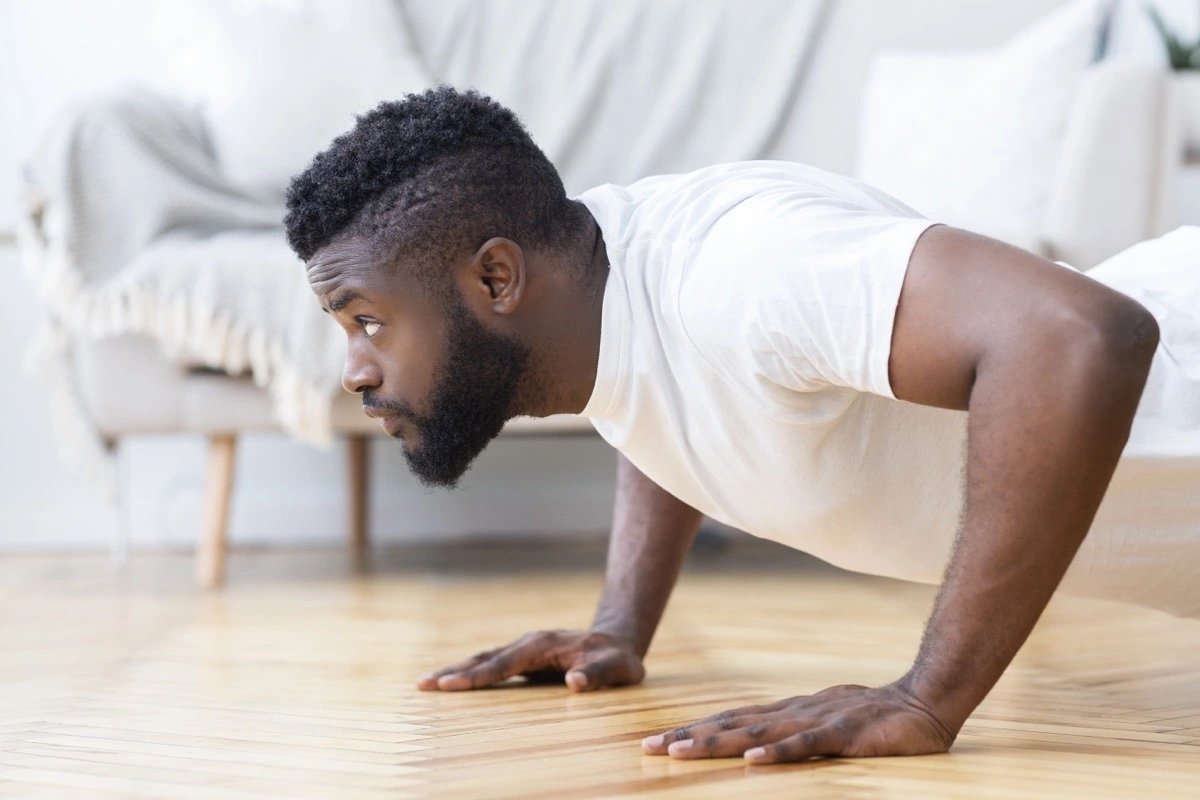
Let’s kill a myth right away: you don’t need a gym to build muscle. You need resistance, progression, protein, and consistency — none of which require a membership, a commute, or waiting for the squat rack. How do I build muscle without going to the gym? By understanding one principle — progressive overload — and applying it with whatever you have: your bodyweight, a doorway pull-up bar, a pair of dumbbells, or a $30 set of resistance bands.
The One Principle That Matters: Progressive Overload
Muscles grow in response to a challenge slightly beyond what they’re used to. In a gym, you add plates to a bar. At home, you progress differently but just as effectively:
- More reps. Went from 8 push-ups to 15? That’s overload.
- Harder variations. Knee push-ups → regular → diamond → archer → one-arm progressions. Every bodyweight movement has a difficulty ladder.
- More sets or slower tempo. Four-second negatives (lowering slowly) make light resistance brutally effective.
- Shorter rests. Same work in less time is a stronger stimulus.
- Added weight. A backpack full of books turns squats and push-ups into serious strength work. It looks silly. It works beautifully.
Track your workouts — a notes app is fine. If you’re not doing slightly more than last week, you’re maintaining, not building. That’s the whole secret, and honestly it’s the same secret gym-goers use.
A Full-Body Home Routine That Actually Works
You can build impressive muscle with just six movement patterns, done 3 times a week. Here’s a template:
- Push: Push-up variations (3-4 sets). Elevate feet to shift emphasis to shoulders as you get stronger.
- Pull: Doorway pull-up bar rows or pull-ups (3-4 sets). This is the one worth spending money on — a $30 pull-up bar opens up training for your entire back. No bar? Resistance band rows anchored in a door.
- Legs: Bulgarian split squats and glute bridges (3-4 sets each). Single-leg work is humbling — most people find bodyweight split squats harder than expected.
- Hinge: Single-leg Romanian deadlifts with a backpack or dumbbell (3 sets). Your hamstrings and glutes will feel these for days.
- Core: Planks, dead bugs, and hollow holds (2-3 sets). Skip the hundred crunches; train stability instead.
- Shoulders: Pike push-ups, progressing toward wall handstand push-up negatives (3 sets).
Rest 60-90 seconds between sets, and take each set within 1-3 reps of failure — that proximity to failure is what signals growth. If you’re brand new to training, start with our guide to the best exercises for beginners at home to build a base first.
Eat Like You Mean It
Here’s the uncomfortable truth about home muscle-building: most people fail in the kitchen, not the living room. Muscle needs protein and sufficient calories. Aim for roughly 0.7-1 gram of protein per pound of body weight daily — for a 160-pound person, that’s 110-160 grams. Spread it across 3-4 meals; your body uses protein better in doses than in one giant dinner.
You don’t need expensive supplements. Eggs, Greek yogurt, chicken, beans, lentils, tuna, and whey protein (if you tolerate dairy) are the workhorses. And eat enough overall — building muscle in a steep calorie deficit is possible for beginners but slow and miserable. A slight surplus of 200-300 calories above maintenance is the sweet spot. For fueling around your sessions specifically, see what to eat before and after a workout.
Recovery: Where Growth Actually Happens
Training breaks muscle down; recovery builds it back stronger. That means:
- Sleep 7-9 hours. Growth hormone peaks during deep sleep. Skimping on rest while training hard is like revving an engine with no oil.
- Don’t train the same muscles daily. Full-body 3x per week with rest days between beats a daily grind for muscle growth.
- Manage soreness smartly. Some soreness is normal when starting; debilitating soreness means you did too much. Light movement and walking beat total couch rest.
- Stay consistent for months, not weeks. Visible muscle takes 8-12 weeks of consistent work. The people who transform at home aren’t doing anything exotic — they’re just still doing it in month four.
The CDC recommends muscle-strengthening activities at least twice weekly for all adults, and how often to work out each week breaks down how to structure that around the rest of your life.
How Do I Build Muscle Without Going to the Gym? Your Questions Answered
How long before I see visible muscle from home workouts?
Strength gains come first (4-6 weeks — that’s mostly your nervous system learning), visible muscle later (8-12 weeks of consistent training and eating). The timeline frustrates people because the first month’s progress is invisible: you’re getting stronger without looking different. Take measurements and progress photos monthly, not daily — and track performance (push-up count, hold times) weekly. The people who quit at week five were one month from the visible payoff. Consistency through the invisible phase is the entire game.
Can I build muscle with just resistance bands?
Yes, absolutely — with one caveat. Bands are excellent for most muscle groups and genuinely effective for hypertrophy when you train near failure. The limitation is legs: it’s hard to load squats and hinges heavily enough with bands alone for advanced leg growth. The fix is single-leg variations (Bulgarian split squats, single-leg Romanian deadlifts), which double the effective load per leg and challenge even strong people. Pair bands with a pull-up bar and you can train everything well for years. Many impressive physiques were built on less equipment than a $50 band set.
Do I need to eat in a calorie surplus to build muscle at home?
Beginners can build muscle at maintenance or even in a slight deficit (the famous “newbie gains” — your body is so unadapted that it builds muscle readily). Beyond the first 6-12 months, a small surplus of 200-300 calories daily optimizes growth. But don’t dirty-bulk at home thinking more food equals more muscle — excess calories beyond that small surplus mostly become fat, and the “I’ll cut later” plan fails more often than it works. Eat enough protein, stay near maintenance or slightly above, and let the training do the work.
The Bottom Line
Building muscle without a gym comes down to progressive bodyweight training three times a week, enough protein, and the patience to let it compound. A pull-up bar and a set of bands cost less than two months of gym membership and last for years. Start where you are, add a little more each week, eat like it matters — because it does — and check back in three months. You’ll be surprised what the living room can build.


