
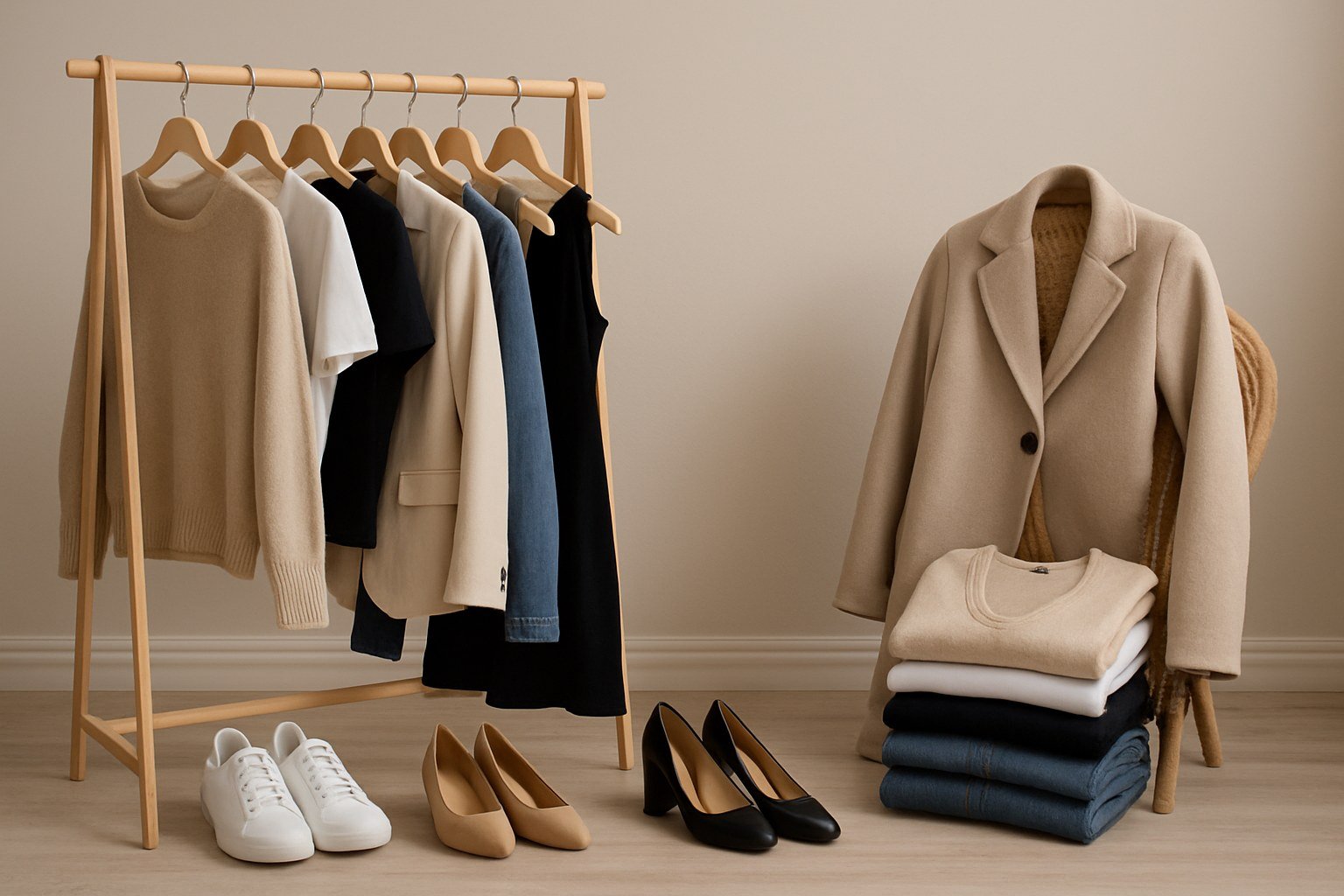
A capsule wardrobe sounds like a luxury concept — thirty perfect pieces, all neutral, all expensive. But the original idea was actually about spending less: fewer, better-chosen clothes that all work together. How can I build a capsule wardrobe on a budget? By shopping your closet first, buying secondhand strategically, and following a formula instead of a fantasy. Here’s the complete playbook.
What a Capsule Wardrobe Actually Is
The concept, popularized by stylist Susie Faux in the 1970s and revived by every minimalist blogger since: a small collection of versatile pieces (typically 25-40, excluding underwear, workout gear, and occasion wear) that mix and match into dozens of outfits. Everything coordinates. Nothing sits unworn. Getting dressed takes two minutes.
The budget version keeps the system but ditches the price tags. A $30 thrifted blazer that fits well beats a $300 one that doesn’t — and honestly, most people can’t tell the difference once it’s on. The capsule wardrobe concept on Wikipedia traces the history if you’re curious, but the practice matters more than the theory.
Step 1: Audit What You Own (The Free Step)
Before spending a dollar, empty your closet. Try everything on. Sort into three piles: love and wear, maybe, and no. Be ruthless with the “maybe” pile — if you haven’t worn it in a year and it doesn’t fit your current life, it’s not capsule material.
What’s left is your starting inventory. Most people discover they already own 60-70% of a capsule wardrobe — the gaps are usually specific (no versatile jacket, no good dark jeans) rather than total. Write down exactly what’s missing. That list is your shopping plan, and it prevents the #1 budget killer: buying random “good deals” that don’t fill actual gaps.
Step 2: Define Your Formula
A classic budget capsule formula (adjust for your climate and lifestyle):
- Tops (8-10): 3-4 tees, 2-3 blouses/button-downs, 2 sweaters, 1-2 tanks
- Bottoms (4-5): dark jeans, black pants, 1 skirt or shorts, 1 versatile alternative
- Layers (3-4): blazer or structured jacket, cardigan, denim jacket, 1 coat
- Dresses (2-3): only if you wear them — don’t include aspirational pieces
- Shoes (4-5): sneakers, flats or loafers, boots, 1 dress shoe, sandals (seasonal)
Color strategy for maximum mixing: choose 2 neutrals as your base (black + white, navy + gray, etc.), 1-2 accent neutrals (denim, tan, olive), and 1-2 accent colors you love. Every piece should match at least 3-4 others. If it only works with one outfit, it doesn’t earn its slot.
Step 3: Shop Smart (Where the Budget Magic Happens)
- Thrift and consignment first. Blazers, coats, jeans, and sweaters are thrift-store gold — quality pieces at 10-20% of retail. Check seams, zippers, and armpits; skip anything needing more than minor tailoring.
- End-of-season sales. Buy coats in March, swimsuits in September. Patience saves 50-70%.
- Budget retailers for basics. Tees, tanks, and underlayers don’t need to be expensive — this is where affordable basics shine. Our guide to affordable clothing brands for quality basics names the best value picks.
- Buy slowly. The biggest mistake is building the whole capsule in one weekend. Buy one piece, wear it for two weeks, then buy the next. You’ll make better choices and spread the cost.
- Tailor the almost-perfect. A $15 hem or taper transforms a $10 thrift find into something that looks custom. Budget for minor alterations — it’s the highest-ROI clothing spend there is.
Step 4: Maintain the System
A capsule wardrobe isn’t a one-time project — it’s a system with rules. One in, one out: when you buy something new, something leaves. Seasonal swap: store off-season pieces (see how to store winter coats in summer) and reassess each season. And before any purchase, run the 3-outfit test: can you name three outfits this piece creates with what you own? No? Don’t buy it.
Care extends the budget too — learning how to make old clothes look new again keeps your small collection looking fresh far longer.
How Can I Build a Capsule Wardrobe on a Budget? Your Questions Answered
How many pieces should a capsule wardrobe have?
The classic number is 25-40 pieces, but the right number is personal. Someone with a varied lifestyle (office, gym, social, outdoor) needs more than someone with a uniform routine. Rather than chasing a number, chase the feeling: getting dressed is easy, everything matches, nothing sits unworn for months. Start with what you have, remove what you don’t wear, and fill only genuine gaps. The capsule wardrobe concept was never about minimalism as competition — it was about intentionality. Thirty well-chosen pieces beat fifteen resentfully minimal ones.
Can I do a capsule wardrobe with a colorful style?
Absolutely — capsules aren’t required to be beige. The principle is coordination, not neutrality. If your style is bold color, build your capsule around your palette: choose 2-3 base colors you love plus neutrals that bridge them. A capsule of jewel tones (emerald, burgundy, navy) with black and cream works exactly like a neutral capsule — everything mixes because the palette is deliberate. The beige-minimalist capsule is just one aesthetic; the system underneath works for maximalists too.
How do I handle different seasons in a capsule?
Most people run seasonal capsules: 25-35 pieces per season, with year-round basics (jeans, tees, blazers) carrying across. Store off-season pieces properly — breathable bags, clean before storing — and do a mini-audit at each swap: what didn’t get worn? What needs replacing? This rhythm also spreads costs across the year instead of demanding one big build. Transitional pieces (light jackets, cardigans, ankle boots) earn their keep by serving two seasons.
What if I get bored with so few clothes?
Boredom usually signals a styling rut, not a wardrobe shortage. The fixes: new combinations (force yourself to pair pieces that never met), accessories (scarves, jewelry, belts transform bases), and the seasonal swap (stored clothes feel new on return). Also check whether your capsule reflects your actual taste or an aspirational minimalism you don’t enjoy — a capsule of clothes you love doesn’t bore; a capsule of clothes you “should” like does. Build for your real style and the boredom rarely comes.
The Bottom Line
A budget capsule wardrobe is built closet-first, formula-driven, and assembled slowly through thrift stores, sales, and strategic basics. Most people need to buy far less than they think — the audit usually reveals the wardrobe was already there, just buried under clutter. Start with the closet cleanout this weekend. The shopping list writes itself.


