
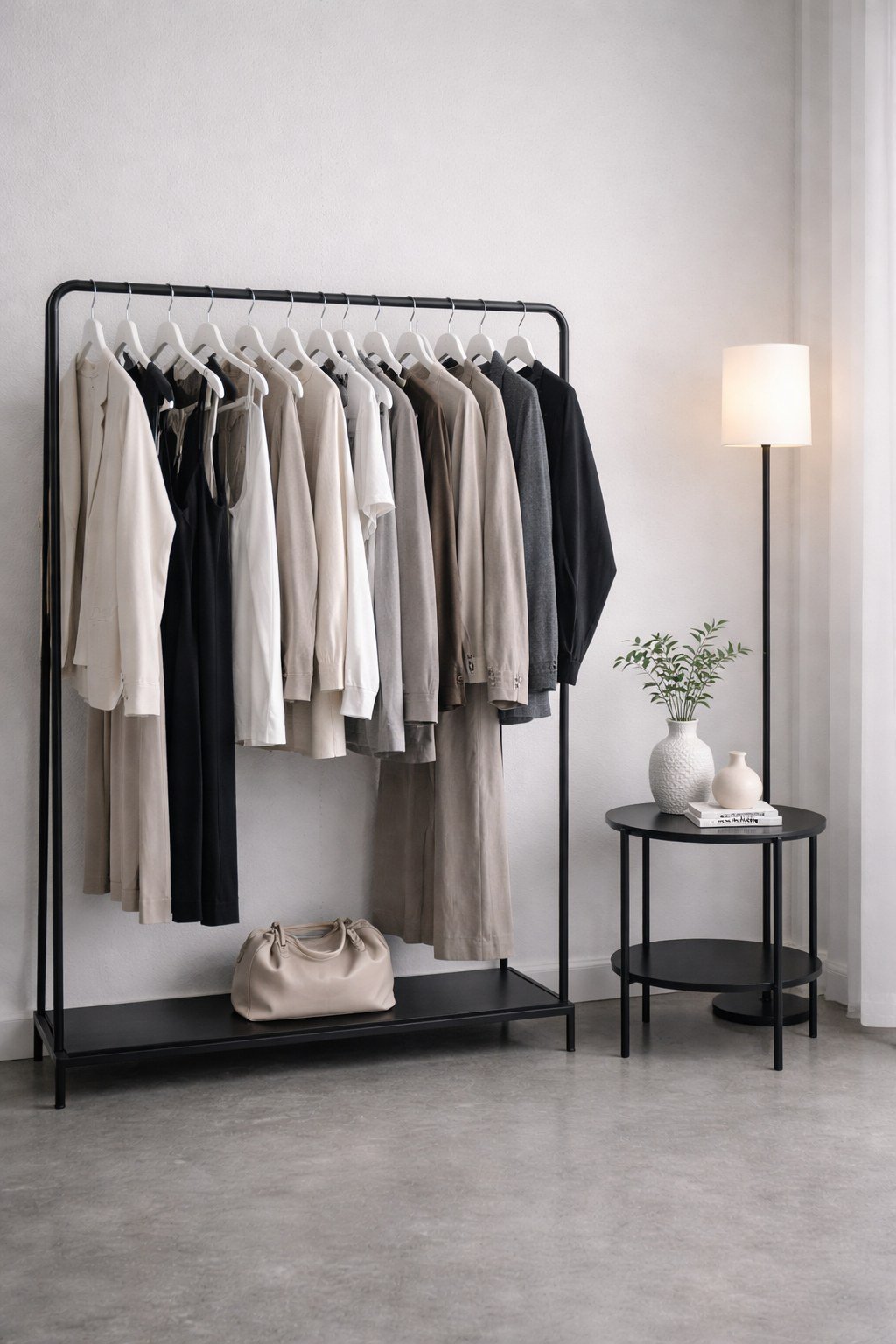
New job, new city, new career — and a closet full of nothing appropriate. Building a professional wardrobe from scratch feels overwhelming because you’re imagining the finished product instead of the process. How do I build a professional wardrobe from scratch? In phases: survive the first two weeks, build the capsule over two months, refine over six. Here’s the exact plan.
Phase 1: The Survival Kit (Week 1-2, ~$200-300)
You need to look professional Monday. The minimum viable work wardrobe:
- 2 pairs of trousers (black, navy) — thrift or budget retail
- 3-4 tops (white button-down, 2 blouses/knit tops, 1 versatile layer)
- 1 blazer (black or navy — thrift this; tailoring transforms it)
- 1 pair of professional shoes (black flats or low heels)
- 1 structured bag
That’s it. Mix, repeat, nobody notices — especially with the blazer rotating over different tops. Shop thrift stores and budget retailers (see our affordable workwear guide for where). Prioritize fit over everything; a $15 steamer makes it all look intentional.
Phase 2: The Capsule (Month 1-2, ~$300-500)
Expand to a true 2-week rotation:
- Bottoms (5): add gray trousers, dark jeans (if allowed), 1 skirt
- Tops (8-10): add variety — patterns, colors within your palette, a striped top, a silk-feel blouse
- Layers (3): second blazer or cardigan, knit jacket
- Dresses (2): a sheath dress and a wrap dress — each is a complete outfit
- Shoes (3): add nude flats and loafers
Color strategy: build around 2-3 neutrals (black, navy, gray are the professional trinity) plus white. Every piece should match at least 4 others. This is the capsule wardrobe principle applied to workwear.
Phase 3: Refinement (Month 3-6, ~$100-200/month)
Now you upgrade strategically based on real data — you know what you actually wear:
- Replace the weakest links. That survival-kit blazer that’s pilling? Upgrade it. The shoes that hurt? Replace with quality.
- Add personality. Now that the foundation is solid, add the pieces with character — the interesting blouse, the colored blazer, the statement jewelry.
- Invest in the high-rotation pieces. The trousers you wear twice a week deserve the quality version. Cost-per-wear justifies it.
- Seasonal additions. Add weather-appropriate layers as seasons change rather than all at once.
- Tailor everything worth keeping. By now you know your keepers — $100 in alterations across 5 pieces transforms the whole wardrobe.
Budget Frameworks
- Tight budget ($500 total): thrift 70%, budget retail 30%. Entirely doable — the thrift blazer + tailored trousers formula looks genuinely professional.
- Moderate ($1,000-1,500): mix of thrifted structure pieces, mid-range basics (Uniqlo, Gap, Target), and 2-3 quality investments (shoes, blazer).
- Comfortable ($2,000+): quality foundations from the start, tailored from day one. Still build in phases — your style data from Phase 1 prevents expensive mistakes.
Whatever the budget: never go into debt for work clothes. A phased build is financially sane and produces better results than a splurge, because each phase informs the next.
Dress Code Calibration
Build for your office, not a generic “professional.” Observe for the first week: what’s the actual daily uniform? Match it, then go one notch sharper. A creative agency and a law firm need different wardrobes — our business casual vs. smart casual guide helps decode the spectrum, and creative interview attire principles apply to creative workplaces generally.
How Do I Build a Professional Wardrobe From Scratch? Your Questions Answered
How much should a starter professional wardrobe cost?
The honest range: $300-500 for a functional two-week rotation via thrift and budget retailers; $800-1,200 for a comfortable build with some quality pieces; $2,000+ for quality foundations from day one. But the number matters less than the phasing: spend $200-300 on the survival kit (week one), then add monthly based on what you actually wear. The most expensive mistake is the $1,000 opening splurge on pieces you later realize don’t suit your office or style. Phased building isn’t just budget-friendly — it produces better results because each phase informs the next. Never go into debt for work clothes; the phased approach makes debt unnecessary.
What if my office has no dress code?
“No dress code” usually means “unwritten dress code” — observe for the first week before buying much. Note what people at your level and one above wear (dress for the job you want is cliché because it’s true). The universal safe zone for ambiguous offices: dark jeans or chinos, a button-down or nice top, and clean shoes — polished but not overdressed. Then calibrate: if everyone’s in hoodies, relax; if there’s a blazer contingent, join it. And remember that “no dress code” often still has invisible lines (no gym clothes, no flip-flops) — find them by observation, not by crossing them.
How do I make a small work wardrobe look varied?
Accessories and layering are the multipliers: the same trousers and top look different with a blazer vs. cardigan, different jewelry, different shoes, tucked vs. untucked. A capsule of 15 pieces in a coordinated palette creates 20+ distinct outfits — the variety is in the combinations, not the piece count. Photograph your outfits for the first month to avoid accidental repeats of the exact same combination (the only repetition people notice). And the two-week rule: if no one sees the same full outfit within two weeks, your wardrobe feels varied regardless of piece count.
Should I buy a suit for interviews if my field is casual?
Own one versatile suit (navy or charcoal) regardless of field — interviews, funerals, weddings, and important meetings all occasionally require it, and scrambling to buy one under time pressure guarantees a bad purchase. For casual-field interviews, you may not wear the full suit (blazer + trousers separately might be right), but owning it gives you options. Buy it during a sale, get it tailored, and maintain it — a suit worn five times a year for a decade is one of the best cost-per-wear purchases in menswear or womenswear. The interview attire guides consistently rank “owning one good suit” as the top wardrobe advice across industries.
How do I dress professionally on a very tight budget?
The $200 survival plan: thrift stores for blazer ($15), trousers ($10 x2), and shoes ($15); budget retailers for tops ($40 for 4); a steamer ($25, the great equalizer); tailoring for the blazer ($20). Total: ~$150-200 for a week of professional outfits. The principles that make it work: fit over brand (tailoring transforms thrift), neutral palette (everything matches), grooming (free and high-impact), and pressing (wrinkles are the #1 cheap signal). Nobody can tell what you paid — they can only tell whether it fits, whether it’s clean and pressed, and whether you look intentional. Those three things are achievable at any budget.
The Bottom Line
Building a professional wardrobe from scratch works in three phases: a $200-300 survival kit for week one, a capsule expansion over two months, and data-driven refinement over six months. Thrift the structure, buy basics affordably, tailor the keepers, and build around neutrals. In six months, you’ll have a wardrobe that looks like it took years — because it was built smart, not fast.


