
Starting exercise is intimidating — gyms are confusing, programs assume fitness you don’t have, and half the internet seems designed for people already in shape. But the best exercises for beginners at home are simple, safe, and require zero equipment. You can build real fitness in your living room. Here’s exactly how to start.
The Best Exercises for Beginners at Home: The Foundational Five
These five bodyweight moves cover your whole body. Master them before anything fancy:
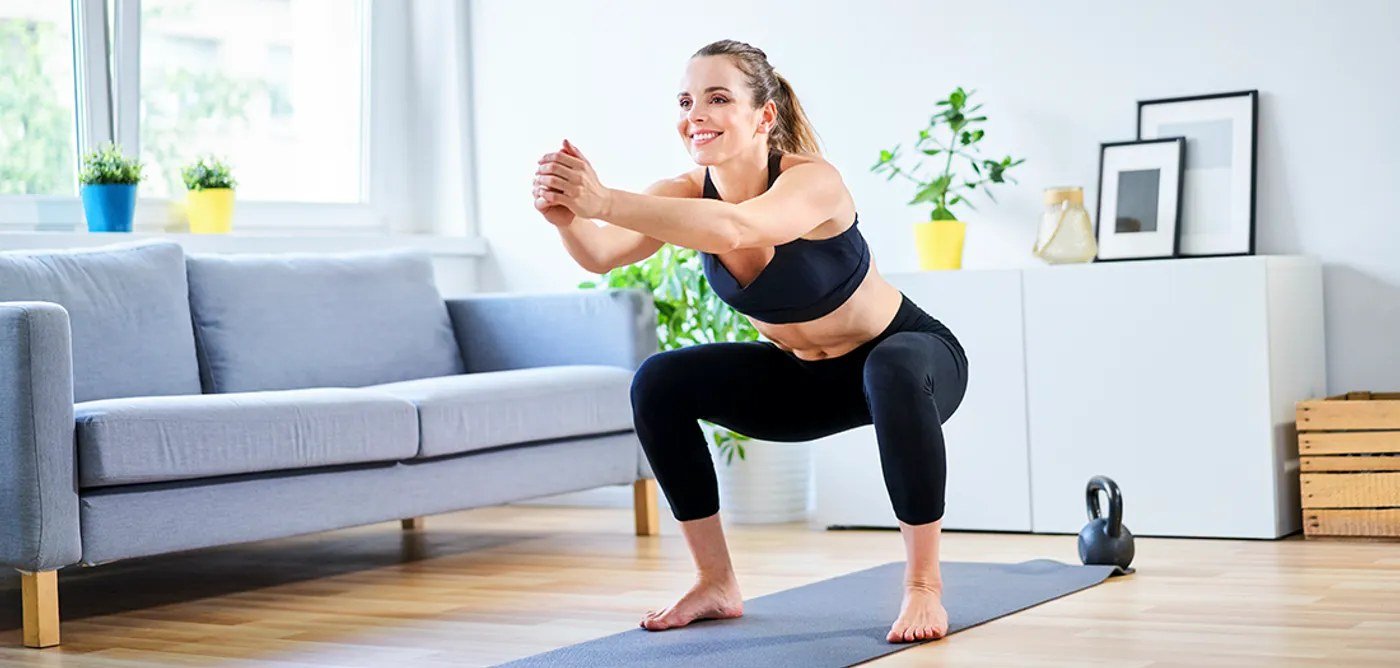
- Bodyweight squats: Feet shoulder-width, sit back like you’re finding a chair, keep knees tracking over toes. The king of lower-body exercises — start with 2 sets of 10. Can’t go deep? Squat to a chair and stand back up.
- Wall or incline push-ups: Start against a wall, progress to a countertop, then the floor. Chest, shoulders, triceps — the upper-body foundation. 2 sets of 8-12 at whatever incline challenges you.
- Glute bridges: Lie on your back, feet flat, lift hips. Wakes up the glutes that chairs put to sleep all day. 2 sets of 15. Your lower back will thank you.
- Bird dogs: On all fours, extend opposite arm and leg. Core stability without a single crunch. 2 sets of 8 per side, slow and controlled.
- Dead bugs: Lie on your back, lower opposite arm and leg while keeping your back pressed to the floor. The safest core exercise that exists. 2 sets of 10.
Form matters more than reps — bad form practiced is injury practiced. Watch a reputable demonstration video for each move once. The CDC’s physical activity guidelines confirm: this kind of muscle-strengthening activity twice weekly is the evidence-based baseline.
Your First 4 Weeks
Weeks 1-2: 2 sessions per week, 20 minutes. The five moves above, resting 60-90 seconds between sets. It should feel easy-ish — you’re learning movement, not proving toughness. Add a daily 10-minute walk (see why walking 30 minutes matters).
Weeks 3-4: 3 sessions per week, 25-30 minutes. Add a set to each exercise. Try the harder variation of one move (countertop push-ups instead of wall). Walking extends to 15-20 minutes.
The rule: if you’re too sore to move normally the next day, you did too much. Mild muscle awareness is fine; limping is not. Progress is measured in months, not workouts.
Common Beginner Mistakes
- Too much, too soon: The #1 beginner error. Enthusiasm week one, injury or burnout week three. Start embarrassingly easy.
- Skipping warm-up: 3-5 minutes of marching in place, arm circles, leg swings. Non-negotiable, even for short sessions.
- Holding your breath: Exhale on effort, inhale on release. If you’re turning purple, the weight (your body) is too much — regress the move.
- No rest days: Muscles strengthen during recovery, not during the workout. Alternate days, especially at first.
- Comparing to others: Your only competition is last week’s you. Social media fitness is a highlight reel of genetic outliers.
Months 2-3: Progressing Beyond the Basics
The first month builds the habit; months two and three build the fitness. Here’s how to progress safely.
Add complexity gradually: Squats → split squats (one foot forward, lunge-like). Incline push-ups → floor push-ups (even 3 good ones). Glute bridges → single-leg bridges. Bird dogs → add a 5-second hold. One progression per exercise per month is plenty — the goal is continuous challenge, not daily novelty.
Introduce structure: Move from “do the exercises” to timed circuits: 40 seconds work, 20 seconds rest, rotate through 5 moves, repeat 3 rounds. Circuits add cardio conditioning to strength work and make sessions feel purposeful. Total time: still under 30 minutes.
Add the missing pieces: Month 2 introduces pulling (you’ve been pushing) — doorway rows using a sturdy table, or resistance band rows (a $15 band is the best fitness purchase for home trainees). Month 3 adds dedicated core finishers: planks (build to 60 seconds), side planks, dead bug variations.
Track progress properly: Log workouts simply — date, exercises, sets, reps. Every 4 weeks, test: max push-ups, wall-sit time, plank hold. Watching numbers climb is the motivation that survives when novelty fades. Progress photos monthly (same lighting, same pose) — the mirror lies daily but tells truth monthly.
Know when you’ve graduated: 3 months of consistent training, comfortable with all progressions, hungry for more — you’re no longer a beginner. Options: add dumbbells/kettlebells, try [[i:140|AI-generated programming]], join a class, or start [[i:158|running]]. The beginner phase’s job was building the identity of someone who exercises. If that’s installed, everything after is just details. Well done — most people never get here.
Beginner Exercise FAQs
How sore should I expect to be?
Mild muscle awareness 24-48 hours after is normal (DOMS — delayed onset muscle soreness), especially in weeks 1-2. What’s not normal: sharp pain, joint pain, or soreness so severe you can’t move normally. The rule: discomfort in the muscles is adaptation; pain in joints is warning. Scale back until you learn the difference.
Do I need rest days?
Yes — muscles strengthen during recovery, not during the workout. Beginners: alternate workout days with rest or light walking. You can be active daily (walking is fine every day), but give trained muscles 48 hours before hitting them hard again. More rest early on isn’t laziness; it’s programming.
When should I add weights?
When bodyweight exercises feel easy for the target reps — typically month 2-3. Start with light dumbbells or a kettlebell (adjustable dumbbells are the best home investment). The progression principle never changes: master the movement unloaded, then add load gradually. Form first, weight second, always.
Building the Habit That Lasts
Exercise adherence isn’t about motivation — it’s about friction. Lay out workout clothes the night before. Exercise at the same time daily. Start with sessions so short they feel silly (10 minutes counts). Track with a simple calendar X — the chain of X’s becomes its own motivation. And pair movement with the rest of the foundation: how often to work out weekly, sleep, and when to exercise. If you’re completely out of shape and want to add cardio specifically, starting running from zero is the natural next step. The hardest rep is the first one. Do it today — ten squats, right now. You’re already started.


