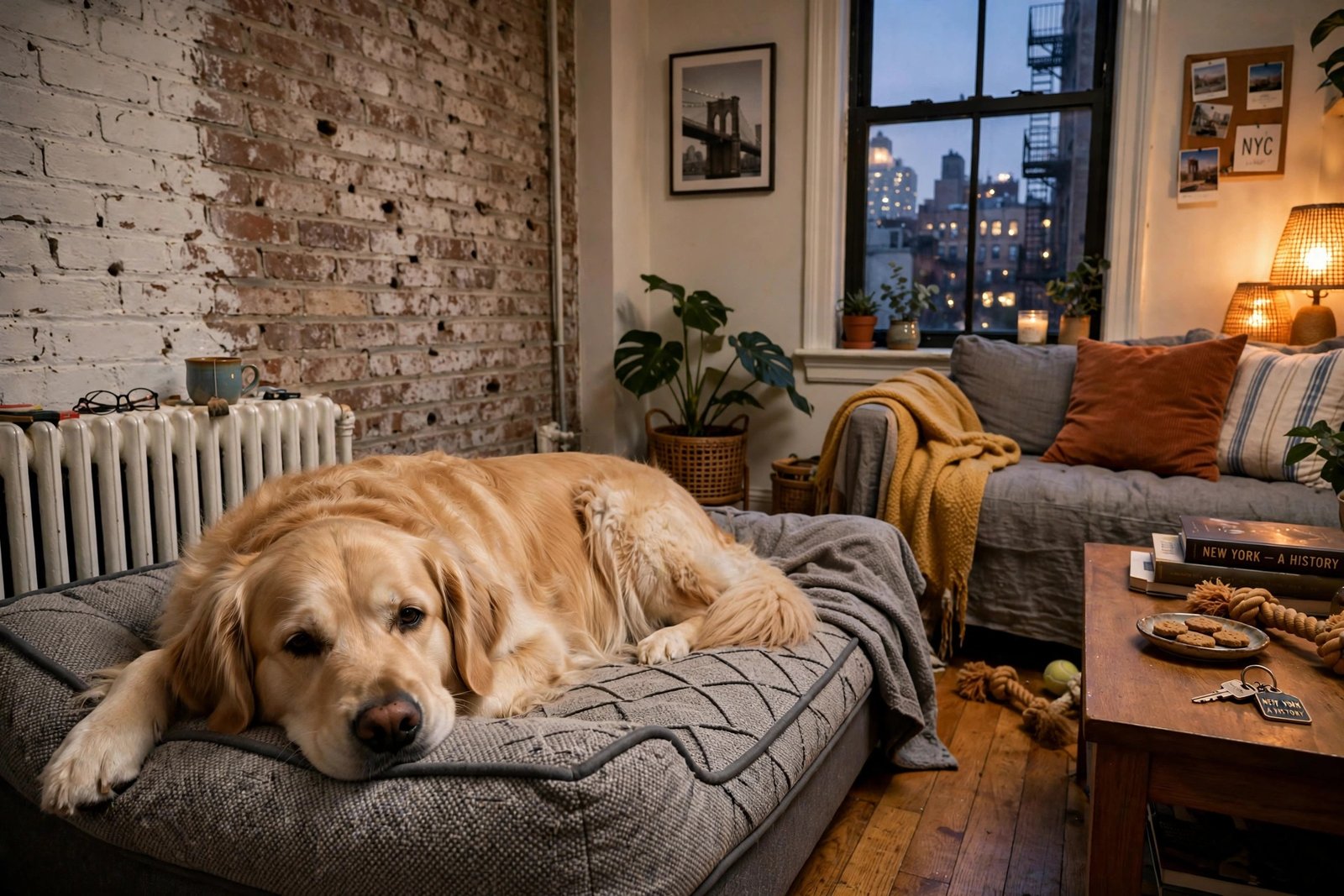
Is it cruel to keep a big dog in an NYC apartment? It is one of the most judgmental questions in city pet culture — asked with a raised eyebrow at the Great Dane in a 600-square-foot studio. The instinct behind the question is understandable: big dogs need space, right? But the answer from veterinary behaviorists is more nuanced: what matters is not the size of your apartment, but the size of your dog’s life. A big dog with an engaged owner in a small apartment thrives; a big dog neglected in a suburban house with a yard suffers. Here is what actually determines whether it is fair.
What dogs actually need (it is not square footage)
Canine welfare science is clear about what dogs need: physical exercise (breed-appropriate intensity and duration), mental stimulation (training, puzzles, novel experiences), social interaction (with humans and other dogs), a comfortable resting space, and predictable routine. Notice what is not on the list: a big apartment. Dogs do not use space the way humans do — a dog’s “territory” is wherever its people are. A Great Dane asleep on its bed for 16 hours a day uses exactly one dog-bed of space whether that bed sits in a studio or a mansion. What big dogs need is output — exercise, engagement, and enrichment — not floor area. The ASPCA’s general pet care guidance emphasizes exercise and enrichment over living space for exactly this reason.
The honest challenges of big dogs in small apartments
None of this means it is effortless. The real challenges:
Exercise logistics: a young Labrador needs 1–2+ hours of real exercise daily — not a stroll around the block, but running, fetching, swimming, or hiking. In NYC, that means committed daily trips to dog runs, parks, or daycare. If your schedule cannot deliver this consistently, a high-energy big dog in an apartment is unfair — to the dog and to you.
Space logistics: a 150-pound dog in a 500-square-foot apartment is a physics problem. Narrow hallways, small elevators, and tight kitchens become obstacle courses. Crate training (essential for apartment dogs) requires a crate the size of a loveseat. Measure your space against the dog’s adult size honestly.
Noise and neighbors: big dogs have big barks, big footsteps, and big zoomies. Thin walls plus a bored big dog equals neighbor wars. Training (especially “quiet” and settle commands) is not optional — it is a lease-preservation strategy.
Building restrictions: many NYC buildings cap dogs at 25–50 lbs. Finding big-dog-friendly housing narrows your options and may cost more. Confirm weight limits in writing before adopting.
Costs: everything scales with size — food, medication doses, crates, boarding. Budget accordingly (typically $5,000–$10,000+ per year for a large dog in the city).
Which big dogs actually suit apartment life
Counter-intuitively, some giant breeds are better apartment dogs than small ones. Great apartment big dogs: Greyhounds (45-mph couch potatoes — famously lazy indoors), Great Danes (gentle giants who sleep 16+ hours), Mastiffs and Bernese Mountain Dogs (calm, low-energy indoors), and senior dogs of any large breed (a 7-year-old Lab is a different animal than a 1-year-old). Tough apartment big dogs: young Border Collies, Belgian Malinois, Jack Russell Terriers (small but manic), and adolescent Huskies — breeds whose exercise needs exceed what most working owners can provide. The pattern: energy level matters more than size. The AKC’s breed profiles rate energy levels honestly — cross-reference before choosing. A calm 120-pound dog fits apartment life better than a hyperactive 20-pound one. Match the dog’s energy to your lifestyle, not the dog’s size to your floor plan. And set up your space smartly — making a small apartment feel bigger benefits both species, and pet-friendly flooring survives big-dog nails.
The daily routine that makes it work
Successful big-dog apartment owners run a non-negotiable routine: morning: 45–60 minutes of real exercise before work (dog run, long walk, fetch in the park) — a tired dog is a good apartment dog. Midday: walker or daycare for dogs alone 8+ hours (non-negotiable for young big dogs). Evening: second exercise session plus training (15 minutes of training tires a dog more than an hour of walking — mental work counts double). Weekends: the big adventures — hiking in the Hudson Valley, swimming, long park days. Daily enrichment: puzzle feeders, frozen Kongs, snuffle mats, and chew toys for the hours between. A big dog whose physical and mental needs are met is a calm, happy apartment companion. One whose needs are not met will redesign your apartment with their teeth. Exercise is health for both of you — 30 minutes of daily walking is the human baseline; your big dog needs you to exceed it.
The ethical checklist: is it fair for YOUR situation?
Answer honestly: 1. Can you provide 1–2 hours of real exercise daily, in all weather, for 10+ years? 2. Can you afford midday walking/daycare ($400–$700/month in NYC)? 3. Does your building allow the dog’s adult weight, confirmed in writing? 4. Is your apartment physically workable (elevator or ground floor for a giant breed; space for a proper crate)? 5. Are all household members on board for a decade-plus commitment? 6. Do you have a plan for the dog’s senior years (stairs become hard; vet costs rise)? If the answers are yes, a big dog in your apartment is not cruel — it is a wonderful life for a dog that might otherwise wait months in a shelter. If several answers are no, the kindest choice is a lower-energy or smaller dog that fits your reality. Cruelty is not about square footage — it is about unmet needs.
Conclusion
Keeping a big dog in an NYC apartment is not cruel when the dog’s real needs — vigorous daily exercise, mental stimulation, social interaction, training, and companionship — are fully met. It is unfair when a high-energy dog gets two short leash walks a day and 22 hours of boredom in a studio. The apartment is not the variable; the owner is. Choose a breed whose energy matches your lifestyle, commit to the daily exercise routine, budget for walking and training, and confirm your building allows it. Do that, and your big dog will live a richer life in your small apartment than most dogs live in big suburban houses.
Frequently Asked Questions
What is the best big dog breed for apartment living?
Greyhounds, Great Danes, Mastiffs, and Bernese Mountain Dogs — all large but famously calm indoors. Senior dogs of any large breed are also excellent apartment companions.
How much exercise does a big dog need in an apartment?
Typically 1–2+ hours of real exercise daily (not just leash walks — running, fetching, dog parks, or daycare), plus mental stimulation through training and puzzle toys.
Do NYC apartments allow big dogs?
Many do, but weight limits (commonly 25–50 lbs) are widespread. Always confirm pet policies including weight limits in writing before signing a lease or adopting.
Is it bad to crate a big dog in an apartment?
No — properly introduced crate training gives dogs a safe den space and prevents destructive behavior. The crate must be large enough for the dog to stand, turn, and lie comfortably, and should never be used as punishment.
Can a big dog be happy without a yard?
Absolutely. Dogs do not exercise themselves in yards — they wait by the door for their humans. Structured exercise (walks, runs, parks, daycare) matters infinitely more than unsupervised yard access.