Finding a trustworthy mechanic in New York City feels like dating in the city — everyone has a horror story, the good ones are taken, and the search itself is exhausting. But the stakes are higher than a bad date: the wrong shop can cost you thousands in unnecessary repairs, while the right one keeps your car safe for years at a fraction of dealership prices. This guide covers how to find an honest mechanic in NYC, how to vet them, and how to build a relationship that saves you money for as long as you own the car.
Why NYC makes this harder (and more important)
New York’s car culture is unique: most drivers use their cars less (which means problems develop from sitting, not just mileage), street parking exposes cars to extra wear (potholes, bump-and-run damage), and shop rents are astronomical — which pressures some shops to upsell aggressively to cover overhead. Dealership service centers in the metro area charge $180–$250+/hour in labor; good independents charge $100–$150/hour for the same work. The savings from finding the right independent shop are enormous over a car’s lifetime. But the density that makes NYC hard also helps: with thousands of shops, the excellent ones exist — you just need a system for finding them. The same vetting instincts apply to any repair relationship — our guide to what to look for when buying a used phone online covers the trust-verification mindset that works for mechanics too.
Where to look: the best sources for honest shops
1. Personal referrals (still king). Ask car-owning friends, coworkers, and neighbors — specifically: “Who do you trust with your car, and what did they charge last time?” One detailed referral beats fifty anonymous reviews.
2. AAA-approved shops. AAA’s Approved Auto Repair network (aaa.com/autorepair) inspects facilities, requires technician certifications, and offers dispute resolution — a meaningful filter in a crowded market.
3. ASE certification lookup. The National Institute for Automotive Service Excellence certifies technicians by specialty. A shop advertising ASE-certified techs (especially ASE Master Technicians) signals professional standards. It is not a guarantee of honesty, but dishonest shops rarely invest in certification.
4. Neighborhood forums and local groups. NYC neighborhood Facebook groups, Reddit’s r/nyc and borough subs, and Nextdoor threads contain gold — “best mechanic in Astoria?” posts get dozens of specific, passionate answers. Look for shops mentioned repeatedly over years, not just once.
5. Reviews — read the negative ones first. Google and Yelp reviews are useful if you read them correctly: ignore the star average and read the 1-star and 2-star reviews for patterns (upselling? surprise charges? communication failures?). A shop with 4.6 stars and thoughtful owner responses to complaints is often better than a 5.0-star shop with fifty generic reviews.
The vetting test: your first visit
Do not commit your car to major work on visit one. Instead, run a low-stakes test: an oil change, a state inspection, or a pre-purchase inspection on a car you are considering buying. During that visit, evaluate:
Do they explain or lecture? Good mechanics explain what is wrong, show you the worn part, and offer options. Bad ones use jargon as a weapon and pressure immediate decisions.
Do they prioritize? An honest shop triages: “Your brakes need doing now; the cabin filter can wait; the transmission fluid is fine until next year.” A shop that declares everything urgent is selling, not diagnosing.
Do they put it in writing? Written estimates with parts and labor itemized, before work begins. Verbal quotes that grow 40% at pickup are the oldest trick in the book.
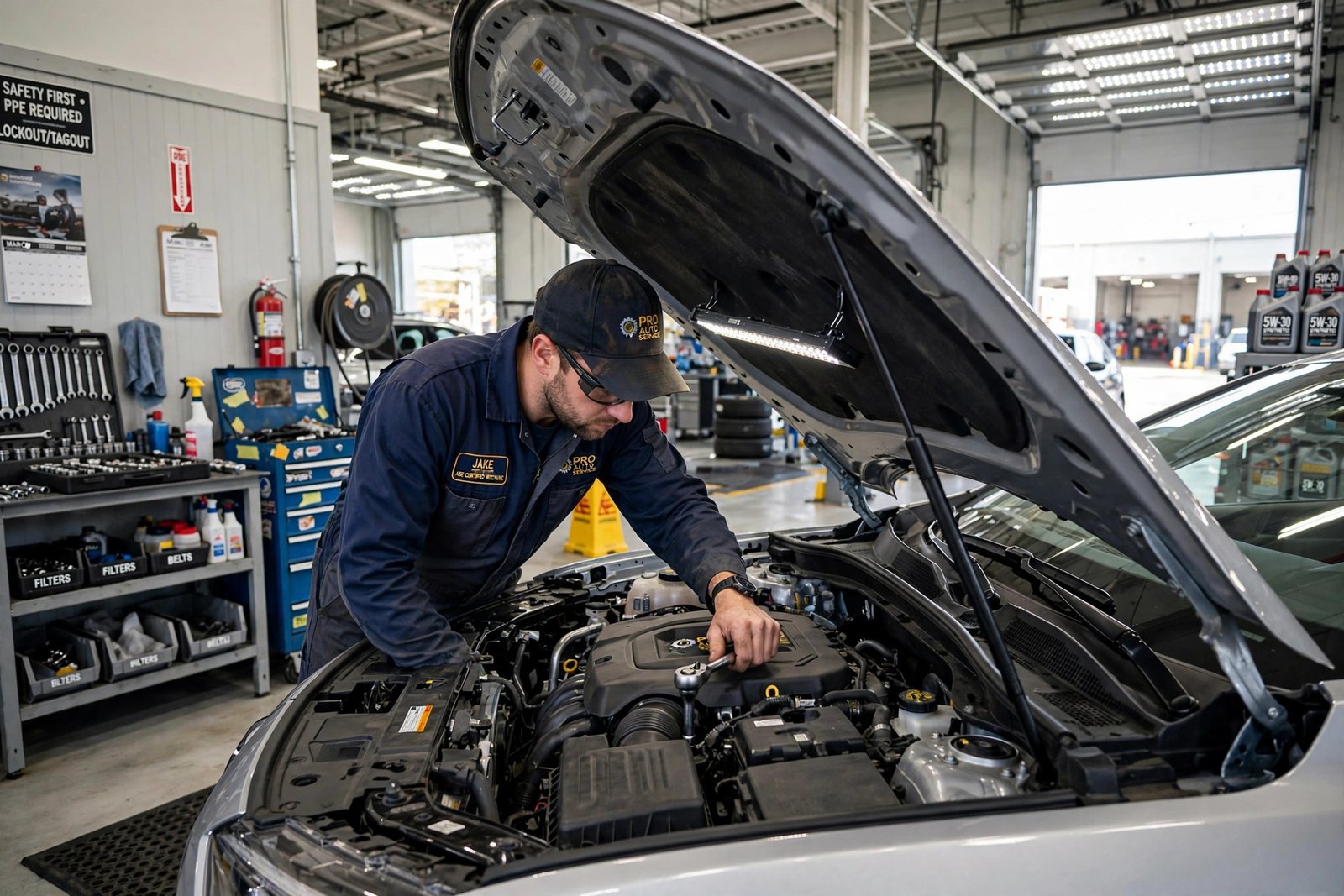
Is the shop clean and organized? Not showroom-clean — it is a garage — but organized. Chaos in the shop often means chaos in the billing.
Do they answer “can I see the old parts?” with ease? Honest shops save replaced parts for your inspection without blinking. Evasion is a red flag.
Red flags: the upsell playbook to recognize
The fluid flush frenzy: “Your [transmission/brake/power steering] fluid is dirty, needs a flush — $200.” Sometimes legitimate; often a high-margin upsell. Check your owner’s manual for actual service intervals — if the manual says 100,000 miles and you have 40,000, decline.
The premature replacement: “Your [tires/brakes/battery] are at 50% — better replace now.” Fifty percent worn means fifty percent remaining. Ask for measurements (tire tread depth in 32nds, brake pad thickness in mm) and decide based on data.
The vague diagnosis: “Could be the alternator, could be the starter — let us replace both.” A good mechanic diagnoses before replacing. Paying for a proper diagnostic ($100–$150) is cheaper than parts-guessing.
The captive audience: shops that will not release your car until you authorize additional work, or that perform unauthorized work and bill you. Both are illegal in New York — the NY Department of State’s consumer protection resources cover your rights with repair shops.
Cash-only, no paperwork: legitimate shops take cards and provide invoices. Cash-only with no receipt means no warranty, no recourse, and often no insurance.
Building the relationship (the long game)
Once you find a good shop, invest in the relationship: be a regular (consistency gets you honest advice and scheduling priority), be reasonable (do not haggle every $20 — good will is worth more), communicate clearly (describe symptoms precisely: “grinding noise when braking at low speed” beats “it sounds weird”), and approve work in writing via text or email. A mechanic who knows you and your car’s history will talk you out of unnecessary work — because they want your business for the next decade, not the next invoice. Keep your own maintenance records too: dates, mileage, what was done. It helps the mechanic diagnose faster and massively boosts resale value. Understanding repair economics helps — what data recovery costs for a broken hard drive illustrates the same principle as car repair: diagnostics first, then targeted fixes, never blind parts-swapping. And for the small stuff, learning basic DIY — like fixing a cracked phone screen yourself teaches the repair mindset — saves hundreds annually on the easy jobs.
Dealership vs. independent vs. chain
Dealerships: best for warranty work, recalls, and complex brand-specific electronics. Most expensive for everything else. Independents: best value for routine maintenance and most repairs — if vetted properly. Chains (Mavis, Firestone, etc.): convenient and consistent for tires, batteries, and oil changes; quality varies wildly by location for complex work. Specialists: for transmissions, alignments, or European/Japanese specialists — worth seeking for complex jobs on specific makes. Most NYC drivers do best with: a trusted independent for 90% of work, the dealership for warranty/recall items, and a tire shop for tires.
Conclusion
Finding a trustworthy mechanic in NYC takes effort upfront — referrals, review archaeology, certification checks, and a low-stakes test visit — but pays off for years in fair prices and honest advice. Vet with the five-visit test (explain, prioritize, document, organize, transparency), learn the upsell playbook so you recognize it, and then build a long-term relationship with the shop that passes. Your car is one of your most expensive assets; the person who maintains it should be someone you chose deliberately, not whoever was closest when something broke.
Frequently Asked Questions
How do I know if a mechanic is ripping me off?
Warning signs: vague diagnoses, pressure for immediate decisions, verbal-only quotes, refusal to show old parts, and recommended services that contradict your owner’s manual intervals. Always get a second opinion on repairs over $500.
Are dealership mechanics better than independents?
Not inherently. Dealerships excel at warranty work and brand-specific issues but charge $180–$250+/hour. A vetted independent at $100–$150/hour does routine and most complex work equally well for far less.
What certifications should a good mechanic have?
ASE (Automotive Service Excellence) certification, especially ASE Master Technician status. AAA-approved shop status is another meaningful credential in the NYC area.
Should I get a second opinion on car repairs?
Yes for any repair over $500 or any diagnosis you do not fully understand. A $100 diagnostic fee at a second shop routinely saves $500+ in unnecessary work.
How often should I change my oil in NYC driving conditions?
Follow your owner’s manual — typically 5,000–10,000 miles with modern synthetic oil. NYC’s stop-and-go qualifies as “severe” conditions for some manufacturers, so check the severe-service schedule.