
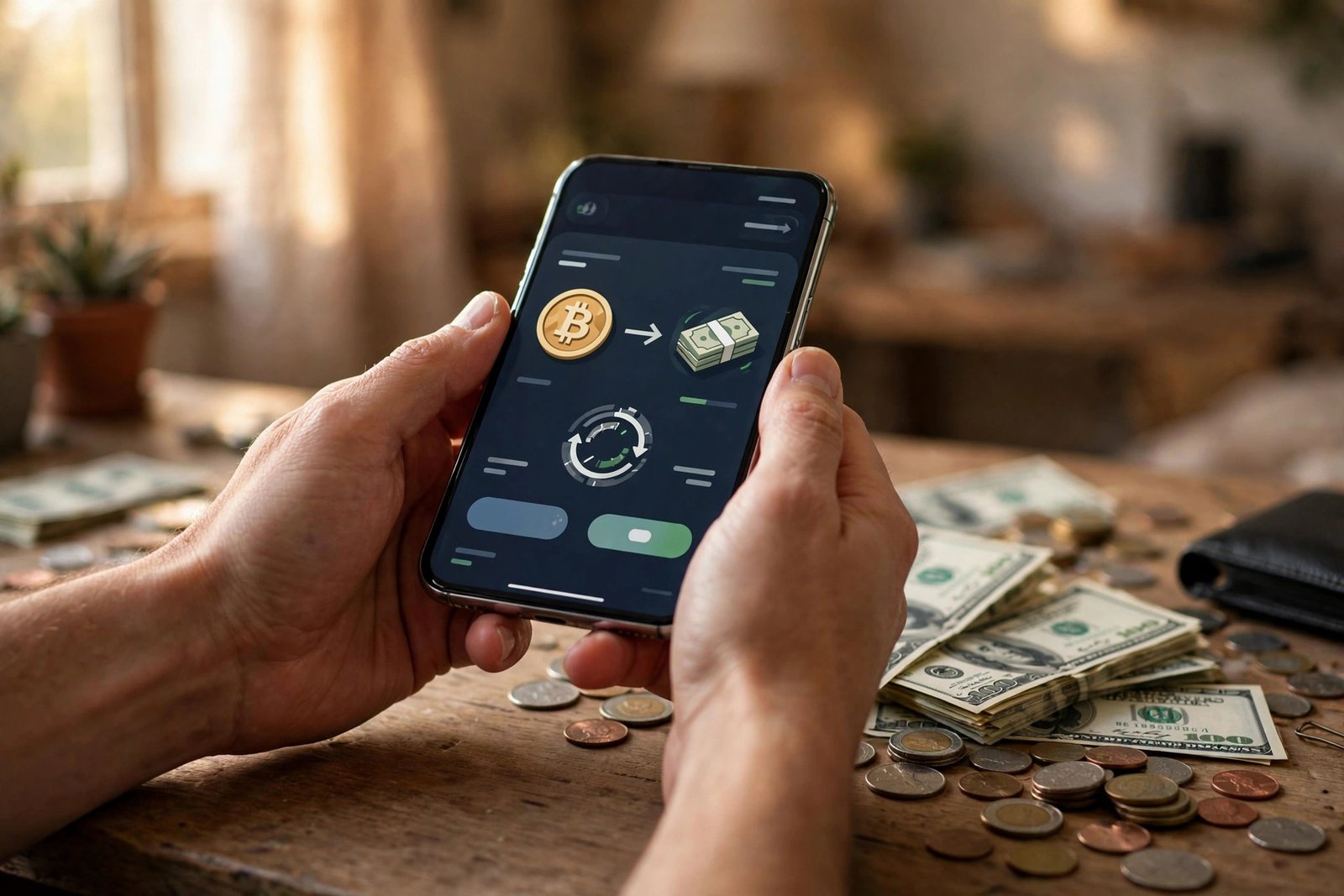
At some point every crypto holder faces the same practical question: how do I turn this digital balance back into dollars I can actually spend? Whether you’re taking profits, covering an emergency, or exiting entirely, selling crypto and getting cash in New York involves choices that affect your fees, your taxes, and how fast the money arrives. The process is straightforward once you know the routes — exchanges, peer-to-peer, crypto ATMs, and debit cards — but each has very different costs and tradeoffs. Here’s the complete guide to cashing out in New York, legally and efficiently.
Route 1: Sell on an exchange, withdraw to your bank (the standard path)
For most New Yorkers, this is the right answer. Sell your crypto for USD on a BitLicensed exchange (Coinbase, Kraken, Gemini, and others serve NY), then withdraw to your linked bank account via ACH (1–5 business days, usually free or cheap) or wire (same-day, $10–30 fee). Total costs typically run 0.5–1.5% in trading fees plus any withdrawal fee — by far the cheapest legitimate route for amounts over a few hundred dollars.
The mechanics: verify your identity fully before you need the money (don’t wait until an emergency — verification can take days), link and verify your bank account in advance, and understand the exchange’s withdrawal limits (daily/monthly caps that can be raised with additional verification). Sell orders can be market (instant, slight price uncertainty) or limit (your price, may not fill). For large amounts, consider selling in tranches to avoid moving the price on thin order books — though on major exchanges this matters only for very large trades.
Route 2: Peer-to-peer sales (for flexibility and privacy tradeoffs)
P2P platforms connect you directly with buyers: you transfer crypto, they send dollars via bank transfer, cash deposit, or even in-person cash. Advantages: negotiable prices, payment-method flexibility, and availability for coins thin on exchanges. Disadvantages: higher scam risk, slower process, and the personal-safety considerations of meeting strangers with valuable assets.
If you go P2P, use platforms with escrow and reputation systems, never release crypto before payment confirms (bank transfers can be reversed — wait for full clearance), and meet in public places (many NYPD precincts offer their lobbies as safe exchange zones for online transactions). For most sellers, the exchange route’s safety and simplicity beat P2P’s marginal benefits — reserve P2P for situations exchanges don’t serve.
Route 3: Crypto ATMs (fast, expensive, use sparingly)
NYC has plenty of crypto ATMs, mostly for buying — but many support selling too: you send crypto to the machine’s wallet and receive cash on the spot. The appeal is obvious: instant cash, no bank account needed, minimal verification for small amounts. The cost is brutal: fees of 7–15% are normal, plus unfavorable exchange rates baked into the quote. On a $1,000 sale, you might net $850–930.
Use ATMs only for small, urgent amounts where speed justifies the haircut. Verify the machine’s operator reputation, count the cash before leaving, and keep the receipt — ATM transactions still create tax obligations. And be aware that scammers love directing victims to crypto ATMs; if anyone is pressuring you to sell via ATM and send cash somewhere, you’re being robbed — hang up.
Route 4: Crypto debit cards (spend without selling first)
Several companies offer debit cards that let you spend crypto directly: at purchase time, the card sells just enough crypto to cover the transaction. It’s the smoothest “crypto to real life” bridge for ongoing spending — no manual selling, no bank transfers. The downsides: every swipe is a taxable sale (tracking cost basis across hundreds of coffee purchases is a nightmare), fees and spreads apply per transaction, and you’re trusting the card issuer’s custody.
For occasional use they’re convenient; as a primary cash-out method they’re tax-inefficient. If you go this route, use it for planned larger purchases rather than daily spending, and keep meticulous records.
The tax bill: the part everyone forgets
This is critical: selling crypto for cash is a taxable event. The IRS treats crypto as property — every sale triggers capital gains or losses measured from your cost basis. Held over a year: favorable long-term rates. Under a year: taxed as ordinary income. New York State taxes the gains too, with no special crypto treatment.
Start tracking now if you haven’t: every purchase date, amount, and price (your cost basis), every sale, and every crypto-to-crypto trade (also taxable). Exchanges provide transaction histories — download them annually. For significant amounts, crypto tax software or a CPA experienced with digital assets pays for itself many times over. The IRS guidance on virtual currency transactions is the authoritative reference, and handling taxes for a freelance business covers similar record-keeping disciplines that transfer directly. Underreporting is the expensive mistake — the IRS has made crypto enforcement a priority, and exchanges report to them.
Timing and strategy: when and how much to sell
A few strategic notes. Don’t sell everything in a panic during a crash unless you need the money — the worst crypto decisions are emotional ones. Consider tax-loss harvesting: selling losers to offset gains is legitimate tax strategy (though wash-sale rules may apply differently to crypto — confirm current rules with a professional). If you’re cashing out a large position, spreading sales across tax years can keep you in lower brackets.
And keep perspective on currency mechanics generally — exchanging currency before a trip teaches the same lesson: conversion always costs something, so minimize the number of conversions and choose the cheapest reliable channel. The Consumer Financial Protection Bureau offers plain-language guidance on money-transfer rights that applies to the fiat side of every cash-out.
Conclusion
Selling crypto and getting cash in New York comes down to: use a BitLicensed exchange and bank withdrawal for the cheapest, safest route; consider P2P only for special cases; treat crypto ATMs as expensive emergency tools; understand that every sale is taxable; and keep records from day one. Plan the cash-out before you need it — verified identity, linked bank, understood tax picture — and converting crypto to spendable dollars becomes as routine as any other financial transaction. The blockchain part is the adventure; the bank-transfer part should be boring, predictable, cheap, and fully documented for tax season.
Frequently Asked Questions
How do I convert crypto to cash in New York?
Sell on a BitLicensed exchange (Coinbase, Kraken, Gemini) and withdraw USD to your bank via ACH or wire. This is the cheapest and safest route for most amounts.
How long does it take to get cash after selling crypto?
ACH bank withdrawals take 1–5 business days; wires arrive same-day for a fee. Crypto ATM sales pay cash instantly but cost 7–15% in fees.
Do I pay taxes when I sell crypto for cash?
Yes — every sale is a taxable event. Gains are taxed as capital gains (favorable long-term rates if held over a year), and New York State taxes them as well. Keep records of every transaction’s cost basis.
Can I sell crypto for cash without a bank account?
Crypto ATMs and some P2P cash deals don’t require bank accounts, but they cost significantly more in fees and carry higher risks. For regular cash-outs, a bank account is strongly preferable.