Phil Collins — The Drummer Who Outsold Them All: A Fortune in Full
Written by admin
Published November 24, 2026
Reading time 8 minutes
The Numbers Born first, net worth second — the full record sits in the “By the Numbers” table after the career section.
Phil Collins — The Drummer Who Outsold Them All: A Fortune in Full
The In the Air Tonight Star With Chiswick Roots
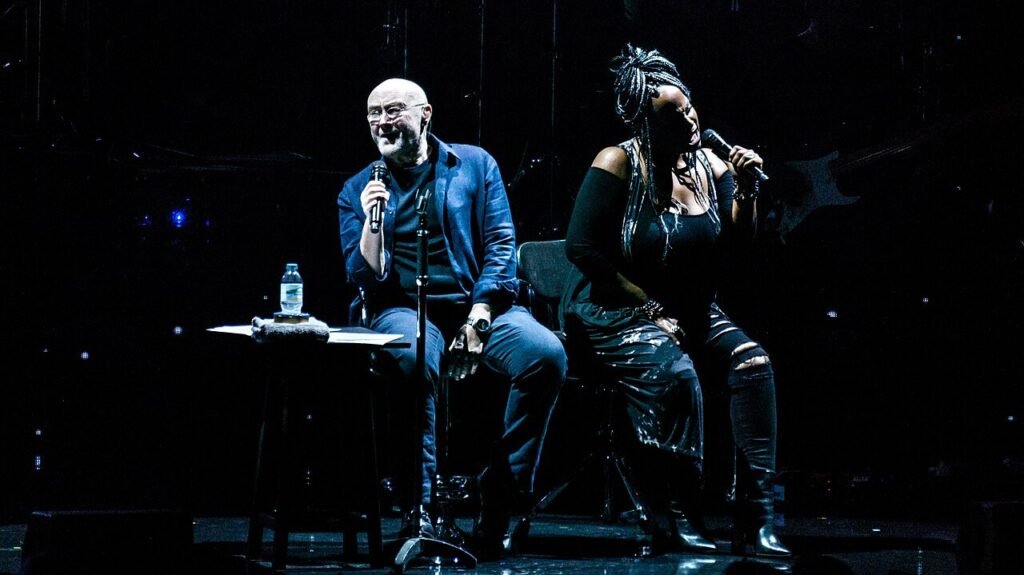
Phil Collins is the drummer who became, by stages nobody planned, one of the best-selling recording artists in history: the man who took over Genesis from behind the kit, then built a solo career in the 1980s that matched the band’s, then did both at once. On 14 November 2026, in Los Angeles, the Rock & Roll Hall of Fame inducted him as a solo artist — his second induction — arriving with two canes, not performing, and telling the room, in the words reported from the night: “I’m a well man now.”
He is 75, the father of five children, and living principally in Switzerland under the 24-hour care arrangements he has described publicly. His health, his retirement from drumming and his own sober account of both are part of the verified record, and this profile tells them as he has told them. This profile attributes the fortune — among the largest in this batch — to its published source, and records the catalogue transaction of 2022 as what it was: a joint deal, not a personal price.
The In the Air Tonight Star, Measured in Facts
| The In the Air Tonight Star, Measured in Facts | The Record |
|---|---|
| Born | 30 January 1951, Chiswick, London |
| Net Worth | $350 million — Celebrity Net Worth |
| Age | 75 |
| Height | 5 ft 6 in (1.68 m) |
| Weight | No reliable published figure exists |
| Partner | No publicly confirmed current partner |
| Children | Five — Joely, Simon, Lily, Nicholas and Matthew |
| Parents | Greville Philip Austin Collins (died 1972); Winifred June Collins, née Strange (died 2011) |
| @officialphilcollins |
A Chiswick Childhood Shapes Phil Collins
Philip David Charles Collins entered the world on 30 January 1951 in Chiswick, London. His father, Greville Philip Austin Collins, worked in insurance and died in 1972; his mother, Winifred June Collins, née Strange, worked as a theatrical agent’s assistant and died in 2011. He was a child performer — stage work in London productions as a teenager, including the role of the Artful Dodger in Oliver! — before the drums took over; the pattern set for this profile records that early stage work without cataloguing it, and the career in this profile begins where his own does: with a kit, in 1970.
The route was an advertisement in Melody Maker: Genesis, a young progressive band, needed a drummer. Collins joined in 1970, aged nineteen, and spent five years as the engine of one of the most musically demanding bands in Britain before the band’s singer left and the auditions for a replacement failed — at which point the drummer, who had sung backing vocals throughout, stepped forward.
The Career That In the Air Tonight Set in Motion
Two full careers, run in sequence and then simultaneously, plus the session work that made him the sound of a decade.
1976 — A Trick of the Tail
With Collins as singer, Genesis released A Trick of the Tail (1976) and Wind & Wuthering (1976), confounding predictions of collapse, and moved through the decade toward a leaner sound: …And Then There Were Three… (1978) brought their first hit single, and Duke (1980) and Abacab (1981) completed the transition to arena scale.
1981 — Face Value
His solo debut Face Value (1981), made during a break in the band’s schedule and carrying “In the Air Tonight” — whose drum break became one of the most famous sounds in recording — outsold the band’s albums and began the double career. Hello, I Must Be Going! (1982) and No Jacket Required (1985) made him, alongside his band work, the dominant male solo artist of the mid-1980s; “Against All Odds” and “One More Night” are among the decade’s defining singles, and in 1985 he played both the London and Philadelphia stages of Live Aid on the same day, drumming for others as well as performing his own set.
1991 — We Can’t Dance and the Departure
Genesis’s We Can’t Dance (1991) was the last studio album of his tenure; he left the band in 1996 to concentrate on solo work, including the big-band project and his composition work that brought an Academy Award in 2000 for a song written for an animated feature. Both Sides (1993), Dance into the Light (1996) and Testify (2002) continued the solo catalogue, and Going Back (2010) closed it with a covers record made as his physical capacity to drum was already narrowing.
2022 — The Last Domino and the Catalogue Sale
Genesis reunited for The Last Domino? tour of 2021–22, with Collins singing seated and his son Nicholas on drums; the final concert, in London in March 2022, closed the band’s performing history. The same year, Collins and his bandmates Tony Banks and Mike Rutherford sold their catalogue interests to Concord in a deal reported at $300 million — a joint transaction for three men’s work, recorded here as exactly that and never as Collins’s personal proceeds.
1985 — The Sound of the Decade
The middle 1980s made Collins ubiquitous in a way no single career explains: alongside the solo albums and the band’s Invisible Touch era — Genesis’s biggest album followed in 1986 — he produced and drummed for other artists, played sessions across the industry, and became, through the gated-reverb drum sound he had stumbled on at the decade’s start, the most imitated drummer in pop. The ubiquity had a ledger: session fees, production points and two full careers of royalties compounding simultaneously, which is how a drummer’s fortune reaches the level the table records.
1999 — The Oscar and the Big Band
His late-1990s work diversified the record: a big-band project that toured the jazz repertoire he had grown up on, and composition for an animated feature that brought the Academy Award for Best Original Song in 2000 — an honour that placed him in the small company of artists with Grammy, Oscar and Hall of Fame honours across two separate careers. The stage adaptations of his animated-feature work extended the catalogue’s earning life into theatre in the following decade.
2016 — The Return That Wasn’t a Comeback
Collins published his autobiography in 2016 and returned to live performance with the Not Dead Yet tour of 2017–19 — the title his own joke about his condition — playing arenas seated, with Nicholas on drums for parts of the show and the drum stool’s succession made visible on stage. The tour grossed at a level that confirmed the catalogue’s live value into his late sixties, and it is the earnings period behind Forbes’ 2020 count recorded in the fortune section.
The Marriage That Anchors Phil Collins
Collins married three times, and all three marriages have ended: to Andrea Bertorelli (1975–1980), to Jill Tavelman (1984–1996), and to Orianne Cevey (1999, divorced in 2006 with the settlement reaching completion in 2008; the couple reconciled in 2016 and separated finally in 2020). He has no publicly confirmed current partner. A woman named in some coverage, Lindsay Evans, is his assistant, and this profile does not promote staff into partners.
He has five children: Joely, who entered the world during his first marriage and whom he adopted — this profile counts adopted children as his, as the programme’s rule requires; Simon, his son with Bertorelli, himself a musician; Lily Collins, his daughter with Tavelman, an actor with a major career of her own; and Nicholas and Matthew, his sons with Cevey. Nicholas’s place in the story is public as well as private: he played drums for Genesis on the final tour, in the seat his father vacated, to his father’s stated pride.
The Wealth Behind the In the Air Tonight Years
Celebrity Net Worth puts Phil Collins’s net worth at $350 million, in an update of 6 November 2026. Forbes’ contribution to the record is earnings — $45 million counted in 2020, a touring year. The composition of the fortune is two catalogues’ worth of writing and performance: as Genesis’s co-writer across fifteen studio albums and as a solo artist whose 1980s run sold in the hundreds of millions, he holds one of the deepest positions in British popular music.
The Concord transaction of 2022 — reported at $300 million for the combined catalogue interests of Collins, Banks and Rutherford — is the fortune’s largest single documented event, and its correct description matters: a joint sale, three sellers, terms undisclosed. It sits in this profile beside, not inside, the personal figure. The fellow performer with whom he shares the era’s defining charity-concert history — the man who played the same two stages on the same day in 1985 — has his own count set out in Sting’s net worth profile; the two men built their fortunes in parallel, on the same decade’s terms.
Homes in Cevey and Beyond
His best-documented property transaction is the Miami Beach mansion bought in 2015 for a reported $33 million and sold in 2021 for a reported $40 million — a transaction entangled with the final separation from Cevey and reported at length at the time. His principal home is in Switzerland, in the Lake Geneva area, where he has based himself for decades. No source has published a verified full inventory of his property.
The Hall of Fame induction of November 2026 was his second — Genesis entered in 2010 — making him one of the small number of artists honoured twice, once for the band and once alone. He attended in person at the Peacock Theater in Los Angeles, accepted without performing, and gave the evening its most-quoted line. The record he leaves the stage with is complete in a way few are: the work finished, the honours doubled, the account given by the man himself.
His children carry the name forward in public: Lily as one of the most visible actors of her generation, Nicholas as the drummer of the final Genesis performances, Simon as a recording artist in his own right. The family record in the table — five children across three marriages — is, like the career, larger than the standard shape of a pop life.
Phil Collins in One Last Look
The health record, in his own words across the BBC’s January 2026 interview and the Sunday Times’ August 2026 account: a spinal injury in 2007 damaged the nerves to his hands; five knee operations followed; in April 2024 an episode he links to drinking put him in hospital; he is now sober, receives 24-hour live-in nursing care, and describes drumming as “probably done”. At the Hall of Fame induction in November 2026 he attended in person, with two canes, and did not perform. This profile prints that record because he has made it public himself, in detail, as the closing chapter of the performing story.
The fortune, $350 million attributed, belongs to the drummer who outsold them all — the session player of 1970 who ended up owning pieces of two of the biggest catalogues in the world. The performance is finished. The count stands.