Paul McCartney — The Richest Songbook in the Business, Weighed
Written by admin
Published November 24, 2026
Reading time 8 minutes
The Numbers Born first, net worth second — the full record sits in the “By the Numbers” table after the career section.
Paul McCartney — The Richest Songbook in the Business, Weighed
Meet Paul: Liverpool Roots and The Beatles Begin Fame
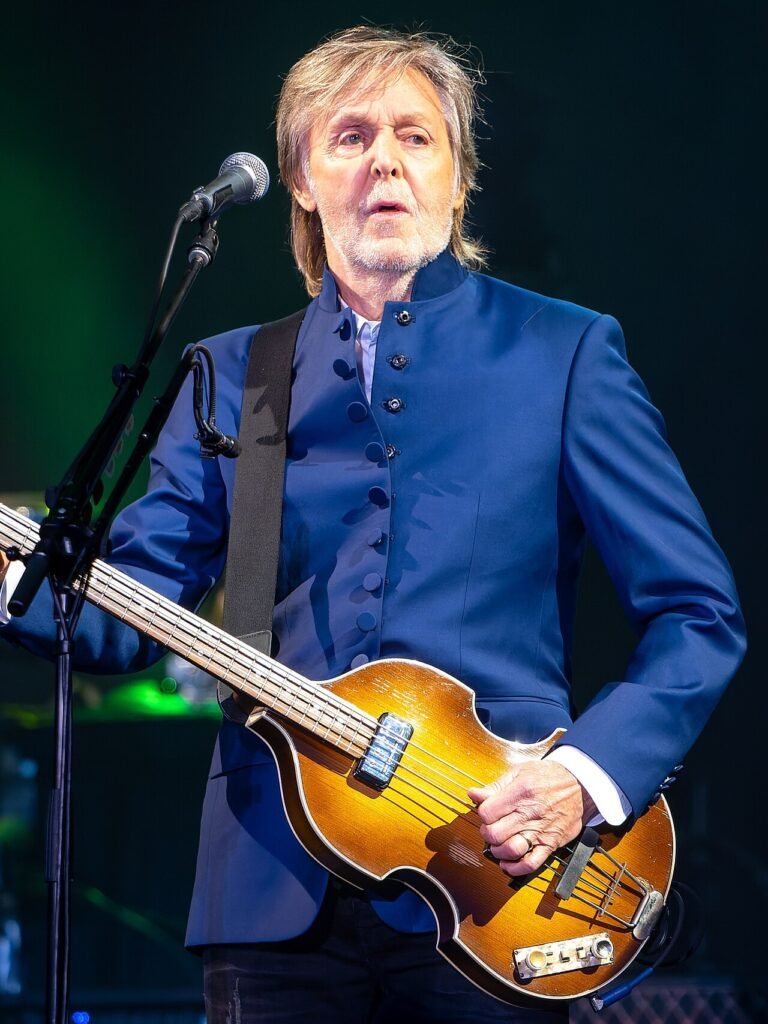
Paul McCartney, at 84, is the most successful songwriter in the history of popular music by the industry’s own measures: more number-one singles as a writer than anyone else, a catalogue that has never left the charts in sixty years, and a live career that still fills stadiums on several continents. The Beatles made him immortal at twenty-five; he has conducted everything since — Wings, the solo decades, the classical works, the tours — in the long afterlife of a fame most artists would consider a complete career by itself.
The money is correspondingly historic, and correspondingly argued over: the trackers disagree, and one of the famous figures is a combined household number that nobody must ever print as his alone. This profile keeps the accounts separate — the Liverpool roots, the career in years, the family, and the fortune with its flags attached.
The Liverpool Roots Behind The Beatles Begin
James Paul McCartney’s life began on 18 June 1942 at Walton Hospital in Liverpool. His father, Jim McCartney, was a cotton salesman and part-time dance-band musician whose piano stood in the front room; his mother, Mary McCartney, was a nurse and midwife whose death from cancer in 1956, when Paul was fourteen, is the wound at the center of the family’s story and, by his own account, part of the bond that later drew him to John Lennon, who lost his mother two years after. His brother Michael — later known professionally as Mike McGear of The Scaffold — is the sibling in the record, a photographer and performer in his own right.
The education was Liverpool grammar school and the city’s skiffle scene; the formation was the Quarrymen, the schoolboy group he joined in 1957 after meeting Lennon at a church fete, impressing him by knowing the words to the songs and how to tune a guitar. Hamburg residencies, a Cavern residency and Brian Epstein’s management followed in the standard sequence — standard only in retrospect. His birthday, 18 June, makes him 84, and the geography of the roots still maps his property holdings: Liverpool and London in England, a farm in Sussex, and long-held American bases.
From the First Jobs to The Beatles Begin
1962 — The Beatles Begin
The Beatles’ recording career opened with “Love Me Do” in 1962 and detonated within eighteen months into a global phenomenon for which no precedent existed. He established McCartney’s role — bassist, co-writer, the melodic counterweight in the Lennon-McCartney partnership — immediately, and it never changed.
1967 — Sgt. Pepper
Sgt. Pepper’s Lonely Hearts Club Band, largely McCartney’s concept, redefined what an album could be and fixed the band at the center of the decade’s culture. The same year brought Epstein’s death, the beginning of the business unravelling that would end the group.
1969 — Abbey Road
Abbey Road, with its McCartney-led closing medley, was the last album the four recorded together — a farewell assembled, fittingly, from fragments into a single long work.
1970 — McCartney and the Split
His solo debut McCartney, recorded at home, arrived with the announcement that he was leaving the Beatles — the first solo career launched from the wreckage, and for several years the least fashionable of the four.
1973 — Band on the Run
Wings, formed with his wife Linda, answered the critics with Band on the Run (1973), recorded in Lagos under chaotic conditions and now ranked among the great albums of the decade. Wings toured the world and, for a period in the mid-1970s, rivalled his old band commercially.
1980 — McCartney II
The experimental, home-recorded McCartney II opened a solo decade of collaborations — with Stevie Wonder, with Michael Jackson — and steady stadium-scale success, shadowed at its start by Lennon’s murder in December 1980.
1982 — Tug of War
Tug of War, reuniting him with producer George Martin, produced “Ebony and Ivory” and the Lennon tribute “Here Today”, and stands as the critical peak of the solo eighties.
1989 — Flowers in the Dirt and the Return to Touring
Flowers in the Dirt, written partly with Elvis Costello, launched his return to world touring after a decade away — the beginning of the modern live career that still continues and that underwrites the present fortune.
1997 — Flaming Pie
Flaming Pie, made in the afterglow of the Beatles’ Anthology project, was his strongest-reviewed album in years. Linda McCartney died the following year, closing the partnership that had structured his adult life.
2018 — Egypt Station
Egypt Station gave him his first number-one album in the United States in thirty-six years — at seventy-six. A lockdown-made third home-recorded album, McCartney III, followed in 2020, and the stadium tours of the 2020s have played to some of the largest audiences of his career.
At Home in Private: Paul and Nancy Shevell
McCartney’s wife is Nancy Shevell, an American businesswoman whom he married in London on 9 October 2011. His first marriage, to Linda Eastman in 1969, lasted until her death in 1998 and was famous in its day for its ordinariness — she joined his band, raised the children on tour, and anchored the Sussex farm life he still keeps. His second marriage, to Heather Mills (2002–08), ended in a divorce whose settlement filled the newspapers of the time.
His five children are Heather — Linda’s daughter from her first marriage, adopted by McCartney — Mary, a photographer; Stella, the fashion designer whose label is a global business in its own right; James, a musician; and Beatrice, the youngest, from the second marriage, whose upbringing has stayed almost entirely private. The family is large, accomplished and mostly self-propelled; his Instagram, @paulmccartney, mixes archive photographs, tour life and family anniversaries in the relaxed proportion of a man with nothing left to promote except the work itself.
Every Key Fact About Paul, Side by Side
| Every Key Fact About Paul, Side by Side | The Record |
|---|---|
| Born | 18 June 1942, Walton Hospital, Liverpool, England |
| Net Worth | Disputed: Forbes $1.4 billion (individual); Celebrity Net Worth $1.2 billion; a Sunday Times figure of £1.055 billion is a combined household figure (see The Fortune, Counted) |
| Age | 84 |
| Height | 5 ft 11 in (1.80 m) |
| Weight | No reliable published figure exists |
| Wife | Nancy Shevell (married 9 October 2011) |
| Children | Five: Heather (adopted), Mary, Stella, James and Beatrice |
| Parents | Jim McCartney (died 1976) and Mary McCartney (died 1956) |
| Siblings | One brother, Michael (Mike McGear) |
| @paulmccartney |
Counting a Fortune Nobody Agrees On: Paul
The figures require their flags, and here they are. Forbes lists Paul McCartney at $1.4 billion (November 2026), an individual figure. Celebrity Net Worth puts him at $1.2 billion. The Sunday Times Rich List’s 2026 figure of £1.055 billion — following £1.0 billion in 2024 and £1.025 billion in 2025 — combines McCartney and Shevell in one figure, and this profile flags it as combined at every mention, never presenting it as his alone. Forbes has separately valued his company MPL Communications, the publishing house he built from the 1960s by buying catalogues when musicians were not supposed to, at a minimum of $250 million — the quiet machine inside the fortune, holding rights in thousands of songs beyond his own.
The famous irony of the catalogue story belongs here too. His early collaborations with Michael Jackson, the friend who later outbid him for the Beatles’ own publishing, produced “The Girl Is Mine” and “Say Say Say” — and a business education McCartney has described with rueful humour ever since. His own songwriting, held through MPL and his personal arrangements, is the asset the billion-dollar estimates ultimately rest on.
The Houses Paul Owns, on Record
The property record is long-held rather than traded: the house in Cavendish Avenue, St John’s Wood, bought in the 1960s and still his London base; the farm at Peasmarsh in Sussex, the family home of the Wings years; a ranch in Arizona; and a house in the Hamptons near his wife’s family roots. Purchase prices from the 1960s are historical curiosities rather than valuations, and nobody publishes current appraisals — this profile records the holdings, not invented totals.
Paul’s Cars, as Reported
No authoritative inventory of his cars exists. An Aston Martin DB6 and a Lamborghini 400 GT are the documented period names in profiles of his motoring history; no citable source publishes a fleet list or valuation, and this profile assembles none.
MPL Communications deserves its own paragraph in any honest weighing of this fortune, because it operates on a principle McCartney learned the hard way. The Beatles’ own publishing escaped the band’s control in the 1960s through deals the young musicians barely understood, and McCartney spent the following decades buying what he had once failed to keep: the catalogues of other writers. MPL now administers rights in thousands of songs — standards, show tunes, Buddy Holly’s catalogue among them — and collects on every performance, broadcast and synchronisation of all of them, forever, in every territory. Forbes values the company alone at a minimum of $250 million, and that figure excludes his own songwriting, the Beatles royalties, the touring operation and the property. When the trackers call him a billionaire, they are not really valuing a pop star. They are valuing a publishing house, a touring institution and a songbook, all of which happen to share one owner, one name and one unbroken working life of sixty-four years.
The touring operation in his eighties deserves the same unsentimental reading as the publishing. His stadium shows run three hours, draw on sixty years of repertoire, and gross at levels promoters describe with the vocabulary usually reserved for sporting events. He takes no support act, sells no shortcut packages of consequence, and performs the Beatles songs alongside the solo catalogue in a single continuous argument about authorship. The audiences now span four generations, and a measurable share of them arrive as grandchildren of the first fans — a demographic fact no other living performer can claim at stadium scale. Each tour therefore does double duty: it earns at the highest level in the present, and it re-teaches the catalogue to the cohort who will stream it for the next fifty years. The fortune’s managers — in his case, principally the man himself — understand that the shows are not the catalogue’s celebration. They are its marketing department.
The Present Day for Paul, Plainly Put
McCartney at 84 is the last man standing from the group that defined the industry, still touring, still releasing records, and still — on Forbes’s count — a billionaire on the strength of songs mostly written before he turned thirty. The disagreement between the trackers is a rounding error against the scale of the thing: by any count he is the wealthiest musician of his generation.
The roots explain the durability better than the numbers do. A working-class Liverpool childhood, a mother lost at fourteen, a trade learned in Hamburg clubs — the most industrious songwriter in the business built the fortune and then, unusually, kept it: publishing bought early, touring never really stopped, and a private life anchored in the same few places for sixty years.