James Blunt — The Soldier Who Sang: You’re Beautiful, a Chart-Topping Return and the Money Counted
Written by admin
Published November 24, 2026
Reading time 8 minutes
The Numbers Born first, net worth second — the full record sits in the “By the Numbers” table after the career section.
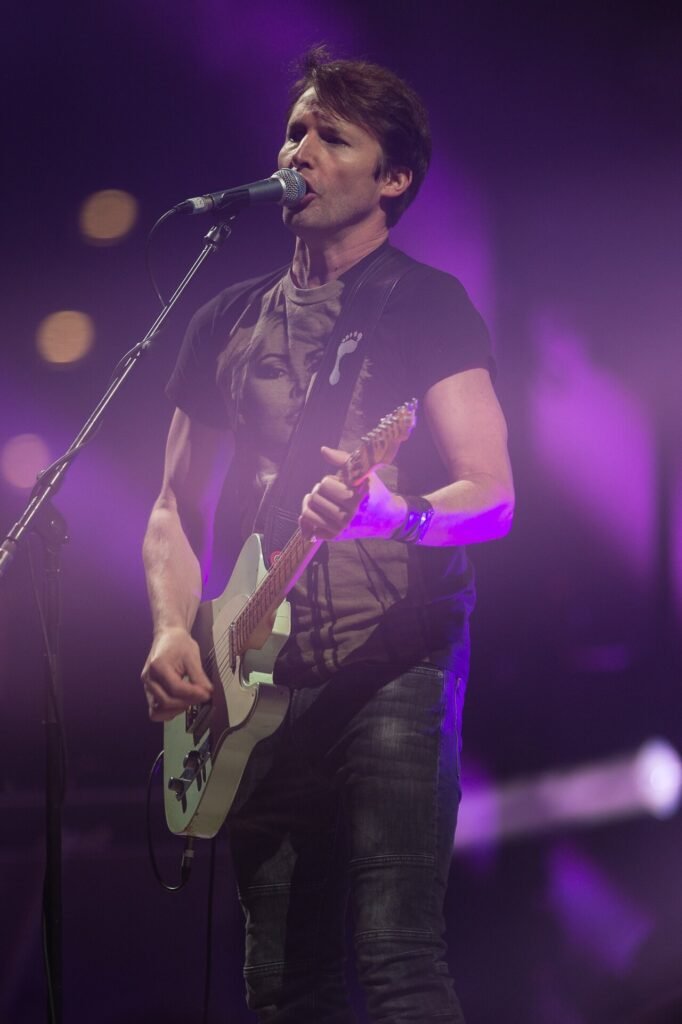
James Blunt — The Soldier Who Sang: You’re Beautiful, a Chart-Topping Return and the Money Counted
The Soldier Who Sang: You’re Beautiful and the Money Counted
James Blunt is the former cavalry officer whose debut album made him one of the best-selling singers of the 2000s, and whose eighth studio album, Airplane Mode, released on 6 November 2026, entered the official albums chart at number one on 13 November 2026 — his first number one album in nineteen years and his third overall.
His wife is Sofia Wellesley, and he is the father of two sons. This profile sets out the record — roots, the career file, the numbers, the family — and counts the fortune in its own section, with the outside estimates that were not adopted identified as such.
Back to Bedlam, the Middle Years and a Chart-Topping Return
2004–2007: Back to Bedlam and You’re Beautiful
Back to Bedlam, released in 2004, was a slow burn that became a wildfire. You’re Beautiful, its third single, topped charts worldwide in 2005, and Goodbye My Lover and Wisemen carried the album past twenty million sales on its way to a worldwide total, across his catalogue, of more than twenty-three million albums by 2021’s count. All the Lost Souls (2007) repeated the number one position, and the former officer was, for a period, the biggest-selling new act in the world.
2010–2019: the steady middle years
Some Kind of Trouble (2010), Moon Landing (2013), The Afterlove (2017) and Once Upon a Mind (2019) charted respectably without matching the debut’s scale, while his live work — long, funny, self-deprecating shows — built a touring audience that outlasted the singles. The compilation The Stars Beneath My Feet (2021) gathered the catalogue. Along the way he became, improbably, one of the most admired celebrity users of social media, answering critics with a wit that kept the name current between albums.
2023–2026: Who We Used to Be and Airplane Mode
Who We Used to Be (2023) set up the return that Airplane Mode completed: released on 6 November 2026, the eighth album went straight to number one on 13 November, his third chart-topping album and his first in nineteen years, with his wife publicly celebrating the result. It is the kind of late-career statistic that rewrites the obituaries the industry had drafted for him. His Instagram, @jamesblunt, carries the jokes and the tour dates in roughly equal measure.
The wit and the second audience
A strand of the career that the sales figures miss is the public voice. Blunt’s social media presence — self-mocking, quick, and aimed at his own legend as often as at anyone else’s — built him a second audience a generation younger than the one that bought Back to Bedlam, and his memoir and stage banter run on the same fuel. Industry profiles of the Airplane Mode launch credited that persona with keeping the name warm through the quieter album years: the jokes were not a distraction from the career but, in the streaming era’s attention economy, a working part of its machinery.
The catalogue’s composition is worth a final note. He is the writer or co-writer of the core material — You’re Beautiful, Goodbye My Lover, 1973, Stay the Night among them — so the publishing share described in this profile has been his throughout, undiluted by the covers and samples that spread the songs further. When Airplane Mode topped the chart in November 2026, the coverage reached instinctively for the comeback frame; the writers’ ledgers, which never stopped, tell the truer story of continuity underneath it.
Tidworth, 1974: a Cavalry Officer’s Son
James Hillier Blount arrived on 22 February 1974 at the military hospital at Tidworth, Wiltshire. His father, Colonel Charles Blount, was a cavalry officer in the 13th/18th Royal Hussars who became a helicopter pilot and colonel in the Army Air Corps; his mother, Jane Blount, née Amos, founded a ski chalet company in Méribel. The upbringing was the services childhood of postings and boarding school — Harrow in his case — followed by sociology at Bristol University on an Army bursary.
The Army came first, as the bursary required: Sandhurst, a commission into the Life Guards, and service that peaked in Kosovo in 1999, where he led a column toward Pristina airport in the famous standoff of that summer — an episode he has told on the record himself, including the order he questioned. He also stood ceremonial duties in London that placed him, for a season, among the most photographed young officers in the country. He left the Army on 1 October 2002 to make the record he had been writing toward for years.
Tidworth’s military hospital and the postings that followed gave him the services childhood in its complete form: prep school, Harrow, and a family expectation — never quite an order — that the Army was the destination. The music ran in parallel from childhood, piano first and then the guitar and the songs, but it was a private pursuit inside a public career until the Kosovo deployment gave him, by his own account, the clarity to resign his commission and test the songs in public. The Army’s loss, as the chart record settled it, was considerable.
Sofia Wellesley, Married in 2014, Granddaughter of a Duke
Blunt married Sofia Wellesley, a lawyer and the granddaughter of the 8th Duke of Wellington, on 6 September 2014 — a registry office ceremony followed by a celebration in Majorca. The marriage is in place in November 2026, per the reporting around the new album’s success. The couple are co-owners of the Fox & Pheasant pub in Chelsea, bought in 2017, a business fact that belongs to the family’s public record.
They have two sons; the couple has never made their names public, and this profile does not print them here. The elder arrived in 2016; some secondary reporting gives the second son’s birth year as 2018, but no firm source establishes it, so this profile asserts only the elder’s year. Ed Sheeran is godfather to the elder son — a detail Blunt has given in interviews, and a measure of the friendship between the two singers.
His parents complete the record: the colonel whose career took the family through the postings of his childhood, and whose later kidney transplant Blunt marked in the song Monsters, written for his father; and Jane Blount, who built the Méribel chalet business. The father’s illness and the son’s song about it became one of the most affecting public moments of Blunt’s later career.
The family maintains its privacy with a discipline worthy of his father’s profession: two sons whose names are not public, a wife whose legal career proceeds in its own right, and a Chelsea pub that is the family’s most visible joint venture. The public exceptions are telling — the celebration of the November 2026 chart result, and the song Monsters, in which the son addressed the father’s illness with a directness that moved audiences who knew nothing of the family. Both were his choices, made on his terms, and they define the boundary this profile observes.
The Tidworth Singer, Counted in One Table
| The Tidworth Singer, Counted in One Table | The Record |
|---|---|
| Born | 22 February 1974, Tidworth, Wiltshire |
| Net Worth | $20 million (Celebrity Net Worth) |
| Age | 52 |
| Height | 5 ft 8 in (1.73 m) |
| Weight | No reliable published figure exists |
| Wife | Sofia Wellesley, married 6 September 2014 |
| Children | Two sons — the couple has never made their names public; the elder arrived in 2016 |
| Parents | Colonel Charles Blount and Jane Blount, née Amos |
| @jamesblunt |
A $20 Million Count Updated on 1 October 2026
Celebrity Net Worth puts James Blunt’s net worth at $20 million, on a page updated on 1 October 2026, and that is the figure this profile uses. No Forbes total and no Sunday Times Rich List wealth figure exists for him. Rich-list figures of up to £50 million printed in newspapers around his chart return come from outside the permitted sources, show no workings, and this profile records them here only as unadopted outside estimates — they do not form the count. Filed accounts tell the checkable part of the story: James Blunt Limited reported net assets of about £9.5 million at March 2025. Those are company assets, explicitly not his personal wealth, and this profile prints them as such.
One album’s extraordinary tail dominates the build-up. Back to Bedlam’s twenty-million-plus sales, and the publishing on You’re Beautiful — a song that has never left the world’s wedding, radio and streaming rotations — created an income that has run for two decades. Eight further albums, the touring circuit and the Chelsea pub he owns with his wife layer on top. The friendship recorded in the family section runs through the money too: Ed Sheeran, godfather to Blunt’s elder son and the subject of his own profile in this series, toured the same stadiums a generation later, and the two men’s catalogues now sit at opposite ends of the singer-songwriter wealth scale.
The number one album of November 2026 will move the next published estimate; until a named source prints one, $20 million is the count, with the company filings standing beneath it as the part any reader can verify.
The relationship between the two money figures in this profile — the tracker’s $20 million estimate and the company’s £9.5 million of filed net assets — is worth stating once, precisely. The filed figure is a floor of a particular kind: money retained inside one company, at one date, excluding everything held personally or elsewhere. The estimate attempts the whole position. That the checkable floor stands at roughly half the estimated total is, by the standards of celebrity finance, an unusually coherent picture — most profiles in this series can offer no filed figure at all — and it is why this profile presents the $20 million with more confidence than a bare tracker figure would ordinarily earn.
The Officer Who Became a Phenomenon, Then Weathered the Backlash
Where the story stands, Blunt has completed one of pop’s neater arcs: the officer who became a phenomenon, weathered the backlash with humor, and returned to the top of the album chart at fifty-two, nineteen years after his last number one.
The fortune, counted at $20 million by the source that publishes one, rests on a debut album that never stopped selling and a catalogue now nine albums deep. The unadopted £50 million headlines aside, that is the record — and it is enough.
The chart statistic of November 2026 deserves the file’s last word, because it rewrites the career’s shape in a single line: a number one album at fifty-two, nineteen years after the previous one, from an artist the industry had filed under nostalgia. The audience that put Airplane Mode there spans the original buyers of 2004 and the streaming generation that knows him as much for the wit as the songs. Manufacturers usually manufacture comebacks; he accumulated this one, quietly, across the middle albums and the live years, and the record this profile sets out — soldier, phenomenon, working singer, chart-topper again — is complete to the present, with the tour to follow.