How to Descale Humidifier: Step-by-Step Guide (2026)
If your humidifier is leaving a chalky white film on your furniture, putting out a weak stream of mist, or smelling faintly musty, it needs descaling. Here is the short version: unplug the unit, empty the tank, fill the tank and the base with undiluted white distilled vinegar, let everything soak for 20 to 30 minutes, scrub away the loosened scale with a soft brush, rinse thoroughly, and let it air-dry completely. That one routine, done every one to two weeks, keeps your humidifier running cleanly and your air healthy.
Humidifiers are lifesavers during dry winters, and in New York City apartments where old radiators turn indoor air bone-dry from November through March, they run almost nonstop for months. But every gallon of water that passes through the unit leaves minerals behind. Over time those minerals harden into crusty scale that clogs the works, feeds bacteria, and shortens the life of the machine. The good news: descaling takes about 30 minutes, costs almost nothing, and needs no special products.
Why Descaling Your Humidifier Matters
It is tempting to just keep refilling the tank and ignore the crusty buildup, but scale causes real problems:
- Health: Mineral deposits create a rough surface where mold, mildew, and bacteria thrive. When the humidifier runs, it can push those contaminants into the air you breathe.
- White dust: In ultrasonic humidifiers especially, minerals get blasted into the air as a fine white powder that settles on furniture, electronics, and floors.
- Poor performance: Scale insulates heating elements and coats ultrasonic transducers, so the unit puts out less moisture while working harder.
- Shorter lifespan: A scaled-up humidifier wears out faster. Regular descaling can add years to a unit that would otherwise die in one or two seasons.
- Bad smells: That stale, swampy odor coming from your humidifier is almost always scale plus bacterial growth in the tank.
Signs Your Humidifier Needs Descaling
Watch for these clues:
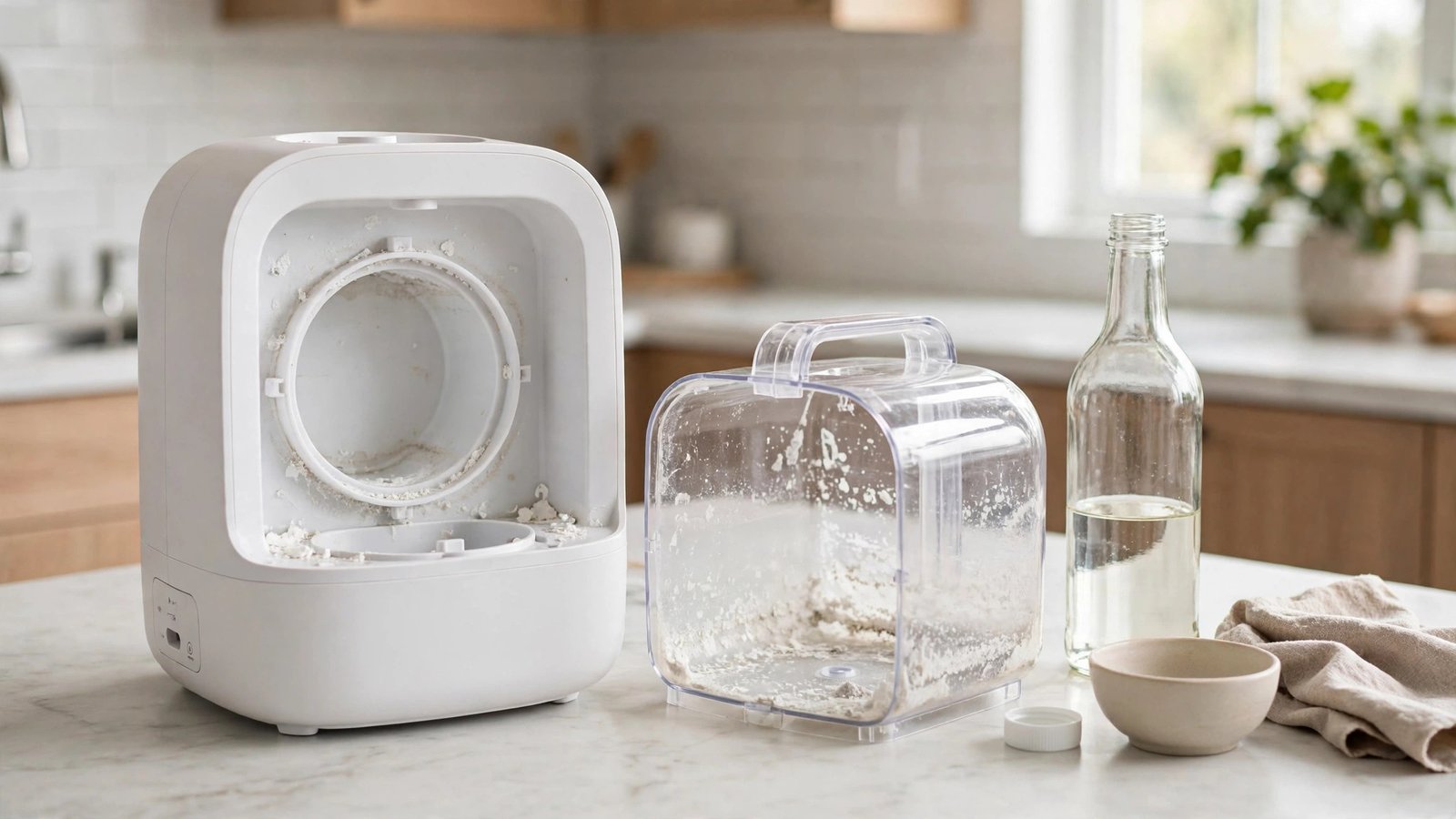
- A white or gray crusty film inside the water tank or base
- Fine white dust appearing on nearby surfaces
- Noticeably weaker mist output than when the unit was new
- A musty or sour smell when the humidifier runs
- The unit running louder than usual or shutting off unexpectedly
- Discolored or cloudy water left sitting in the tank
If you spot any of these, do not wait. Descale today.
What You Will Need
You probably have everything already:
- White distilled vinegar (about 1 to 2 cups)
- A soft-bristled brush or an old toothbrush
- Cotton swabs for tight corners
- A microfiber cloth
- Clean water for rinsing
- Hydrogen peroxide (3%) or household bleach for the optional disinfecting step
Skip specialty descaling products. Vinegar is cheaper, safer, and just as effective for routine scale.
How to Descale a Humidifier: Step by Step
Step 1: Unplug and Take It Apart
Safety first: unplug the humidifier and let any warm-mist unit cool down completely. Empty the water tank and the base. Remove the filter or wick if your model has one — set it aside, since filters should be rinsed or replaced rather than soaked in vinegar. Take off any detachable parts like the mist nozzle or cap so you can reach every surface.
Step 2: Fill the Tank and Base with Vinegar
Pour undiluted white distilled vinegar into the water tank until it is about half to three-quarters full. Swish it around so it coats the inside walls, then pour a cup or so of vinegar into the base of the unit where the water sits. Make sure the vinegar reaches the areas with visible scale.
Step 3: Let It Soak for 20 to 30 Minutes
Set a timer. Vinegar’s acetic acid dissolves calcium and lime deposits on contact, and 20 to 30 minutes handles normal buildup. For heavy, neglected scale, you can extend the soak up to an hour. Do not soak overnight — prolonged acid exposure can damage seals and some plastic parts.
Step 4: Scrub Away the Loosened Scale
Pour out the vinegar and scrub every surface with your soft brush or toothbrush. Use cotton swabs to get into crevices, corners, and around the mist outlet. The scale should come off easily now; if a stubborn patch remains, dab it with a vinegar-soaked cloth and let it sit for 10 more minutes. Never use steel wool, scouring pads, or anything abrasive — scratches in the plastic become new homes for bacteria.
Step 5: Rinse Everything Thoroughly
Rinse the tank, base, and all parts under clean running water several times. Keep rinsing until the vinegar smell is completely gone. Leftover vinegar can irritate airways when the unit runs, so do not rush this step.
Step 6: Disinfect (Optional but Smart)
Descaling removes minerals; disinfecting kills germs. After rinsing, fill the tank with water and add either one teaspoon of household bleach per gallon of water or a cup of 3% hydrogen peroxide. Let it sit for 15 to 20 minutes, then rinse thoroughly. If you use bleach, rinse extra carefully.
Step 7: Air-Dry Completely Before Reassembling
Shake off excess water and set all parts on a clean towel to air-dry. Reassembling a damp humidifier invites mold right back. Once everything is bone dry, put it back together, refill with fresh water, and you are done.
How to Descale Different Types of Humidifiers
Ultrasonic Humidifiers
The most common type. Follow the steps above, and pay special attention to the small metal disc at the bottom of the base (the transducer) — wipe it gently with a vinegar-dampened cloth. This is the part that produces the mist, and scale here causes most performance problems.
Evaporative (Cool-Mist with a Wick Filter)
Descale the tank and base as described, but do not soak the wick filter in vinegar. Wick filters trap minerals by design and cannot be descaled — rinse them under cool water and replace them every one to three months, or sooner if they look crusty or smell bad.
Warm-Mist (Steam) Humidifiers
The heating element in these units attracts the heaviest scale. Let the vinegar soak go the full 30 minutes, and scrub the heating chamber carefully. These units benefit most from using distilled water going forward.
How Often Should You Descale a Humidifier?
As a rule of thumb: descale every one to two weeks during periods of daily use. If you run your humidifier around the clock, lean toward weekly. Do a full clean — descaling plus disinfecting — at least once a month. New York City tap water is relatively soft compared to much of the country, so most NYC users can stick to the two-week schedule, but if you notice scale forming faster, switch to weekly. Always descale before storing the unit for the season, and again when you bring it out.
Mistakes to Avoid When Descaling
- Using bleach as the descaler: Bleach disinfects but does not dissolve mineral scale well. Use vinegar for scale, bleach only for disinfecting.
- Scrubbing with abrasives: Steel wool and scouring pads scratch plastic and metal coatings, making future buildup worse.
- Soaking electronic components: Keep vinegar away from power cords, control panels, and any part the manual says not to submerge.
- Skipping the rinse: Residual vinegar mist can irritate eyes, throats, and lungs. Rinse until the smell is gone.
- Putting the unit away wet: Storing a damp humidifier guarantees mold. Dry it completely first.
- Descaling the wick filter: Soaking a wick in vinegar ruins it. Replace wicks instead.
Tips to Slow Down Mineral Buildup
- Use distilled or demineralized water instead of tap water. It costs a bit more but dramatically reduces scale and white dust.
- Empty and rinse the tank daily. Fresh water every day prevents minerals from concentrating.
- Do not let water sit. If you will not run the humidifier for a day or two, empty it.
- Keep indoor humidity between 30 and 50 percent. Over-humidifying wastes water and encourages mold.
- Wipe the base every few days with a dry cloth to catch scale before it hardens.
Frequently Asked Questions
Can I use apple cider vinegar instead of white vinegar to descale my humidifier?
You can in a pinch, but white distilled vinegar is better. It is more acidic, cheaper, colorless (so it will not stain), and leaves no residue or odor behind after rinsing. Apple cider vinegar works but may leave a tint and a lingering smell.
How long should I let vinegar soak in a humidifier?
Twenty to thirty minutes is enough for routine buildup. For heavy scale that has been neglected for months, extend the soak to an hour, but do not leave vinegar sitting overnight, since prolonged exposure can damage seals and plastic parts.
Is the white dust from my humidifier harmful?
The white dust is mostly calcium and magnesium — the same minerals in tap water — and is generally not considered dangerous. Still, it settles on everything, can irritate sensitive airways, and signals that your unit needs descaling. Switching to distilled water eliminates it.
Can I use citric acid instead of vinegar to descale?
Yes. Dissolve two to three tablespoons of citric acid powder in a tank of warm water, soak for 20 to 30 minutes, then scrub and rinse. It works as well as vinegar and leaves no smell, though it costs more.
Why does my humidifier smell bad even after descaling?
A lingering smell usually means bacteria or mold in a part you missed — often the wick filter, the mist nozzle, or a rubber gasket. Replace the filter, disinfect with a diluted bleach or hydrogen peroxide soak, and make sure everything dries completely before reassembly.
Descaling is one of those small chores that pays for itself many times over: cleaner air, a quieter and more efficient machine, and a humidifier that survives winter after winter instead of dying in February. Set a reminder every two weeks, keep a jug of white vinegar under the sink, and the whole job takes less time than brewing a pot of coffee.