
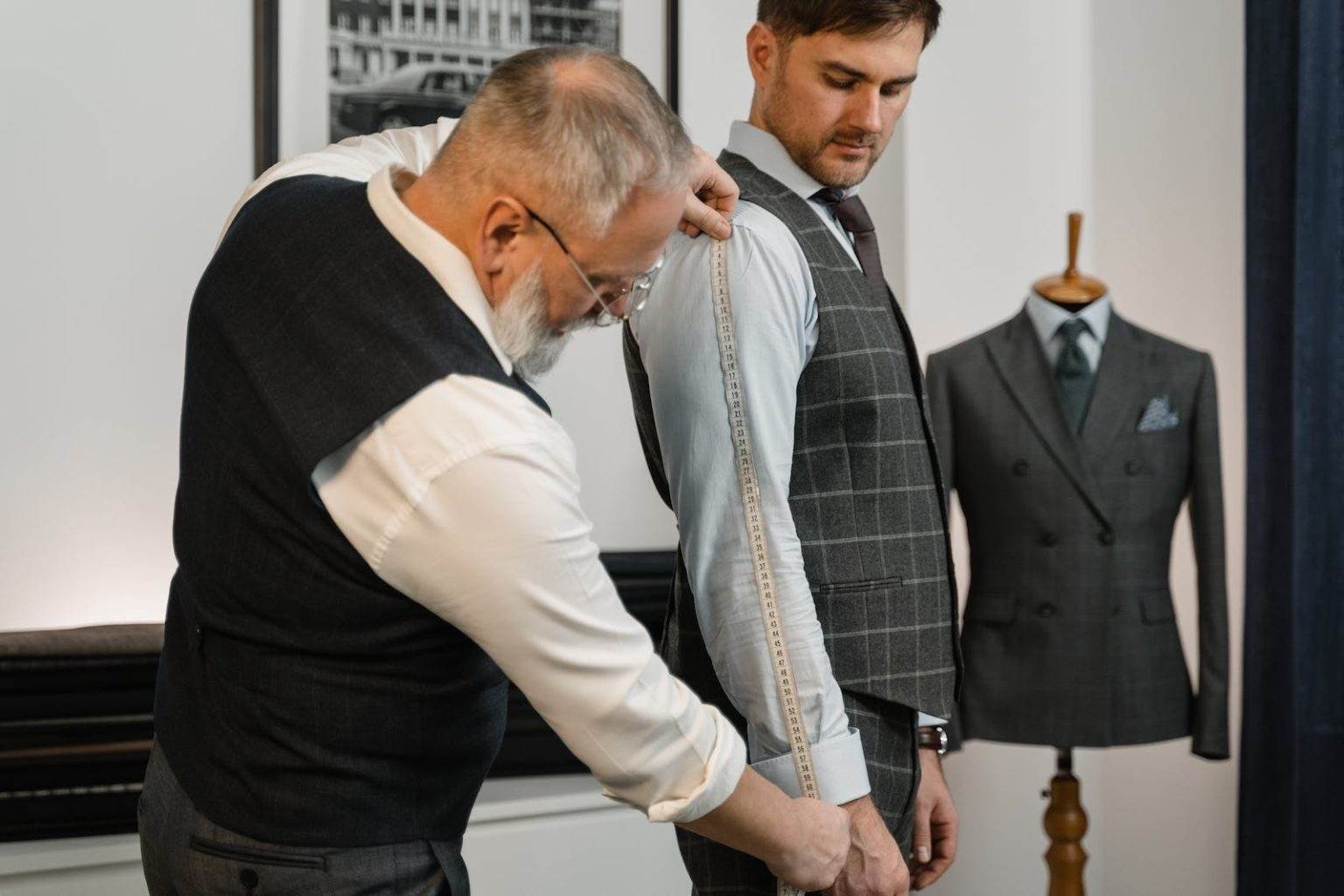
Here’s the fashion industry’s best-kept secret: fit matters more than brand, price, trend, or fabric. A $30 shirt that fits perfectly looks better than a $300 shirt that doesn’t. Yet most people wear clothes that are subtly (or not so subtly) wrong — too long here, too tight there — without knowing the benchmarks. How do I know if clothes fit properly? With specific, checkable standards for every garment type. Here’s the complete checklist.
The Universal Fit Principles
- Comfort + movement: you should sit, reach, walk, and breathe comfortably. If you can’t, it’s too tight regardless of how it looks standing still.
- No pulling or gaping: fabric should lie smooth. Pull lines (X-shapes at buttons), gaping at the bust or waist, and straining seams all signal “too small.”
- No drowning: excess fabric that bunches, billows, or obscures your shape signals “too big.” Clothes should follow your body’s lines.
- The sit test: always sit down in the fitting room. Pants, skirts, and jackets behave completely differently seated — waistbands dig, hems ride, buttons strain.
- The mirror lie: fitting-room mirrors and lighting flatter. Take a phone photo — the camera is more honest than the mirror.
Shirts and Blouses
- Shoulders: the seam sits exactly at the edge of your shoulder — not drooping down the arm (too big), not pulling inward (too small). This is the hardest to alter, so prioritize it.
- Chest/bust: no gaping between buttons (the dreaded button pull-X). If it pulls, size up and tailor the waist.
- Sleeves: dress shirt cuffs hit the wrist bone, showing half an inch under a jacket. Casual sleeves shouldn’t swallow your hands.
- Length: untucked shirts should hit mid-hip (covering the belt but not the seat); dress shirts for tucking need enough length to stay tucked when you sit.
- Torso: you should pinch 1-2 inches of fabric at the sides — more is too big, none is too tight.
Pants and Jeans
- Waist: you should fit two fingers (not a fist, not barely one) inside the waistband. No muffin top, no gaping at the back.
- Seat: smooth across the backside — no pulling (too tight), no sagging or excess fabric (too loose). Back pockets should sit on the fullest part.
- Thighs: no horizontal pull lines; you should pinch about an inch of fabric.
- Length/break: full break (fabric pooling) looks sloppy; no break (ankle-baring) is modern; slight break is classic. Choose intentionally — and hem to get there. Our jeans fitting guide goes deeper on denim specifically.
- Rise: comfortable at the waist/hips without constant hitching. If you’re always pulling them up, the rise or size is wrong.
Jackets and Blazers
- Shoulders: again the priority — seam at the shoulder edge. Shoulder fit determines whether a blazer looks expensive or cheap.
- Button test: button the jacket — it should close without an X-pull, with a fist’s width of ease. If it pulls, it’s too small (not “slimming”).
- Sleeves: hit the wrist bone, showing half an inch of shirt cuff. Too long sleeves are the most common blazer flaw and the easiest tailor fix.
- Length: classic blazers cover the seat; modern cuts may be shorter. Either is fine if intentional.
- Collar: should hug the neck with no gaping when you move. A gaping collar means the shoulders or chest are wrong.
Dresses and Skirts
- Bodice: no pulling across the bust, no gaping at the neckline or armholes. Darts should point at (not above/below) the bust apex.
- Waist: defined at your natural waist without squeezing. You should breathe and sit comfortably.
- Hem: hits at a flattering point — just above, at, or below the knee are all fine; avoid hems hitting mid-calf’s widest point (shortens legs visually).
- Zippers: should lie flat. A wavy zipper means the dress is too tight through the torso.
What a Tailor Can (and Can’t) Fix
Easily fixed: hemming (pants, skirts, sleeves), taking in waists, tapering legs, shortening straps. These $10-25 alterations transform fit.
Expensive/difficult: shoulder alterations, changing rise, letting out (limited by seam allowance), major size changes.
The rule: buy to fit the hardest-to-alter area (shoulders for tops, hips/thighs for bottoms), then tailor the rest. This single strategy — also key for plus-size dressing and men’s budget style — is how well-dressed people actually shop.
How Do I Know If Clothes Fit Properly? Your Questions Answered
Should I buy for my current size or the size I want to be?
Current size, always. “Goal weight” clothes are the most unworn garments in existence — they hang in closets generating guilt instead of getting worn. Your present body deserves clothes that fit now; looking good today does more for your confidence (and motivation, if that’s relevant) than a aspirational garment ever will. Bodies also change in unpredictable ways — the size you imagined may fit differently than expected when you arrive. Dress the body you have, beautifully, today. Future you can shop later.
Why do sizes vary so much between brands?
Vanity sizing and the absence of standardization. US women’s sizing is particularly chaotic — a “size 8” can span 3+ inches across brands, and vanity sizing means today’s 8 was yesterday’s 12. Men’s sizing is more consistent (inches are inches) but still varies by cut (slim vs. classic). The industry has no incentive to standardize: vanity sizing flatters customers into buying. The defense: know your measurements in inches, check size charts (not the number, the inches), read fit reviews, and always try on or order with free returns. Your “size” is brand-specific trivia; your measurements are facts. GQ’s fit guides are a solid reference for translating those measurements into confident purchases across brands.
Is it worth tailoring cheap clothes?
Often yes — the math is about the result, not the garment’s price. A $25 thrifted blazer plus $40 in tailoring is a $65 blazer that fits like custom. A $30 pair of pants hemmed for $12 looks like $100 pants. The question isn’t “is this garment worth tailoring?” but “will I wear this constantly if it fits perfectly?” High-rotation pieces justify tailoring at any price point; rarely-worn pieces don’t justify it at any price. Build a relationship with a tailor before you need one — and start with the easy wins (hemming, waist suppression) to see the transformation firsthand.
The Bottom Line
Proper fit means shoulders at the shoulder, no pulling or gaping, comfortable movement, and hems hitting intentional points — verified by the sit test and a phone photo, not just the mirror. Buy for the hardest-to-alter area and tailor the rest. Fit is the cheapest luxury in fashion: it costs attention, not money.


