Cate Blanchett — Two Oscars, Four Children and the Fortune of a Reluctant Star
Written by admin
Published November 24, 2026
Reading time 9 minutes
The Numbers Born first, net worth second — the full record sits in the “By the Numbers” table after the career section.
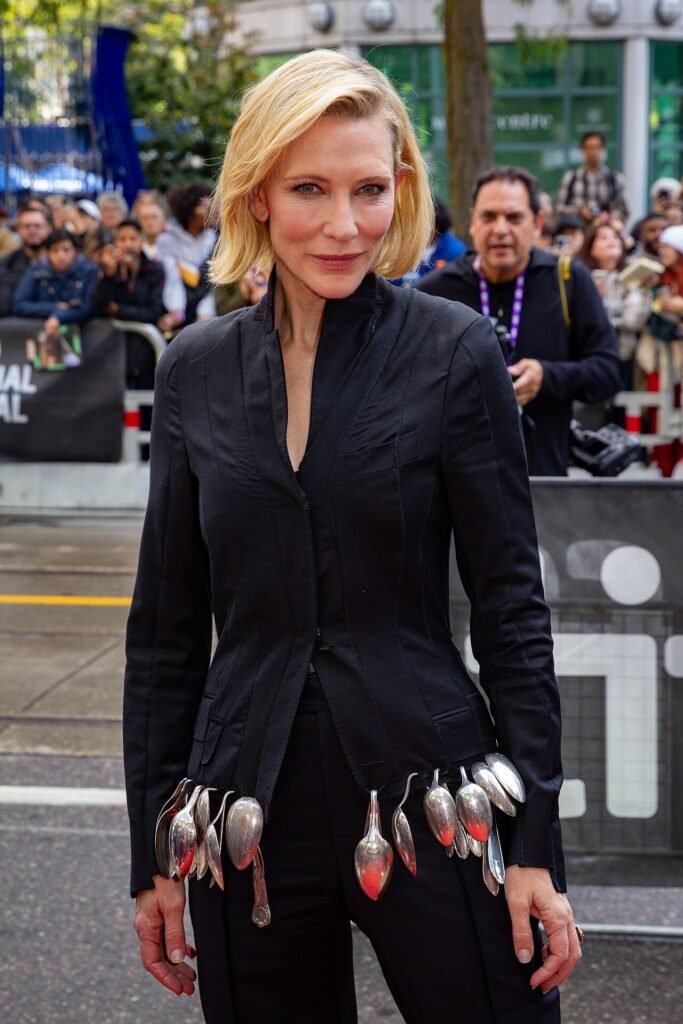
Cate Blanchett — Two Oscars, Four Children and the Fortune of a Reluctant Star
Two Oscars and the Finest Actress of Her Generation
Critics routinely describe Cate Blanchett as the finest actress of her generation, and the record supports the description in the plainest way: two Academy Awards from eight nominations, a filmography that runs from Elizabethan queens to Norse goddesses to a Bob Dylan impersonation, and a parallel career running one of Australia’s major theatre companies. She is also, by Hollywood standards, a reluctant celebrity — no official public Instagram account, a family raised between Sydney and the English countryside, and a public persona built almost entirely out of the work itself.
Her present-day position, as the record stands in late 2026, is that of an actress in her late fifties choosing projects at the highest level — prestige films, occasional blockbusters, theatre and producing — and a cultural figure whose off-screen identity is as likely to involve refugee advocacy or theatre governance as a red carpet. She married the playwright and screenwriter Andrew Upton in 1997, and they have four children. The searches behind this profile ask her nationality, and this profile answers it directly below: she is Australian, whatever the bank’s country tag says. the money count counts the fortune, with its source named; this briefing carries no figure.
Elizabeth, Galadriel, Blue Jasmine and Tar
1997–1999 — Oscar and Lucinda, Elizabeth and the arrival
Her film breakthrough came in quick succession: Oscar and Lucinda (1997) opposite Ralph Fiennes, then Elizabeth (1998), in which her Elizabeth I — young, wary, hardening into majesty — brought her first Academy Award nomination and a Golden Globe, and made her an international name at twenty-nine. The Talented Mr. Ripley (1999) and a run of Australian stage work filled out the arrival years; the voice and the stillness that became her signatures were already fully formed.
2001–2007 — Galadriel, the first Oscar and Dylan
As Galadriel in Peter Jackson’s The Lord of the Rings trilogy (2001–2003) she became part of the highest-grossing film series of its era. In The Aviator (2004) she played Katharine Hepburn — the only actress ever to win an Academy Award for playing another Oscar-winning actress — taking Best Supporting Actress. Notes on a Scandal (2006) and Elizabeth: The Golden Age (2007) brought further nominations, and in Todd Haynes’s I’m Not There (2007) critics received her incarnation of Bob Dylan as one of the decade’s great performances. Indiana Jones and the Kingdom of the Crystal Skull (2008) and The Curious Case of Benjamin Button (2008) kept the commercial column filled.
2008–2013 — Running the Sydney Theatre Company, Blue Jasmine
From 2008 to 2013 she and Andrew Upton served as co-artistic directors and CEOs of the Sydney Theatre Company, programming seasons, touring productions internationally and acting on its stages — a five-year executive chapter almost without parallel in a film star’s career. It ended with a summit: in Woody Allen’s Blue Jasmine (2013) she played a disgraced New York socialite in collapse, and won the Academy Award for Best Actress, along with virtually every other acting prize of that season.
2015–2026 — Carol, Hela, Tár and the producing years
Carol (2015), opposite Rooney Mara, brought her seventh Oscar nomination; Thor: Ragnarok (2017) gave her Hela, the Marvel Cinematic Universe’s first female main villain, and a blockbuster salary tier; Ocean’s 8 (2018) put her in an ensemble heist hit. In Todd Field’s Tár (2022) she played the conductor Lydia Tár in a performance that won the Volpi Cup at Venice and the BAFTA and Golden Globe, and brought her eighth Academy Award nomination. Producing, through the company Dirty Films founded with Upton, has become a growing share of the work — the career’s centre of gravity shifting, deliberately, toward projects she originates.
The stage file inside those years is as significant as the screen one. For the Sydney Theatre Company she played Blanche DuBois in A Streetcar Named Desire (2009), in a production that toured to Washington and New York; Hedda Gabler and Yelena in Uncle Vanya followed in Sydney; and in 2017 she made her Broadway debut in The Present, the Chekhov adaptation by Upton that transferred from Sydney, earning a Tony Award nomination. The theatre work was never a hobby between films: it formed the second half of the profession, and she pursued it at the cost of film fees throughout her most bankable years, and it is the clearest evidence for the argument this profile’s fortune section makes — that she optimised her career for the work itself, with the money as a consequence rather than the objective.
Ivanhoe, Melbourne, 1969
Catherine Elise Blanchett arrived on 14 May 1969 in Ivanhoe, a suburb of Melbourne, Australia; her birthday falls in mid-May and she is 57 years old. Her father, Robert Blanchett, was an American naval officer from Texas who met her mother, June Gamble, an Australian teacher and property developer, during his ship’s posting to Melbourne; he later worked in advertising. When Cate was ten, her father died of a heart attack — she has described leaving for school that morning without saying goodbye, and keeping a ritual of goodbyes ever since. Her mother and grandmother raised her in Sydney, attended Methodist Ladies’ College in Melbourne, studied economics and fine arts at the University of Melbourne, and then — after a trip abroad that included work as an extra in an Egyptian film — enrolled at the National Institute of Dramatic Art in Sydney, graduating in 1992.
The roots explain the career’s double structure. The Australian theatre was not a stepping stone she discarded but a home institution she returned to run: within fifteen years of graduating from NIDA she and her husband were artistic directors of the Sydney Theatre Company. The American father and the Melbourne birth also explain the ease with which she has moved between industries — Australian stages, British costume drama, American blockbusters — without belonging wholly to any of them.
Stage, Screen and a $95 Million Fortune
Celebrity Net Worth puts Cate Blanchett’s net worth at $95 million, and that is the figure printed here, attributed to its source. Its composition is an actor’s composition at the prestige end of the market: three decades of film salaries, rising from Australian art-house fees to the eight-figure tier that Marvel and ensemble blockbusters pay, set against a career pattern — long theatre seasons, small films taken for the role — that deliberately leaves money on the table in exchange for the work itself. The Sydney Theatre Company years are the clearest example: five years of executive and stage work at Australian theatre salaries, undertaken at the exact height of her film earning power, because the institution mattered to her and Upton.
The producing layer is the growing one. Dirty Films, the company she runs with Upton, converts her judgement into ownership on selected projects, and her name attaches financing to films that would struggle to exist without it. The instructive comparison in this series is with the actor who has shared two of her most prominent films: the file on Brad Pitt’s own fortune and career covers the other side of The Curious Case of Benjamin Button and Babel, and the contrast between the two fortunes — his built substantially on a production company sold at a premium, hers on craft at the top rate plus a theatre company run as a public service — is the clearest illustration in this series that there is more than one way to convert stardom into a balance sheet.
The Sydney Base and the Sussex Retreat
The family’s documented property history centres on Sydney and England. In Sydney they bought a historic Hunters Hill house in the mid-2000s — purchased for around $7 million in 2006 reporting and sold in 2017 for a reported $13 million — and the family later based itself substantially in England, where they bought a Victorian house in East Sussex in the mid-2010s for a reported figure around $4 million. Current holdings beyond those documented transactions are private, and this profile records the verified transactions and leaves the present portfolio as the family keeps it: unpublished.
The plain count stands at $95 million on the named estimate, the fortune of an actress who has spent thirty years at the top of her profession and has repeatedly traded maximum earnings for maximum choice — and this profile prints it as an estimate with its source attached, because no audited figure exists and nobody claims one.
Blanchett in Brief: Four Children, $95 Million
| Blanchett in Brief: Four Children, $95 Million | The Record |
|---|---|
| Born | 14 May 1969, Ivanhoe, Melbourne, Australia |
| Net Worth | $95 million — Celebrity Net Worth |
| Age | 57 |
| Height | 5 ft 8½ in |
| Weight | No reliable published figure exists |
| Birthday | 14 May |
| Husband | Andrew Upton (married 29 December 1997) |
| Children | Four — Dashiell (2001), Roman (2004), Ignatius (2008) and Edith (adopted 2015) |
| Parents | Robert Blanchett and June Gamble |
| Nationality | Australian |
| No official public account — per her own interview statements |
Producing, Directing and the Years Ahead
In late 2026 Blanchett stands where she has stood for a decade: at the top of the casting lists for the most ambitious films in production, with a producing company extending her influence to other actors’ projects, and a public identity — UNHCR goodwill ambassador, theatre figure, environmental campaigner — that she built from commitments rather than publicity. Tár confirmed in 2022 that the instrument is undiminished; she has chosen the work since, not chased it.
The story, on the record, is of a fortune assembled as a by-product. The $95 million estimate is what accumulates when the defining actress of a generation works constantly for thirty years, even one who keeps walking away from the money to run a theatre. It is, by the standards of this series, one of the most explicable numbers in the file.
Andrew Upton and Four Children Since 1997
Blanchett married the playwright, screenwriter and director Andrew Upton on 29 December 1997, and the marriage — nearly three decades long, and for five of those years also a professional partnership running the Sydney Theatre Company — is the fixed point of her family record. They have four children: three sons, Dashiell, born in 2001, Roman, born in 2004, and Ignatius, born in 2008, and a daughter, Edith, whom the couple adopted in 2015. A source error is worth correcting on the record: Celebrity Net Worth’s page refers to three children, but the verified record is four, and four is what this profile prints. This series counts adopted children as children, here as everywhere.
Her parents frame the family’s other end: Robert Blanchett, the American father whose death when she was ten she has called the formative loss of her life, and June Gamble, who raised her family in Sydney after it and lived to see her daughter’s career at its height. The household the couple runs is deliberately low-visibility — children kept out of publicity, no official public Instagram account, a position she has explained in interviews by a simple lack of interest in performing her private life. Away from the cameras, the documented picture is school runs, theatre governance and a family that appears in the press principally when she chooses to mention it.