
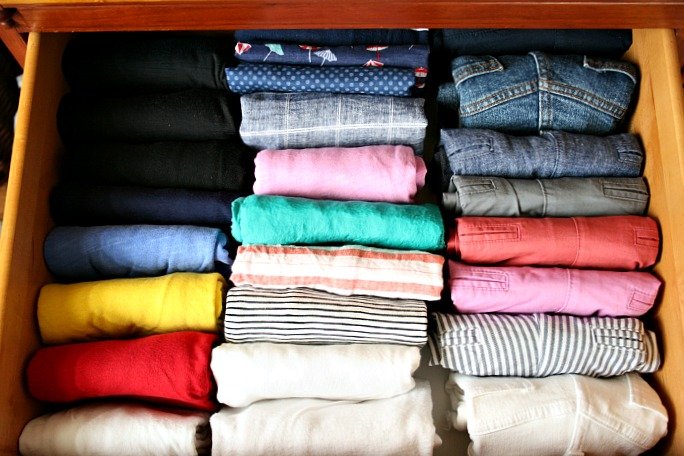
Most people fold clothes the way they were taught as kids: flat stacks that topple, hide everything underneath, and waste half the drawer. There’s a better way — actually, several — and the difference in usable space is dramatic. What is the best way to fold clothes to save closet space? File folding for drawers, rolling for travel and casual items, and specific techniques per garment. Here’s the full system.
File Folding: Why It Works So Well
Popularized by Marie Kondo, file folding means folding clothes into rectangles that stand upright in drawers like files in a cabinet. The benefits: you see everything at once (no more forgotten bottom-of-pile shirts), you fit 50-100% more per drawer, and removing one item doesn’t avalanche the rest.
How to file fold (basic method):
- Lay the garment flat, front down.
- Fold both sides inward to create a long rectangle (about 4-6 inches wide).
- Fold the rectangle in halves or thirds until it stands upright on its own — it should be roughly the height of your drawer.
- Place upright in the drawer, packed snugly enough to support each other.
It takes a few tries to get the sizing right for your drawers — measure once, then it’s muscle memory. The standing test: if it topples, fold once more or pack tighter.
Technique by Garment
- T-shirts: the file-fold showcase item. Fold sleeves in, sides in, then thirds. A drawer of file-folded tees is deeply satisfying and wildly space-efficient.
- Jeans and pants: fold in half lengthwise, then fold into thirds or quarters depending on drawer depth. File-folded jeans stand beautifully.
- Sweaters: fold loosely (don’t compress the knit), wider rectangles, fewer folds. Cashmere and wool prefer gentle folding over tight rolling.
- Underwear and socks: fold underwear into small packets; socks should be folded (not balled — balling stretches the elastic), then tucked. These fill drawer gaps perfectly.
- Hoodies and sweatshirts: bulky — fold the hood in first, then treat like a sweater. Consider hanging heavy hoodies instead; they eat drawer space.
- Dress shirts: button up, fold precisely to avoid wrinkles, file fold or lay flat. For travel, bundle wrapping beats folding.
Rolling: When It Beats Folding
Rolling wins for: travel packing (saves space, minimizes wrinkles for casual fabrics), gym bags, and soft casual clothes. The ranger roll (military method) creates tight, compact bundles that don’t unroll. But rolling is worse for: dress shirts (wrinkles), structured garments, and drawer organization (rolls don’t stand as neatly as file folds). Use each where it excels.
What Should Be Hung, Not Folded
Folding isn’t universal. Always hang: blazers, coats, dresses, button-downs you want crisp, pleated skirts, and anything in wrinkle-prone fabric (linen, silk). Fold: knits (hanging stretches them out — this is the #1 knit-killer), tees, jeans, casual pants, underwear, and workout clothes. The hang/fold decision affects garment lifespan as much as space — our closet organization guide has the full zone system.
Space Multipliers Beyond Folding
- Drawer dividers: keep file-folded rows from migrating. Spring-loaded dividers adapt to any drawer.
- Vacuum bags (seasonal only): for off-season storage, not daily use. Never vacuum-seal structured or down items long-term.
- Vertical door space: over-door organizers for accessories free drawer space for clothes.
- Under-bed storage: shallow bins for off-season folded clothes — the forgotten square footage.
- Declutter first: the ultimate space-saver. Folding techniques multiply space, but removing unworn clothes multiplies it more. See seasonal storage for the rotation system.
What Is the Best Way to Fold Clothes to Save Closet Space? Your Questions Answered
Does the KonMari method really save space?
The file-folding component genuinely does — standing clothes upright like files typically fits 50-100% more per drawer than flat stacking, because it eliminates the dead space of unstable piles and lets you use the drawer’s full depth. But KonMari’s space-saving is partly a decluttering effect: the method’s famous keep/discard process removes the excess that was consuming space. The folding technique multiplies whatever space decluttering frees. Together they’re powerful; either alone is partial. The KonMari method’s real insight: organization systems fail when there’s simply too much stuff, and no folding technique fixes overaccumulation.
How do I fold a fitted sheet? (Seriously.)
The eternal question, with an actual answer: tuck each corner into the next (nest all four corners together), lay the resulting rectangle flat, fold the elastic edges inward to make a clean rectangle, then fold into thirds. It takes practice — the first five attempts look lumpy, then it clicks. The alternative honest answer: nobody’s linen closet is inspected, and a neatly rolled fitted sheet in a matching pillowcase (the “pillowcase package” trick — store the whole set inside one pillowcase) looks organized regardless of fold quality. Perfection is optional; containment is what matters.
Should I hang or fold sweaters?
Fold — always fold knitwear. Hanging stretches sweaters at the shoulders (those little hanger points are permanent), especially heavier knits and anything with loose weaves. The exception: very lightweight, structured knits can hang on padded hangers without damage. Fold loosely rather than compressing — tight folding creases knits unnecessarily. And store folded sweaters with cedar or lavender (moths love natural fibers), never in plastic long-term. The fold-vs-hang decision affects garment lifespan as much as closet space — it’s a care question disguised as an organization question.
What’s the fastest way to fold a t-shirt?
The 2-second Japanese fold (pinch at shoulder and middle, lift and fold) is genuinely fast once learned — retail workers fold hundreds this way daily. But speed isn’t the goal for home organization; consistency is. Uniformly folded clothes stack neatly and file-fold evenly; rushed inconsistent folds create the wobbly piles that collapse. Learn one method, use it for everything, and the speed comes with repetition. The 2-second fold is a party trick; the standard file fold done consistently is the system. Systems beat tricks for daily life.
How do I organize deep drawers that swallow clothes?
Deep drawers are where folded clothes go to disappear. The fixes: drawer dividers or boxes that create shallow compartments within the depth (file-fold within each compartment), rolling for the bottom layer with file-folding on top, or decanting deep drawers into two layers using a shallow tray insert. The principle: no garment should be more than one layer from visibility. If you can’t see it, you won’t wear it — deep drawers full of invisible clothes are just expensive storage. Divide vertically (compartments) rather than stacking deeply, and the drawer becomes as functional as a shallow one.
The Bottom Line
The best way to fold clothes to save space is file folding for drawers (stand garments upright like files), rolling for travel, and garment-specific techniques for tricky items — while hanging what should be hung. Add drawer dividers and a declutter, and most people reclaim 30-50% of their drawer space without buying a single organizer.


