
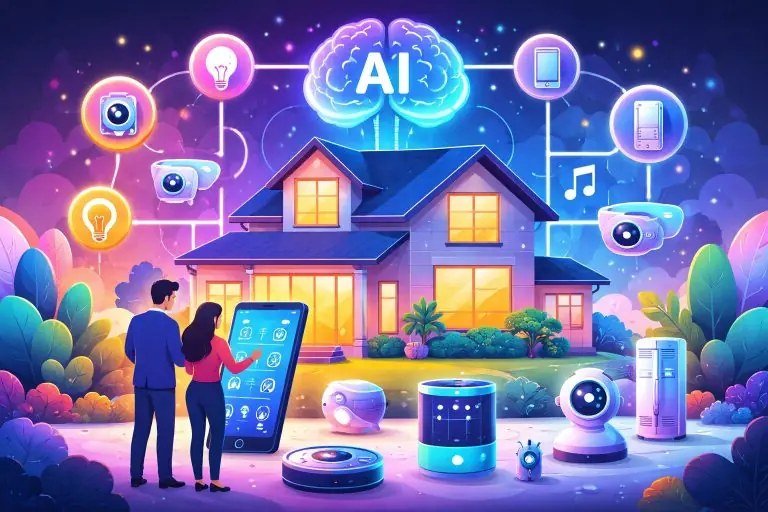
When people picture AI, they imagine robots or chatbots. But if you’re wondering how AI is being used in everyday life, the honest answer is: it’s already everywhere, quietly doing unglamorous jobs you’ve stopped noticing. You probably interacted with a dozen AI systems before breakfast today. Let’s pull back the curtain.
How Is AI Being Used in Everyday Life? Start With Your Phone
Start with the thing in your pocket. Your phone’s camera uses AI to decide exposure, sharpen faces, and turn night shots into something usable — that “night mode” miracle is machine learning, not magic. Voice assistants transcribe and understand your speech with AI. Your keyboard’s autocorrect and predictive text? AI. Photo apps that find “beach” among 10,000 pictures without you tagging anything? AI image recognition.
Then there’s the most useful AI feature on your smartphone — whether that’s live translation, spam call filtering, or the assistant that summarizes your notifications. These features feel like “just how phones work now,” which is exactly the point: the best everyday AI is invisible. It doesn’t announce itself; it just makes the thing work better.
The AI Running Your Home and Commute
Your thermostat learned your schedule. Your doorbell camera distinguishes a person from a passing cat. Your streaming services’ recommendations — the eerily accurate “because you watched” rows — are AI models trained on millions of viewing patterns. Navigation apps reroute you around traffic using AI predictions built from real-time driver data.
Even your inbox is AI-managed: spam filters catch the junk, priority inboxes surface the important stuff, and smart replies draft responses. Online, AI is quietly changing how you shop — from search results ranked for you personally to chatbots answering sizing questions at midnight. None of this feels futuristic anymore, which tells you how thoroughly AI has blended into normal life.
AI at Work and in Public Services
At work, AI drafts emails, transcribes meetings, summarizes long documents, and flags anomalies in spreadsheets. Customer service chats increasingly start with AI triage before a human steps in. Banks use AI to flag fraudulent charges in real time — that text asking “did you just spend $400 in another state?” is a model doing its job.
In public life, AI helps doctors spot issues in scans, helps cities time traffic lights, and powers the weather models behind your forecast app. None of these replaced the humans involved; they gave the humans better information faster. That’s the pattern of everyday AI: augmentation, not replacement.
A Day in the Life: The AI You Don’t Notice
Let’s trace one ordinary day and count the AI encounters — you’ll be surprised.
6:30am: Your alarm’s smart wake feature roused you during light sleep. The weather app’s forecast — AI-enhanced modeling — told you to grab a jacket. Your phone’s news briefing was algorithmically curated for your interests.
8:00am: The commute: navigation rerouted you around an accident using real-time AI traffic prediction, saving 15 minutes you never knew you saved. Your music app’s “morning mix” was machine-curated. Spam calls were silently screened.
12:00pm: Email’s smart replies drafted responses; the spam filter caught eleven junk messages invisibly. Your lunch spot was suggested by maps based on your habits. The food delivery app’s estimated time was an AI prediction.
3:00pm: Work: the document you dictated was AI-transcribed, the spreadsheet’s anomaly flag caught an error, and the customer chat widget answered three routine questions without human involvement.
7:00pm: Streaming recommendations picked your show. Your thermostat had pre-cooled the house, having learned your schedule. The doorbell camera distinguished the delivery driver from a stranger.
10:00pm: Your phone’s bedtime mode silenced notifications using learned patterns. The white noise app generated its soundscape algorithmically.
Count: roughly 20 AI interactions, zero of which felt like “using AI.” That’s the real story of [[i:97|AI in everyday life]] — not a robot revolution, but a thousand quiet optimizations. The implications are worth sitting with: this convenience runs on your data, it shapes your choices invisibly (that “personalized” feed is a choice architecture), and opting out entirely is increasingly impractical. The mature response isn’t rejection or blind embrace — it’s awareness. Notice the systems, understand the trade, decide deliberately. You’re already living in the AI future. Might as well be conscious in it.
Everyday AI FAQs
Is AI really “intelligent”?
Not in the human sense. Current AI is extraordinarily sophisticated pattern-matching — it predicts, classifies, and generates based on training data, without understanding, consciousness, or intent. “Intelligent” describes what it does (tasks requiring intelligence) not what it is. The distinction matters because it explains both the brilliance and the bizarre mistakes.
Will AI keep getting more capable?
Almost certainly, though the pace and direction are debated. What’s certain: AI is being embedded into more everyday tools, making the “invisible AI” trend accelerate. The practical move isn’t predicting the future — it’s building AI literacy now, so each wave is an opportunity rather than a disruption.
Should I be worried about AI?
Worried enough to stay informed, not so worried you freeze. The realistic concerns are concrete: privacy (your data training systems), misinformation (convincing fakes), job disruption (specific roles, gradually), and over-reliance (trusting AI for things needing human judgment). None require panic; all reward attention. Informed users get AI’s benefits while sidestepping its traps — which is the entire thesis of understanding it in the first place.
What This Means for You
Understanding everyday AI matters for two practical reasons. First, it demystifies the technology — once you see it’s mostly pattern-matching at scale, the hype and the fear both shrink to reasonable size. For the technical background, the overview of artificial intelligence covers how these systems actually work. Our plain-English explainer on what generative AI actually is and how to explain AI to your grandparents can help you talk about it confidently.
Second, it reframes the privacy question. All this convenience runs on data — yours. That’s worth thinking about deliberately rather than discovering later, which is why the privacy concerns around AI home devices deserve your attention. You don’t need to fear everyday AI or worship it. Just notice it, understand the trade-offs, and decide consciously what you’re comfortable with. It’s been part of your life for years — now you know where to look.


