How to Spot a Link Farm Before It Puts Your Business at Risk
Written by admin
Published November 26, 2026
Reading time 5 minutes
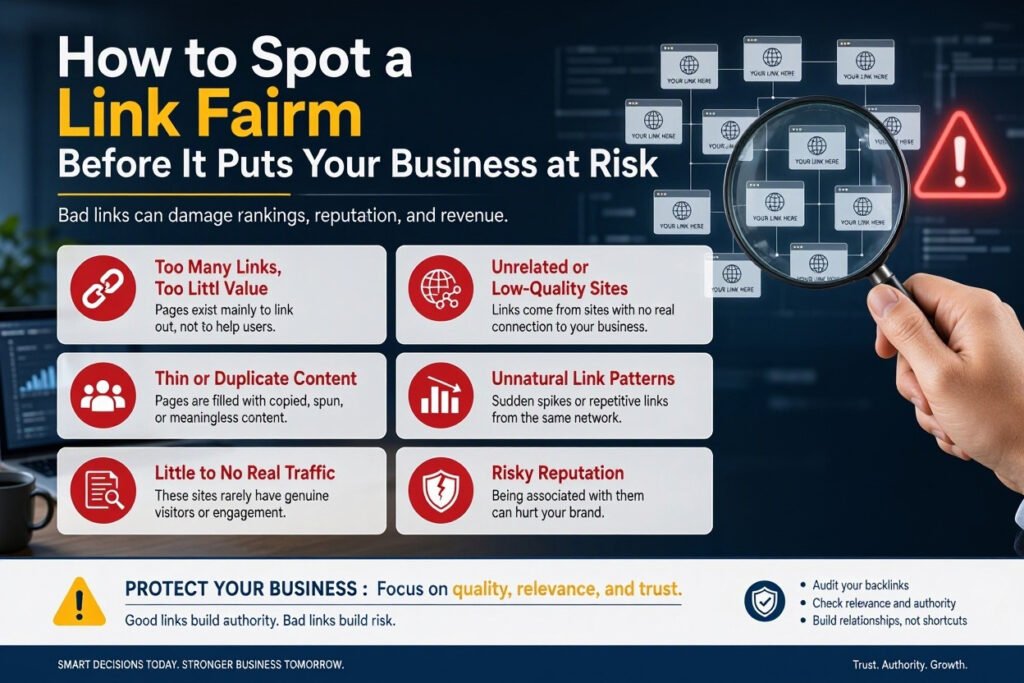
A link-building offer can look polished: a spreadsheet of websites, promises of fast rankings and a low price per placement. But if those sites exist mainly to publish links, the shortcut can become a liability. Knowing how to spot a link farm helps business owners, publishers and marketing teams judge whether a backlink is likely to build credibility—or just add noise to a profile search engines may distrust.
Why Link Farms Still Matter
A link farm is a group of websites, or a network of pages, created chiefly to link to other sites and manipulate search rankings. The pages may be packed with thin articles, unrelated topics and outbound links that have little editorial reason to appear together. Some networks are obvious; others imitate ordinary blogs, niche publications or business directories.
The risk is not that every paid placement or guest article is improper. A relevant article can introduce a business to a real audience, and a useful directory can help customers find a service. The warning sign is a link arranged primarily to influence rankings, without meaningful editorial standards or reader value. Search engines can discount manipulative links, and in serious cases a site may face ranking losses or other action.
How to Spot a Link Farm: Start With the Site
Do not judge a publisher by its domain name, design or a single metric from an SEO tool. Open several recent articles and ask whether the site feels like a publication with a defined readership—or a container for paid placements.
- Topics jump without a clear audience. A site may publish about accounting software, celebrity fashion, home repairs and cryptocurrency within a few days, with no apparent connection between its readers or editorial mission.
- Articles are thin or interchangeable. Look for vague introductions, recycled explanations, awkward wording and posts that offer little beyond a place to insert a link.
- Outbound links dominate the page. A long list of commercial links, especially to unrelated businesses, can indicate that publication is being treated as inventory.
- Publishing volume looks unnatural. A sudden flood of posts across unrelated subjects may suggest the site is built around placement sales rather than regular reporting or informed commentary.
- There is little evidence of an actual publication. Check for named editors or authors, clear contact information, consistent coverage and signs that readers engage with the work. No single missing detail proves misconduct, but a pattern matters.
Check the Link in Context
Even a legitimate website can publish a weak placement. Read the full article, not just the sentence containing the link. Does the linked page genuinely help someone understand the subject? Is the anchor text natural, or does it repeat a commercial search phrase exactly? Would the article make sense if the link disappeared?
Also inspect the surrounding links. A story about local restaurants that sends readers to an unrelated payday loan site is difficult to defend editorially. One incongruous link may be an isolated mistake; a repeated pattern across multiple posts points to a broader problem.
When assessing a vendor’s list, sample several domains rather than accepting a few impressive examples. Review their latest content, their older archive and the pages they link to. Ask how placements are selected, whether the publisher can reject a submission, and whether sponsored content is identified appropriately. A seller that cannot explain its process—or guarantees ranking improvements from a fixed number of links—deserves extra scrutiny.
Separate Useful Outreach From a Shortcut
Guest posting is not automatically a link scheme. A thoughtful contribution can be valuable when it fits the publication, demonstrates expertise and serves its readers. The link should be a relevant citation or a natural way to explore a resource, not the only reason the article exists.
For teams considering guest-posting opportunities, apply the same checks to every proposed blog: inspect the site yourself, read the editorial guidelines and ask what audience the article is meant to reach. Treat a large inventory of placements as a starting point for review, not proof that each publication is worthwhile.
It also helps to set a sensible objective before commissioning content. Are you trying to reach a specific community, explain a product category or earn a citation from a source people already read? If the only success measure is a keyword ranking, it becomes easier to justify low-quality placements. Track referral visits, relevant inquiries and the quality of the surrounding coverage alongside search visibility.
Budget for the Work, Not Just the Link
Search strategy often overlaps with other digital investments. A company planning an app, for example, may need to balance development costs against content, analytics and customer acquisition. Osdire’s mobile app development cost breakdown can help frame that budgeting conversation. The point is broader: make room for work that builds a durable product and audience, rather than spending the entire marketing budget on placements whose quality is hard to verify.
For a small business, a modest program of useful articles, expert commentary and carefully chosen industry relationships may be slower than a bulk link package, but it creates assets customers can actually use. Keep records of outreach, publication terms and the pages that link to you. If a questionable arrangement has already happened, document it and seek qualified SEO advice before making changes; impulsive link removals or disavowals can create new problems.
The Practical Test
Before approving a backlink, ask three questions: Would the site publish useful material even without selling links? Does this specific article make sense for its audience? Would the link still be worth having if it passed no ranking value at all?
If the answers are mostly no, walk away. A credible backlink is earned in a context readers can understand. A link farm tries to make the link itself the product—and that is precisely the distinction a careful business should learn to see.