How to Reduce Food Waste as a Single Person in NYC
How to reduce food waste as a single person in NYC: smart shopping for one, storage tricks that double freshness, and meal strategies built for tiny kitchens.
Written by admin
Published November 7, 2026
Reading time 6 minutes
You live alone, cook for one, and somehow still throw away wilted greens, half a loaf of bread, and leftovers you meant to eat three days ago. It feels absurd — how does a single person waste so much food? But the economics are stacked against you: grocery packaging is designed for families, recipes serve four, and produce is sold in quantities that assume you are feeding a household. In a tiny NYC kitchen with a mini-fridge, the challenge is real.
Here is the single person’s system for wasting almost nothing — without eating sad, repetitive meals.
Why Single People Waste More (Per Person)
The math is structural. A bunch of kale is a bunch of kale whether you are one or four — but four people finish it before it wilts. Recipes scale down badly (half an onion still leaves half an onion). Bulk “deals” are anti-deals for singles (the big bag of spinach that rots is not a savings). And the EPA’s food waste data confirms households waste roughly a third of food — with single-person households wasting more per capita than larger ones.
The fix is not willpower; it is a system designed for one. Every strategy below assumes a single cook, a small fridge, and NYC grocery realities.
Shop Like a Single Person, Not a Family
Shop more often, buy less. NYC’s grocery density is your superpower — the store is blocks away, so abandon the weekly mega-shop. Two or three small trips weekly means produce is always fresh and nothing languishes. This single change eliminates most waste.
Buy from the salad bar, bulk bins, and deli counter. Need two tablespoons of olives, a single chicken breast, or a cup of grains? Buy exactly that. The per-unit price is higher; the total waste is zero; the net cost is lower. Do the real math: the “cheap” family pack you half-throw-away costs more than the precise small quantity.
Frozen is your friend. Frozen vegetables, berries, and proteins are nutritionally equivalent (often superior — frozen at peak ripeness), last months, and let you use exactly what you need. The stigma is outdated; the practicality for singles is unmatched.
Ugly produce and markdown racks. Many NYC grocers discount produce nearing its prime — perfect for same-day cooking. Feeding America notes that “imperfect” produce is a major waste stream; buying it is environmentalism with a discount.
For the money side of all this, our guide to saving money on groceries every month and stretching a small grocery budget pair directly with waste reduction — the strategies are nearly identical.
Store Like You Mean It
Most produce waste is storage failure, not overbuying. The essentials:
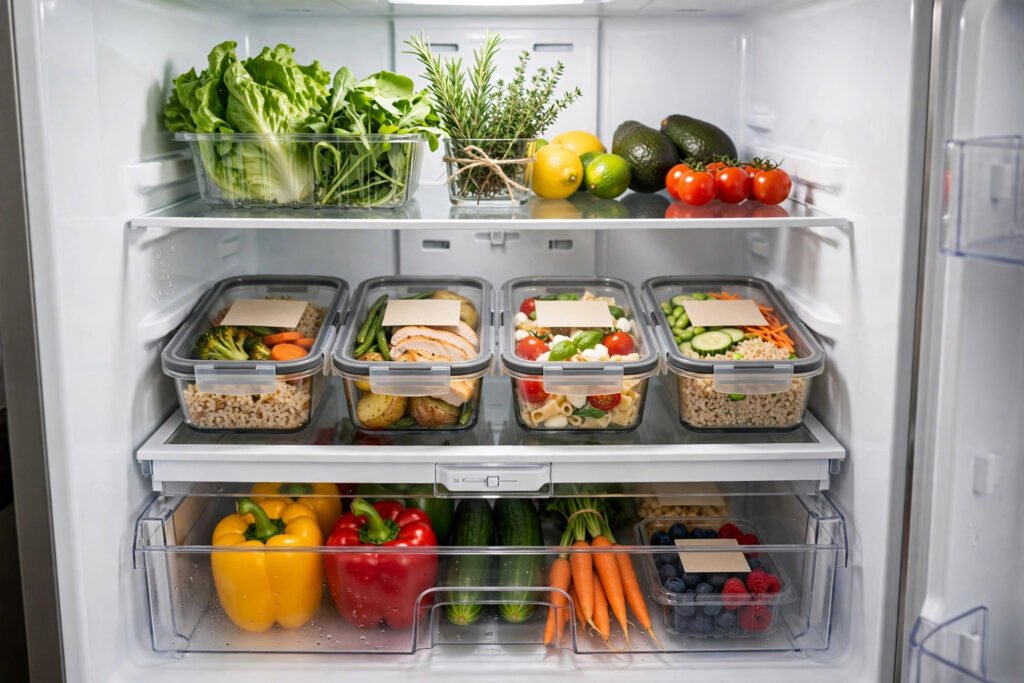
Greens: wash, dry thoroughly, store with a paper towel in a sealed container — lasts 2x longer. Herbs: treat like flowers — stems in water in the fridge (basil at room temp). Berries: do not wash until eating; a vinegar-water rinse extends life dramatically. Onions/potatoes: cool, dark, separate (onions’ ethylene sprouts potatoes). Bread: freeze half the loaf on day one; refresh slices in the toaster.
Learn your fridge zones: door = condiments (warmest); top shelf = ready-to-eat; middle = dairy; bottom = raw meat; crisper drawers = produce (high humidity for leafy, low for fruits). Most mini-fridges run warm — keep a thermometer and aim for 37–40°F.
The USDA’s FoodKeeper guidance gives specific storage times for hundreds of foods — bookmark it and stop guessing.
Cook Like a Single Person
Component cooking. Instead of cooking full recipes, prep versatile components: a grain, a protein, roasted vegetables, a sauce. Mix and match through the week — variety without the “four servings of the same casserole” fatigue. This is meal prepping for one, adapted.
The “use it up” meal. Designate one weekly meal for clearing the fridge: stir-fries, frittatas, fried rice, soups, and grain bowls accept almost anything. Professional kitchens call this “family meal” — it is the highest-skill, lowest-waste cooking there is.
Freeze in single portions. Soups, stews, cooked grains, sauces, bread, even milk and eggs (beaten, frozen in ice cube trays) — your freezer is a time machine for food. Label everything with dates; frozen meals older than 3 months get eaten this week.
Scale recipes intentionally. Halving recipes is a skill: halve everything except seasoning (season to taste), use smaller pans (surface area affects cooking time), and expect slightly shorter cook times.
Understand Dates (Stop Throwing Away Good Food)
“Sell by,” “best by,” “use by” — except for infant formula, these are manufacturer quality suggestions, not safety deadlines, and they are unregulated federally. Milk is typically good 5–7 days past its date if properly refrigerated and smelling fine. Eggs last 3–5 weeks refrigerated. Canned goods last years. Your senses — sight, smell, taste — are the real expiration dates for most foods. The premature disposal driven by date-label confusion is one of the largest single waste streams in American homes.
Compost the Unavoidable
Some waste is inevitable — peels, cores, coffee grounds, the occasional casualty. NYC’s curbside composting (brown bin, all boroughs) means even the unavoidable does not have to become landfill methane. Keep a small countertop container, empty it regularly, and close the loop. Apartment-friendly and odor-free if managed right.
The Single-Person Pantry: Stocking for Zero Waste
Waste prevention starts at the pantry, not the fridge. A well-designed single-person pantry makes waste nearly impossible: staples in bulk (rice, lentils, oats, pasta — bought in exact quantities from bulk bins, lasting months without spoiling); a tight spice rotation (ten spices you actually use beats thirty that go stale); condiments as flavor insurance (soy sauce, hot sauce, mustard, vinegar — they last nearly forever and rescue boring leftovers, preventing the “I am tired of this” waste); frozen backups (frozen dumplings, frozen berries, frozen bread — the emergency reserves that prevent desperate takeout and the wasted groceries it displaces). The principle: every item in a single person’s kitchen should either last months or be consumed within days — nothing in between. Audit your shelves quarterly and evict anything that has sat untouched for six months. A lean pantry is a waste-free pantry, and it makes the daily “what is for dinner” question answerable in seconds.
Conclusion
Reducing food waste as a single person in NYC means: shop small and often, buy precise quantities (bulk bins, frozen, markdowns), store produce correctly, cook components not casseroles, freeze single portions, trust your senses over date labels, and compost the rest. None of this requires more time or money — most of it saves both. The family-sized food system was not designed for you; build your own, and the waste stops.
Frequently Asked Questions
How much food does the average single person waste?
Single-person households waste more per capita than larger households — estimates suggest 25–40% of purchased food, driven by family-sized packaging, recipe scaling, and produce quantities designed for households.
Is frozen produce as nutritious as fresh?
Yes — often more so. Produce is frozen at peak ripeness, locking in nutrients, while “fresh” produce loses nutrients during transport and storage. For singles, frozen eliminates the spoilage race entirely.
How long does milk last past its expiration date?
Typically 5–7 days past the printed date if continuously refrigerated at 37–40°F and smelling/tasting normal. Date labels are quality estimates, not safety deadlines (except infant formula).
What is the best way to store fresh herbs?
Trim stems and stand in water in the fridge (like flowers) for parsley, cilantro, dill; keep basil at room temperature in water. Both last 2+ weeks this way versus days in a plastic bag.
Can you freeze bread, milk, and eggs?
Yes to all. Bread freezes perfectly (slice first); milk freezes well (thaw in fridge, shake before use); eggs freeze beaten (not in shell) — ice cube trays make perfect single-egg portions.