Best Home Workout Equipment Under $200 (2026 Picks)
What is the best home workout equipment under $200? Bands, a pull-up bar, a kettlebell and more — the exact gear to buy in priority order, plus what to skip.
Written by admin
Published October 22, 2026
Reading time 6 minutes
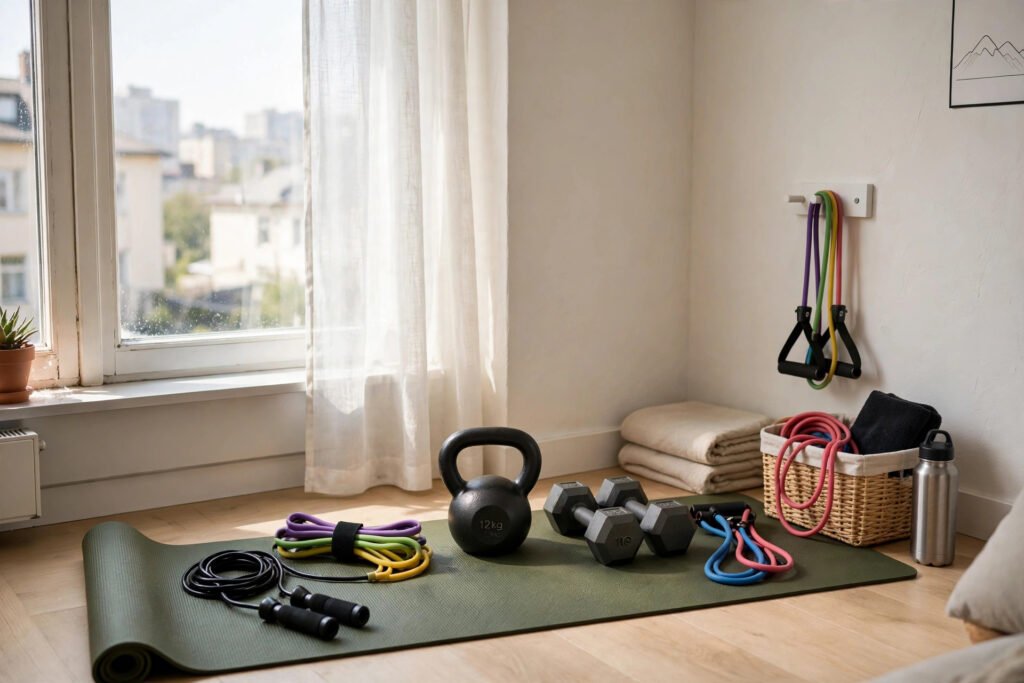
You do not need a $2,000 home gym to get seriously fit at home. With a $200 budget and smart choices, you can assemble a setup that covers strength, cardio, mobility, and core — everything a beginner or intermediate trainee needs — and it all fits in a closet. The trick is buying versatile, proven equipment instead of infomercial gadgets. Here is exactly what to buy, in priority order, with real 2026 price ranges.
The ground rules: what makes equipment worth buying
Before the list, the filter every item must pass: it must enable progressive overload (you can make it harder over time), it must serve multiple exercises, and it must survive daily use. A $30 ab wheel that lasts five years beats a $150 “smart” gadget that becomes a clothes rack by March. Adjustable and bodyweight-leveraged tools win; single-use machines lose. If you are pairing equipment with a bodyweight foundation, our guide to the best beginner exercises at home shows you the movements this gear will amplify.
1. Adjustable resistance bands set (~$30–$40)
The single best value in home fitness. A set of loop or tube bands with handles (typically 10–150 lbs of combined resistance) replaces an entire dumbbell rack for pressing, rowing, squatting, and curling. Bands add accommodating resistance — they get harder at the top of the movement, where you are strongest — which makes them joint-friendly and brutally effective for hypertrophy. Anchor them in a door (most sets include a door anchor) and you can replicate cable-machine exercises: face pulls, lat pulldowns, chest flyes. Buy a set with fabric-covered loop bands rather than bare latex tubes; they do not roll, snap, or pinch skin.
2. Doorway pull-up bar (~$25–$40)
No piece of equipment builds the upper back, lats, and biceps like pull-ups, and a doorway bar installs in seconds with no screws on most door frames. Even if you cannot do one pull-up yet, the bar enables dead hangs (fantastic for grip and shoulder health) and assisted variations with a band looped over it. Work from hangs to negatives to full reps — a journey that can take months and builds serious strength the entire way. Check your door frame’s molding depth before buying; most bars fit standard 24–36 inch frames and support 250–300 lbs.
3. Adjustable dumbbells or a kettlebell (~$50–$90)
This is where the budget gets real choices. Option A: a single adjustable dumbbell (dial-a-weight style, 5–52 lbs) runs $80–$150 new — over budget alone, so look for used pairs on local marketplaces where they routinely sell for $50–$80. Option B: one 35-lb kettlebell (~$50–$70) unlocks swings, goblet squats, presses, rows, and carries — arguably the most versatile single weight ever made. For most people under $200 total, the kettlebell plus bands covers everything. Kettlebell swings alone, per ACE Fitness research summaries, deliver a potent mix of strength and cardio conditioning in 15-minute sessions.
4. Yoga mat (thick) + foam roller (~$30–$40 combined)
A 6mm+ thick mat ($20–$30) protects knees and elbows on hard floors and defines your workout space psychologically — unrolling it is a ritual that tells your brain it is training time. A basic foam roller ($10–$15) handles the mobility and recovery side: five minutes of rolling quads, lats, and thoracic spine after sessions noticeably reduces next-day soreness. Skip the vibrating $80 rollers; the $12 one does the same job.
5. Jump rope (~$10–$15)
The most underrated cardio tool in existence. Ten minutes of jump rope intervals torches roughly as many calories as 30 minutes of jogging, builds calf and ankle resilience, and fits in a drawer. A simple speed rope with ball bearings ($12) is all you need — the weighted and “smart” ropes are solutions in search of a problem. If you live below neighbors, jump on your mat or take it to the hallway; the impact noise is real.
6. Ab wheel (~$12–$18)
Kneeling rollouts are one of the hardest, most effective core exercises ever devised — they hammer the entire anterior chain, not just the abs. A basic dual-wheel roller costs less than a pizza and will humble anyone. Start with limited range (roll to a wall) and extend over weeks; the eccentric loading is intense, so soreness the first week is normal.
Sample $200 cart (two build options)
The strength-first build (~$195)
Bands set ($35) + pull-up bar ($30) + used adjustable dumbbell ($70) + thick mat ($25) + jump rope ($12) + ab wheel ($15) + foam roller ($12) = $199. Covers every movement pattern with real loading potential.
The minimalist build (~$120)
Bands set ($35) + pull-up bar ($30) + kettlebell 35 lb ($55)… that is $120 and honestly enough for a year of progress. Add the mat, rope, and wheel as motivation milestones — rewarding consistency with gear upgrades is a legitimate adherence trick. To structure it all, using AI to create a workout plan can turn your new equipment into a periodized weekly program in minutes.
What NOT to buy
All-in-one “smart” home gyms ($1,000+) — great products, wrong budget conversation. Shake weights and toning gadgets — no progressive overload, no results. Cheap adjustable benches under $80 — wobbly, unsafe, and unnecessary when the floor works. A second cardio machine — one jump rope plus bodyweight circuits covers conditioning; the treadmill can wait. And anything requiring a subscription to function — your $200 budget should not come with a $40/month tail. Desk workers adding evening sessions should also address the other 23 hours: our guide to improving posture at a desk pairs perfectly with a new home routine.
Making it last: the unsexy part
Equipment does not get you fit; the 150 sessions you do with it do. Keep everything visible, not buried in a closet — friction kills home workouts faster than anything. Schedule sessions like appointments, follow a written program (even a simple one), and track your reps. The gear above is proven, but it is the consistency that compounds. Per CDC physical activity guidelines, adults need at least 150 minutes of moderate activity weekly plus two days of muscle-strengthening — this $200 setup covers both, indefinitely.
Conclusion
Two hundred dollars buys you a genuinely complete home gym: bands for versatile resistance, a pull-up bar for back development, a kettlebell or dumbbell for loaded strength, a mat and roller for floor work and recovery, a rope for cardio, and a wheel for core. No subscriptions, no assembly nightmares, no spare bedroom required. Buy in priority order, train three to four times a week, and reassess in six months — by then the only upgrade you will want is heavier weight, which is the best problem in fitness to have.
Frequently Asked Questions
Can I build muscle with just $200 of home equipment?
Yes. Resistance bands, a pull-up bar, and a kettlebell provide progressive overload for every major muscle group. Studies show similar hypertrophy from band and free-weight training when sets are taken near failure.
What is the first thing I should buy for a home gym?
A resistance band set. It is the cheapest, most versatile option — it enables pressing, rowing, squatting, and curling variations, stores in a drawer, and costs around $30.
Are adjustable dumbbells worth it on a budget?
New dial-style dumbbells usually exceed a $200 total budget alone, but used ones frequently sell for $50–$80 locally. A single kettlebell is often the better budget buy for the same money.
How much space do I need for a home gym?
A 6×6 foot clear area handles everything on this list. All of it stores in a closet or under a bed when not in use.
Do I need a bench for home workouts?
No. Floor presses, Bulgarian split squats with a chair, and band work cover the same patterns. A bench is a nice-to-have, not a need, at this budget.