
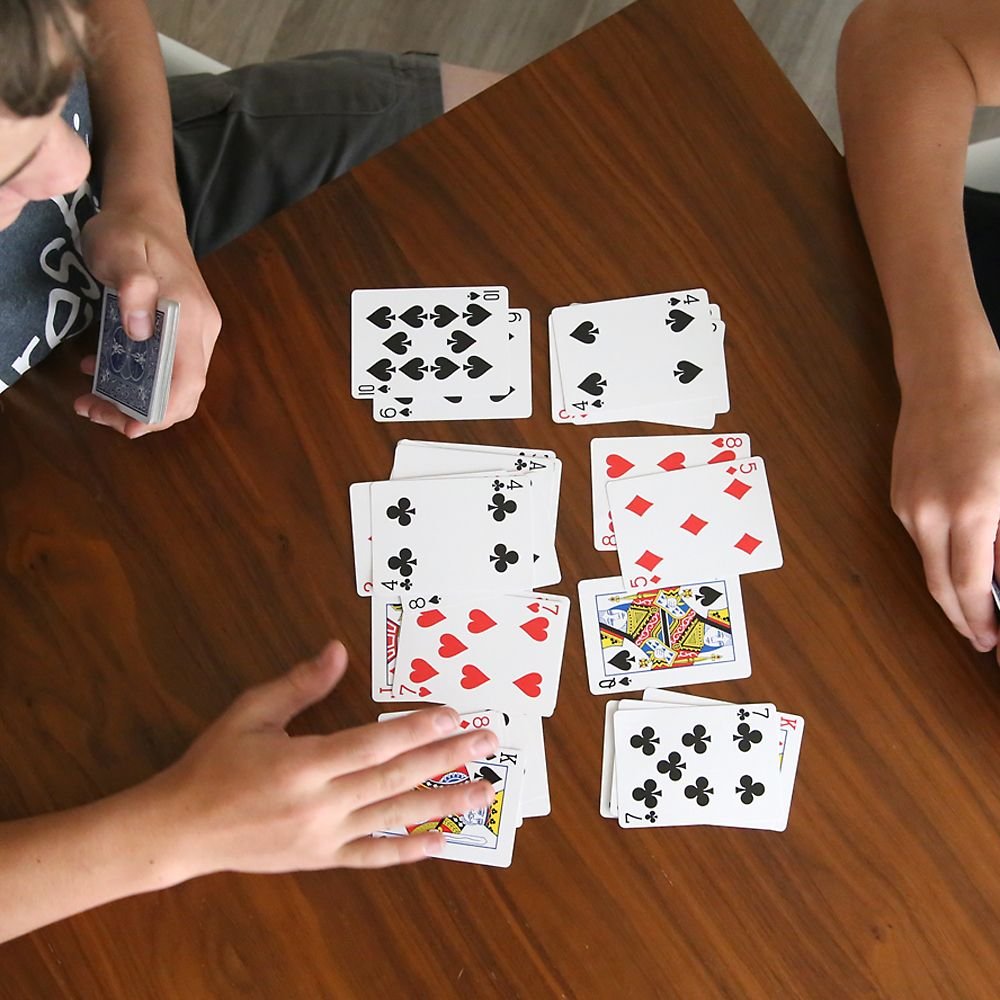
A deck of cards is the most versatile entertainment object ever made — $3, fits in a pocket, and contains hundreds of games. But most families only know Go Fish and War, which get old fast. If you want good card games to learn for family nights, here are the ones worth your time: easy to learn, fun across ages, and varied enough that game night never gets stale.
What Are Good Card Games to Learn for Family Nights? By Age Group
For young kids (ages 4–7)
Go Fish. The classic for a reason — teaches matching, turn-taking, and basic strategy (“do you have any…?”). Every kid learns it, every parent remembers it. Play with a standard deck or the themed versions.
War. Zero strategy, pure luck — flip cards, high card wins. It’s basically a random number generator, but 5-year-olds find it thrilling. The real value: it teaches number comparison and handling winning/losing gracefully.
Slapjack. Flip cards onto a pile; slap the pile when a Jack appears. Fast, physical, hilarious. Teaches reflexes and attention. (Establish the “no bloody knuckles” rule upfront — slapping hands gets enthusiastic.)
Old Maid. Pass cards, make pairs, avoid ending with the Old Maid. Simple, quick, and the “don’t get stuck with it” tension is perfect for little kids.
For older kids (ages 8–12)
Uno. Technically its own deck, but it’s a card game and families love it. The special cards (skip, reverse, draw four) add strategy and drama. House rules vary wildly — establish yours before starting to avoid the “that’s not how we play it” argument. (For the record: the official rules say no stacking draw cards. Your family will ignore this.)
Crazy Eights. Uno’s ancestor with a standard deck — match suit or rank, eights are wild. Slightly more strategic than Uno, and it teaches the shedding-game concept.
Golf (the card game). Each player has a grid of face-down cards, trying to get the lowest score by swapping. Simple, quick rounds, surprising depth. Great for 2–6 players.
Spit / Slam. Speed-based — two players race to play cards onto shared piles. Frantic, loud, addictive. Best as a two-player duel while others watch and heckle.
For teens and adults
Hearts. The classic trick-taking game — avoid taking hearts and the queen of spades. Easy to learn, genuinely strategic, perfect for 4 players. The “shooting the moon” mechanic (taking all the penalty cards for a huge swing) creates legendary moments.
Spades. Partnership trick-taking with bidding — you and your partner bet on how many tricks you’ll take. More complex than Hearts, deeply satisfying. The standard for “serious” family card nights.
Rummy (and Gin Rummy). Collect sets and runs — the foundation of a hundred card games. Gin Rummy (2-player) is the purest form; regular Rummy handles bigger groups. Teaches pattern recognition and probability.
Poker (for chips, not cash). Texas Hold’em with poker chips or pennies — the betting, bluffing, and reading people make it endlessly engaging for teens and adults. Keep stakes symbolic; the game is the point, not the money.
President / Scum. Shedding game with a social hierarchy — the winner becomes President, the loser becomes Scum (with hilarious handicaps). The power dynamics make every round different. Huge with teens.
The modern classics (special decks worth owning)
Exploding Kittens. Russian roulette with kittens — strategic, silly, beautiful art. The gateway modern card game; 15 minutes to learn, endlessly replayable.
Sushi Go! Draft the best sushi meal — adorable, quick (15 minutes), and teaches drafting mechanics that underpin serious board games. Perfect family weight.
The Crew. Cooperative trick-taking in a tiny box — work together to complete missions. Brilliant, quiet, and deeply satisfying. My board game guide covers it too.
Love Letter. 16 cards, 20 minutes, surprising depth — deduce and outplay in a tiny package. The best filler game ever made.
Teaching Tips (How to Not Ruin Game Night)
- Learn it yourself first. Fumbling through rules with everyone watching kills momentum. Play a practice round solo or watch a 5-minute tutorial.
- Teach the goal first, then the turn. “We’re trying to get the lowest score. On your turn, you flip two cards…” — context before mechanics.
- Play an open practice round. First round with cards face-up, talking through decisions. Then play for real.
- Start simple, add complexity. Hearts before Spades. Go Fish before Rummy. Let skills build naturally.
- Keep it moving. Analysis paralysis kills card games — gentle time nudges for slow players.
Making It a Tradition
The families with the best card traditions keep it simple: a regular night (Friday cards, Sunday Spades), a running score (season-long tournament with a silly trophy), rotating game choice (each person picks next week’s game), and snacks (the game night snack rules apply — nothing greasy on the cards). My game night hosting guide has the full setup playbook.
The Practical Takeaway
Good family card games: Go Fish, War, Slapjack for littles; Uno, Crazy Eights, Golf for older kids; Hearts, Spades, Rummy, Poker for teens/adults; Exploding Kittens, Sushi Go, Love Letter as modern essentials. Teach goal-first, practice open-handed, keep it moving.
Grab a deck tonight and teach someone Hearts. In a week, you’ll have a family tradition.
Card Games for Two (Date Night and Beyond)
Most card games want 3+, but the two-player shelf is deeper than people think. Gin Rummy is the classic — quick, strategic, endlessly replayable. Spit/Slam for the adrenaline junkies. Love Letter plays great at two (deduction gets deliciously tense). Jaipur and 7 Wonders Duel are board-game-adjacent two-player masterpieces worth owning. Cribbage — the old-school two-player game with the peg board; learning it feels like joining a secret society, and it’s genuinely one of the best-designed card games ever. Two-player games are perfect for date nights, quiet evenings, and travel (a deck of cards weighs nothing and entertains for hours). Keep a deck in your bag — you never know when a delayed flight becomes a Gin Rummy tournament.
As your family’s card skills grow, explore the wider world: bridge for the strategically minded (the deepest card game ever designed), canasta for big groups, euchre (a Midwest obsession worth joining), and the endless shedding games of the world. Every culture has its card tradition — learning your grandparents’ game connects you to family history in a way nothing else does. Ask the oldest card player you know to teach you theirs. That lesson is worth more than any rulebook.
For official rules to hundreds of card games, Bicycle’s how-to-play library has clear, illustrated instructions for everything from Hearts to Spades.


