
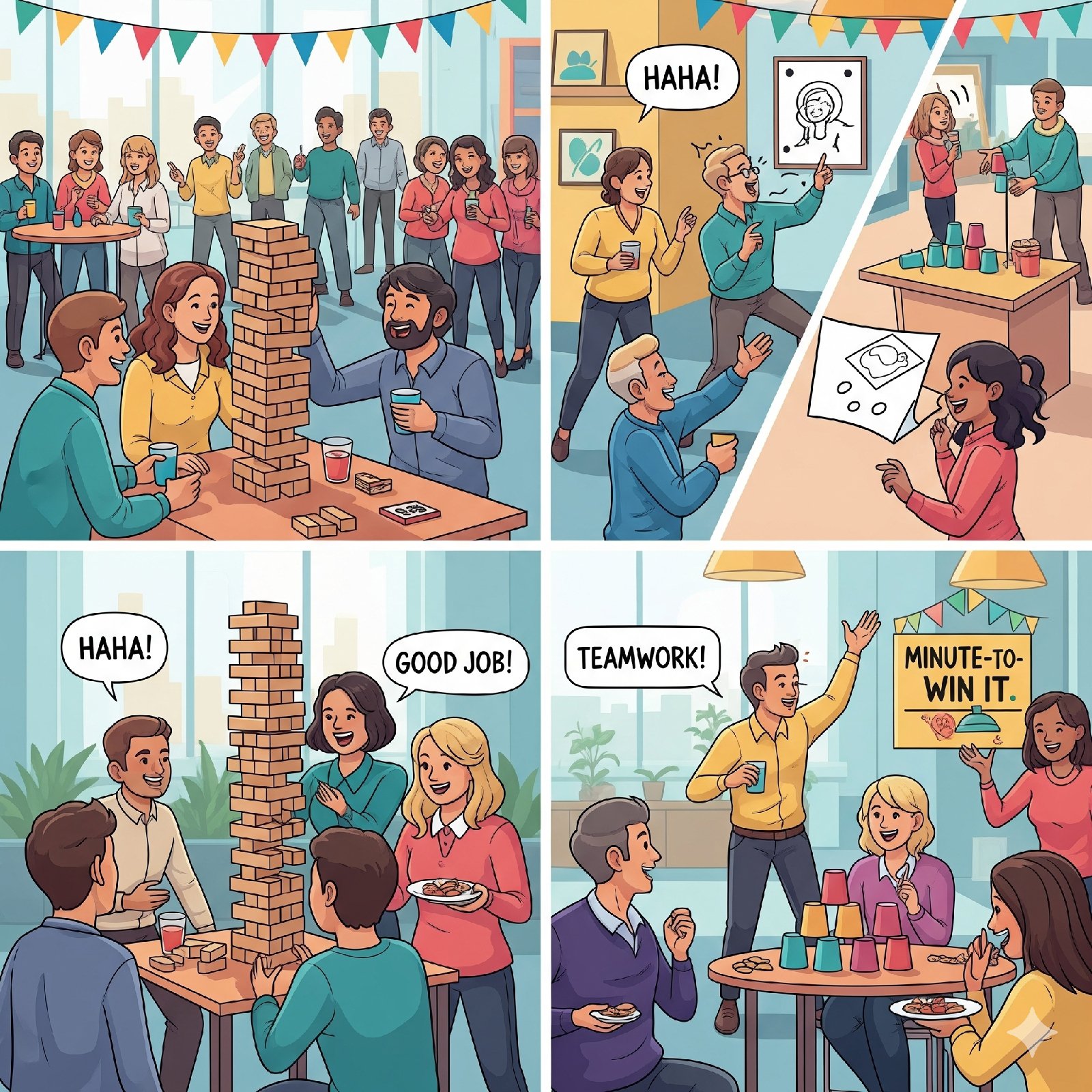
Work parties have a specific awkwardness: people who email each other daily but have never had a real conversation, standing around with drinks, talking about projects. Icebreaker games get a bad rap — the trust falls, the forced fun — but the good ones genuinely work. They give people something to do besides small talk, create shared stories, and loosen up the room. Here are good icebreaker games for a work party that adults won’t hate, organized from low-key to high-energy.
The golden rule of work icebreakers: make them opt-in comfortable. Nobody should feel singled out, embarrassed, or forced to reveal something personal. The best work games are team-based (safety in numbers), short (10–20 minutes), and funny rather than deep.
What Are Good Icebreaker Games for a Work Party? The Safe Bets
Two truths and a lie (work edition)
Everyone writes two true things and one lie about themselves — but with a work twist: one must be work-related (“I’ve worked here 7 years,” “I once presented to the CEO in mismatched shoes”). The group guesses the lie. It’s revealing without being invasive, and people learn surprising things about colleagues. Works for groups of 10–50; split larger groups into teams.
Human bingo
Custom bingo cards with squares like “has been to more than 5 countries,” “can juggle,” “joined the company this year,” “has a pet reptile.” Everyone mingles to find people matching squares, getting signatures. First to complete a row wins. Why it works: it forces mingling with a purpose — the introverts’ dream, because “I’m doing the bingo thing” is a perfect conversation opener. Make the squares specific to your company for insider laughs.
Trivia: company edition
Mix general trivia with company-specific questions: founding year, the CEO’s first job, office lore, product trivia. Teams of 4–5, 3–4 rounds. My trivia night guide has the format and general questions — add 10 company questions and it’s instantly personalized. Competitive departments get very into this.
The marshmallow-spaghetti tower
Teams get spaghetti, tape, string, and a marshmallow; tallest freestanding tower in 18 minutes wins. It’s a classic team-building exercise because it actually works — it forces collaboration, it’s hilarious to watch, and the engineering reveals team dynamics. Plus it’s tactile and silly, which breaks down hierarchy fast (the intern’s tower beats the VP’s — great equalizer).
Step It Up (Higher Energy)
Office scavenger hunt
Teams race to find or photograph items around the office: “something older than the company,” “the best view,” “a photo with someone from another department.” Photo-based hunts work great — teams submit to a shared album, judged at the end. Gets people moving and exploring parts of the office they’ve never seen.
Pictionary / charades: work edition
Standard rules, but the prompts are company-specific: project names, industry terms, “our Q3 goals” (acted out — always hilarious). The in-jokes write themselves. Split into teams, keep rounds to 60 seconds, and watch the normally-reserved finance team get weirdly competitive.
Speed networking (not as bad as it sounds)
Pair up for 3-minute conversations with prompt cards (“What’s the most interesting project you’ve worked on?” “What’s your hidden talent?”), then rotate. It’s structured enough that introverts can handle it, and 3 minutes is short enough that bad pairings don’t suffer. Way better than unstructured “mingle.”
Lip sync battle: department edition
Each department performs one song. The bar is low, the commitment is high, and the videos become company legend. Best for holiday parties or milestone celebrations rather than formal events — read the room on this one.
What to Avoid
- Anything physically risky or embarrassing. No trust falls, no eating challenges, nothing involving being blindfolded by coworkers. HR nightmares.
- Overly personal sharing. “Share your biggest failure” is a terrible work prompt. Keep it light.
- Forced participation. Always allow opting out gracefully. The person who doesn’t want to play shouldn’t feel punished.
- Games that take too long. 15–20 minutes max per activity. Work parties have limited patience.
- Anything with alcohol as the mechanic. Drinking at the party is fine; drinking games at a work event are a liability.
Logistics for the Organizer
Timing: schedule icebreakers for the first 30–45 minutes, when awkwardness peaks — not after everyone’s settled into conversations. Prizes: small but real — gift cards, extra PTO hours (the ultimate prize), silly trophies. MC: designate an energetic host; the organizer shouldn’t also run the games. Opt-outs: have a comfortable alternative (the bar area, a photo booth) so non-players don’t stand around awkwardly. For bigger event planning, my block party organizer guide covers logistics that scale.
For team-building beyond parties, see my guide to team-building activities for small groups.
The Practical Takeaway
Good work party icebreakers: human bingo and two-truths for mingling, company trivia and Pictionary for competition, spaghetti towers for teamwork, scavenger hunts for energy. Keep them short, team-based, opt-in, and prize-backed. Avoid anything embarrassing, personal, or alcohol-driven.
The goal isn’t forced fun — it’s giving people a reason to talk to the colleague they’ve emailed 500 times but never really met. That’s when work parties actually work.
Virtual Work Parties (The Remote Team Playbook)
Remote teams need this more than anyone — and it’s harder over video. What works: online trivia (my trivia guide has the format; Kahoot handles virtual scoring), virtual scavenger hunt (“find something in your home older than the company”), Jackbox games (screen-share + phones — Quiplash is perfect for work groups), “show and tell” (everyone shares one interesting object from their desk — surprisingly revealing), and virtual backgrounds contest (funniest/most creative wins). Keep it to 45–60 minutes max — video fatigue is real. Send a small gift box beforehand (snacks, a drink) so everyone’s sharing the same treats. The shared physical experience, even remote, makes it feel like an event instead of another meeting.
Remember that the best icebreaker is often no game at all — just good food, good drinks, and enough time for conversations to develop naturally. Games are tools for breaking the initial awkwardness, not the entire event. Once people are mingling comfortably, let the games end and the party breathe. The organizer’s real skill isn’t running activities; it’s reading the room and knowing when to step back. A work party where people genuinely enjoyed each other’s company — game-assisted or not — is a complete success.
For research-backed team building guidance, SHRM (Society for Human Resource Management) publishes practical resources on employee engagement and workplace culture.


