
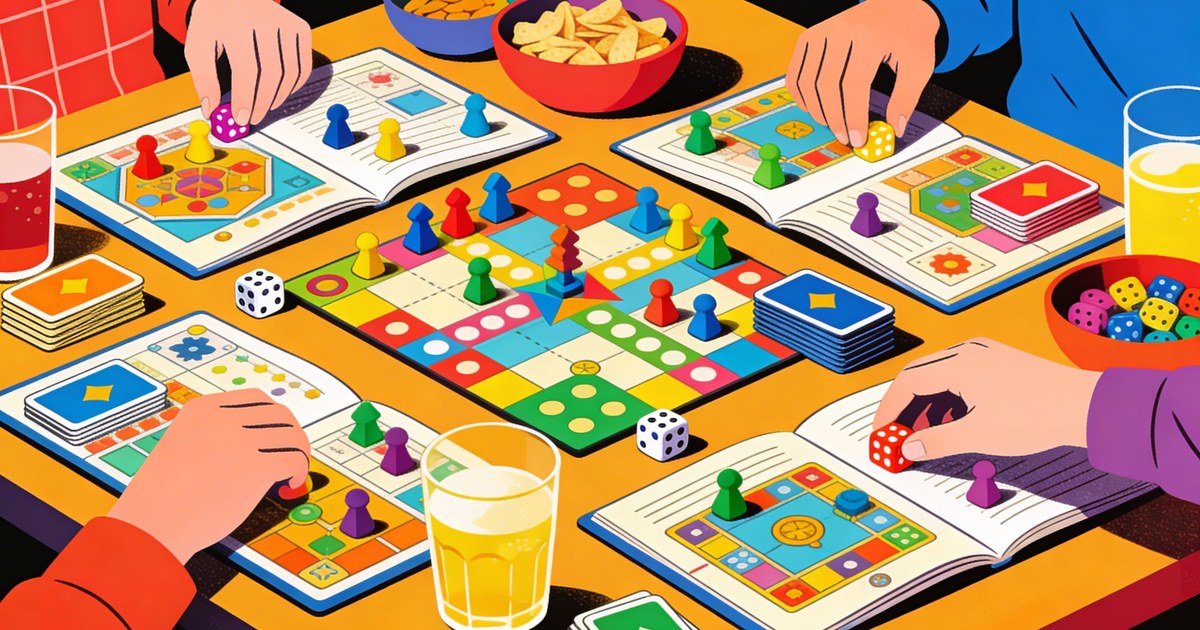
Adult game night lives or dies on the game choice. Pick wrong and you’ve got four people staring at a 40-page rulebook while the wine goes warm. Pick right and it’s 1 AM, everyone’s shouting, and someone’s demanding a rematch. If you’re looking for fun board games for a group of adults, here are the games that consistently deliver — organized by group size and energy level, with honest notes on what makes each one work.
My criteria: learnable in under 15 minutes (nobody wants homework), plays well with 4–8 people, generates laughter or lively debate, and doesn’t eliminate players early (sitting out for an hour while others play is the worst).
What Are Fun Board Games for a Group of Adults? The Tier List
The party games (4–10+ players, maximum laughs)
Codenames. The best party game ever made, full stop. Two teams, one spymaster per team giving one-word clues to connect multiple words on the grid. It’s a word-association puzzle that creates incredible “OH!” moments. Plays in 15 minutes, endlessly replayable, works with mixed groups including non-gamers. If you buy one game, make it this one.
Wavelength. A psychic-party game where one player gives a clue on a spectrum (hot–cold, good movie–bad movie) and the team guesses where the target lands. Sparks hilarious debates about where things fall on absurd spectrums. Brilliant with 4–8.
Just One. Cooperative party game: everyone writes a one-word clue for a mystery word, duplicates get erased, the guesser sees what’s left. Simple, funny, and the duplicate-erasing creates great tension. Excellent for groups that include shy players — low pressure, high laughs.
Telestrations. Telephone meets Pictionary. Draw, guess, pass — the results devolve hilariously. The bigger the group, the funnier. Zero skill required, which is the point.
The strategy games (3–6 players, thinky but accessible)
Ticket to Ride. The gateway strategy game. Collect cards, claim train routes across the map. Rules take 5 minutes to learn, but there’s real tactical depth in blocking opponents. Beautiful, relaxing, and competitive without being cutthroat. Perfect for game-night beginners.
Carcassonne. Tile-laying game where you build a medieval landscape together while competing for control of cities, roads, and fields. Simple turns, surprising depth, plays in 35 minutes. Great for 2–5 players.
Splendor. Collect gems, buy cards, attract nobles. An engine-building game that teaches in 10 minutes and reveals its depth over multiple plays. Elegant, quick (30 minutes), and the poker-chip components feel fantastic.
Azul. Draft beautiful tiles to complete patterns. Abstract, gorgeous, and the rare strategy game that’s genuinely relaxing to play. Easy to teach, hard to master.
The social deduction games (5–10 players, lying to friends)
The Resistance / Avalon. Hidden traitors sabotage missions while the loyal players try to figure out who’s lying. Creates incredible accusations and dramatic reveals. Needs 5+ to shine; best with 7–10. Not for conflict-averse groups — the lying is the game.
Secret Hitler. Similar hidden-role concept with a political theme and more structure. Excellent with 7–10, plays in 30–45 minutes. The policy-passing mechanic gives quieter players ways to contribute.
The co-ops (play together, not against)
Pandemic. Work together to cure diseases before the world is overrun. Tense, collaborative, and nobody gets eliminated. Great for groups that don’t love direct competition. (The theme hits different now, but the game design is superb.)
The Crew. A cooperative trick-taking game in a tiny box. Deceptively simple, surprisingly deep, and plays up to 5. Perfect travel game too.
Choosing for YOUR Group
- Mixed gamers + non-gamers? Codenames, Wavelength, Just One — party games with near-zero learning curve.
- Everyone’s competitive? Ticket to Ride, Splendor, Azul — strategy without cruelty.
- Big group (8+)? Codenames (split into teams), Telestrations, Wavelength, or run two tables.
- Drinking involved? Keep it light — party games only. Complex strategy + alcohol = abandoned game.
- Short on time? Just One, The Crew, Love Letter (15-minute filler game worth owning).
Hosting Tips That Matter More Than the Game
Have snacks that don’t grease up the components (nobody wants Cheeto-dusted cards). Keep the rules explanation under 10 minutes — learn it yourself beforehand and teach by playing a practice round. Start with something light while people arrive and settle in. And have a backup filler game for when the main event ends early. For the full hosting playbook, see my guide to hosting a game night everyone enjoys — and if your group prefers cards, card games for family nights has more picks.
Where to Buy (and Try Before You Buy)
Your local game store (not the big-box aisle) is worth visiting — staff recommendations are excellent and many stores have demo libraries. BoardGameGeek is the definitive database: ratings, reviews, player counts, and complexity ratings for every game ever made. Many games also have free app versions or Tabletop Simulator mods for trying before buying.
The Practical Takeaway
Fun adult board games = Codenames for the sure thing, Wavelength/Just One for laughs, Ticket to Ride/Splendor/Azul for strategy, Resistance/Avalon for drama, Pandemic for teamwork. Match the game to your group’s size and competitiveness, teach rules in under 10 minutes, and keep the snacks component-safe.
Buy Codenames this week. Your next gathering is about to get a lot more interesting.
Building a Game Collection on a Budget
You don’t need a shelf of fifty games — five great ones cover every situation. Start with Codenames (party), Ticket to Ride (strategy gateway), and Just One or Wavelength (easy laughs). Add one social deduction game (The Resistance) and one co-op (Pandemic) and you’re set for any group, any mood. Buy used: BoardGameGeek’s marketplace, local game store trade-ins, and thrift stores regularly have near-mint copies for half price — board games are durable and previous owners barely dent them. Many libraries now lend games too, which is perfect for try-before-you-buy. And resist expansion packs until you’ve played the base game at least five times; most groups never exhaust the base game, and expansions add complexity that casual players don’t want.
The beautiful thing about board games is how they reveal people — the quiet friend who turns ruthless in Codenames, the strategist nobody suspected, the terrible liar everyone loves anyway. A year of game nights gives you stories and inside jokes that no other activity produces quite the same way. So build the collection slowly, host regularly, and watch your friend group develop its own mythology, one game night at a time.


