
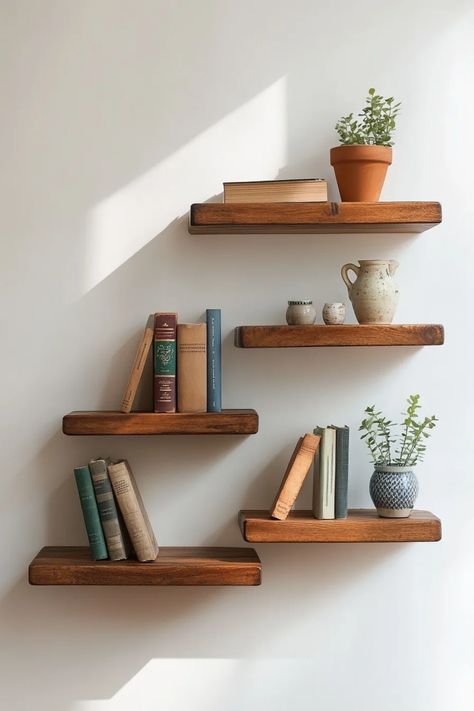
A shelf loaded with books crashing down at 2am is a special kind of disaster — damaged walls, broken belongings, and occasionally injuries. The difference between a shelf that holds for decades and one that fails is entirely in the mounting. So how do I hang heavy shelves on drywall safely? The short version: hit studs whenever possible, use the right anchors when you can’t, and respect weight ratings. Here’s the complete guide.
Rule #1: Find the Studs
Studs (the vertical 2×4s behind your drywall, typically 16″ apart) are the only thing in a wall designed to hold weight. A screw driven 1.5″+ into a stud holds 50–100+ pounds. Drywall alone holds almost nothing — the paper facing tears under sustained load.
- Use an electronic stud finder ($15–$25) — slide slowly, mark both edges, the center is between them.
- Verify by driving a thin finish nail — you should feel solid resistance after 1/2″–5/8″ of drywall.
- Plan shelf placement around studs, not the other way around. If your ideal shelf position misses studs, shift it a few inches. The studs win.
- For long shelves, hit at least two studs. Three is better.
- Use 2.5″–3″ wood screws or lag screws into studs (long enough to penetrate 1.5″ into the stud past the drywall).
How Do I Hang Heavy Shelves on Drywall Safely? When There Are No Studs
Sometimes the studs just aren’t where you need them. That’s what heavy-duty anchors are for — ranked by strength:
- Toggle bolts (best): the wings open behind the drywall, spreading load across a wide area. Rated 50–100+ lbs each in 1/2″ drywall. The gold standard for heavy shelves without studs. Require a 1/2″ hole — larger than others, but worth it.
- Snaptoggles (best easy-install): like toggle bolts but the bolt stays captive — you can remove and reinstall the screw without losing the anchor behind the wall. My top recommendation for DIYers: strong AND forgiving.
- Molly bolts: expand behind drywall as you tighten. Rated 25–50 lbs each. Good, but one-time use — removing the screw collapses them.
- Threaded drywall anchors (E-Z Ancor style): screw directly into drywall, rated 25–50 lbs each. Fine for medium loads; I wouldn’t trust a bookshelf to them alone.
- Plastic expansion anchors: rated 10–25 lbs. Fine for light shelves and decor — not for heavy shelves. This is where most failures start: plastic anchors holding 40 lbs of books.
Anchor math: divide the total loaded weight by the number of anchors, then stay under 50% of the anchor’s rating per anchor. A 60-lb loaded shelf on 4 toggle bolts = 15 lbs per anchor against a 50+ lb rating. Comfortable margin. Family Handyman has load-test comparisons showing how dramatically anchor types differ — worth a look before you buy.
Bracket Selection Matters Too
- Heavy-duty L-brackets: rated per pair — check the rating and use the manufacturer’s screws/anchors, not whatever’s in your junk drawer.
- Floating shelf hardware: concealed rod systems are only as strong as their wall attachment — into studs they’re rock solid; on anchors alone, be conservative.
- Standards and brackets (shelf tracks): excellent for adjustable heavy shelving — the vertical track distributes load across multiple anchor points. Great for garages and offices.
- French cleats: a beveled strip on wall + matching strip on shelf. Enormous weight capacity, easy to level, removable. The pro’s choice for heavy single shelves.
The Installation Process
- Plan and mark. Hold the shelf in place, mark bracket positions, verify level. Measure twice.
- Locate studs at each bracket position. Shift the layout to catch studs where possible.
- Drill pilot holes. Right size for your screws/anchors — too big and anchors spin uselessly.
- Install anchors or drive into studs. Snug, not gorilla-tight (overtightening strips drywall anchors).
- Mount brackets, check level again (walls are never perfectly straight — shim behind brackets if needed).
- Load gradually. Put weight on over a day, checking for any movement. Better to discover a problem with 10 lbs than 60.
Common Failures (Learn From Others’ Mistakes)
- Plastic anchors for heavy loads. The #1 cause of shelf collapses. They creep and pull out over months.
- Too few attachment points. A 4-foot shelf needs at least 3 brackets (2 is a seesaw waiting to happen).
- Ignoring the load. Books weigh ~20–25 lbs per linear foot. That “small” bookshelf holds 100+ lbs loaded. Do the math.
- Anchors in old plaster. Plaster + lath behaves differently than drywall — toggle bolts still work, but test carefully; crumbling plaster needs repair first.
- Not checking for utilities. Use a stud finder with AC detection, and avoid drilling above/below outlets and switches where wires run vertically.
Styling Heavy Shelves (So They Don’t Look Like a Warehouse)
A well-mounted shelf that looks cluttered is a wasted opportunity. Styling principles for shelves that hold real weight:
- The 2/3 rule. Fill roughly two-thirds of the shelf; leave one-third empty. Negative space is what separates “styled” from “stored.” Crammed shelves look like a stockroom regardless of how nice the items are.
- Vary heights and depths. Tall books, medium plants, small objects — the rhythm of different heights creates visual interest. Line everything up in a row and it looks like a spreadsheet.
- Group in odd numbers. Threes and fives photograph and perceive better than evens. A stack of three books + a plant + a small frame beats six evenly spaced items.
- Anchor with weight (visually). Heaviest-looking items at the ends or bottom shelf; lighter items up high. It mirrors structural logic and feels stable.
- Leave the practical accessible. Daily-use items at arm height; display up high. A shelf that’s beautiful but annoying to use gets abandoned — then it becomes clutter storage.
- Contain the small stuff. Baskets, boxes, and trays corral little items into single visual units. Ten small things scattered = mess; ten small things in two baskets = organized.
The seasonal refresh: twice a year, pull everything off, dust, and restyle. You’ll rediscover things, discard the irrelevant, and the shelves feel new without spending anything. And when you rearrange — moving shelves to new studs or new walls — patching the old anchor holes properly keeps the walls looking as intentional as the shelves. A shelf is only as good as its mounting and its styling — nail both and it’s furniture, not just storage.
The Practical Takeaway
Hanging heavy shelves on drywall safely means: find studs and drive 2.5″+ screws into them wherever possible; where studs aren’t available, use toggle bolts or Snaptoggles (never plastic anchors for real weight); choose brackets rated for your actual load; and keep each anchor under half its rated capacity. Books are heavy — calculate the loaded weight honestly. Do it right once and the shelf outlives the room’s paint color. If you’re building out storage, pair this with a proper basic toolkit — a good stud finder and level are the foundation of every safe install.


