
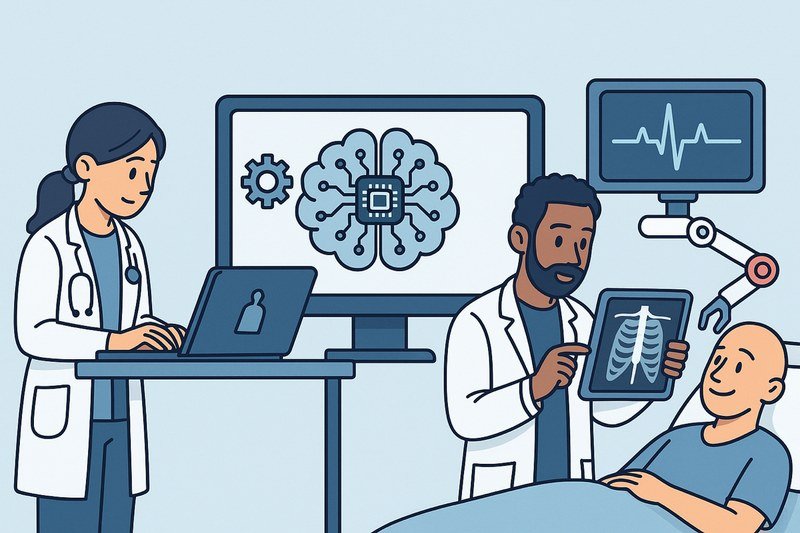
AI now detects cancers in scans, predicts heart disease from eye photos, and flags rare conditions humans miss. So will AI change how doctors diagnose patients? It’s already changing it — but not in the way the headlines suggest. The future isn’t robot doctors. It’s doctors with superhuman assistants. Here’s the real story.
Will AI Change How Doctors Diagnose Patients? Where AI Excels
AI shines at pattern recognition in medical data — and modern medicine runs on pattern recognition. In radiology, AI systems match or beat specialists at spotting tumors, fractures, and retinal disease in images. In pathology, AI scans biopsy slides tirelessly, catching subtle cell patterns. Dermatology apps classify skin lesions with impressive accuracy. These aren’t demos; they’re deployed systems with peer-reviewed results, much of it funded through NIH research on AI in medicine.
AI’s structural advantages are real: it never gets tired, it has effectively memorized millions of cases, and it catches the rare thing a busy doctor might miss at 4pm on a Friday. For image-heavy specialties, AI as a second reader is becoming standard — the radiologist still decides, but with an tireless assistant flagging what deserves a closer look.
Where Doctors Still Win Decisively
But diagnosis isn’t just pattern-matching images. It’s the patient who mentions the “unrelated” symptom that turns out to be the key. It’s the physical exam — the feel, the look, the smell of disease that experienced clinicians read unconsciously. It’s knowing when the test is wrong, when the patient is minimizing, when the textbook presentation doesn’t fit because humans are gloriously non-textbook.
AI also lacks the two things diagnosis ultimately requires: accountability and judgment under uncertainty. When the data is ambiguous — and it often is — someone has to make the call and own it. A model outputs probabilities; a doctor makes decisions, explains them to a frightened patient, and lives with the consequences. That gap isn’t closing with better algorithms; it’s structural. Which is also why asking AI directly for medical advice without a clinician involved remains risky.
The Emerging Model: Augmented Diagnosis
What’s actually emerging is a partnership model: AI handles data-crunching at superhuman scale while doctors handle integration, judgment, and the human relationship. Early evidence suggests the combination outperforms either alone — AI catches what humans miss, humans catch what AI misreads. The diagnostic process gets faster, more accurate, and more consistent, especially in underserved areas where specialist access is limited.
This also changes what doctors train for: less memorization (AI remembers everything), more interpretation, communication, and complex reasoning. Medical education is already shifting — the doctor of 2035 will be an AI-fluent diagnostician, not a walking textbook.
What to Ask Your Doctor About AI in Your Care
AI is entering clinics — often invisibly. These questions make you an informed patient.
“Is AI involved in reading my scans/tests?” A reasonable question deserving a straight answer. Many radiology and pathology practices now use AI assistance — knowing helps you understand the process. Follow up: “How do you use its findings — as a second check or a primary read?” You want the former.
“What are this AI tool’s limitations for someone like me?” AI systems train on datasets that may underrepresent certain demographics — accuracy can vary by age, sex, ethnicity. A good doctor acknowledges this; it’s an active area of research and a legitimate question, not an accusation.
“Can I see the basis for this recommendation?” Whether AI-assisted or not, you deserve to understand why — what evidence, what alternatives, what uncertainties. Doctors comfortable with AI should be comfortable explaining its role.
“What happens to my data?” Medical AI runs on patient data. Ask about de-identification, storage, and whether your information trains commercial models. HIPAA provides a floor, not a ceiling — your comfort level may demand more.
The bigger picture: The best use of medical AI is making your doctor better — catching what fatigue misses, recalling what memory drops, analyzing what humans can’t at scale. Be glad when your care team uses good tools well, and stay engaged enough to ask how. Medicine’s future isn’t AI or doctors — it’s AI with doctors, with patients informed enough to benefit from both. Your questions are part of making that future work. Ask them.
AI in Medicine FAQs
Can I request AI-assisted analysis of my scans?
You can ask what’s available — many practices already use AI second-reads routinely. But “requesting AI” isn’t quite the frame; you want the best diagnostic process, which increasingly includes AI. Ask instead: “what tools do you use to ensure accuracy?” — the answer tells you more than any specific technology request.
Will AI make healthcare cheaper?
Potentially, eventually — automation of analysis and administration could reduce costs. But healthcare economics are complex (the savings often get absorbed elsewhere), so don’t hold your breath for the bill to drop. The near-term win is better accuracy and access, especially in underserved areas, rather than lower prices.
Should I trust an AI diagnosis app?
As a triage signal, cautiously; as a diagnosis, no. Regulated clinical AI (used by your doctor, validated in trials) and consumer apps (variable validation, no clinical context) are different categories. The former is medicine’s future; the latter is a sophisticated guess. Know which you’re using.
What It Means for You as a Patient
Practically: expect AI involved in your scans and lab analysis within years — mostly invisibly, as a safety net behind your doctor’s judgment. Expect faster answers and fewer missed findings. Don’t expect (or want) the AI to replace the conversation where your doctor explains what it all means and what to do next. And keep perspective on AI accuracy limits: these clinical systems are validated, regulated tools — a different universe from a chatbot’s confident guesses. The future of diagnosis isn’t artificial intelligence replacing doctors. It’s doctors finally having the assistant they always deserved — and patients getting the benefit of both.
The Patient’s Role in the AI Era
Medical AI works best with engaged patients. What you can do: keep your health records organized and accessible (good data improves AI-assisted care), ask the questions from this article, and stay informed without falling into cyberchondria. The empowered patient — organized, curious, appropriately skeptical — gets better outcomes in every era of medicine, AI-assisted or not. Technology changes the tools; your engagement was always the most important variable. That hasn’t changed, and it won’t.


