
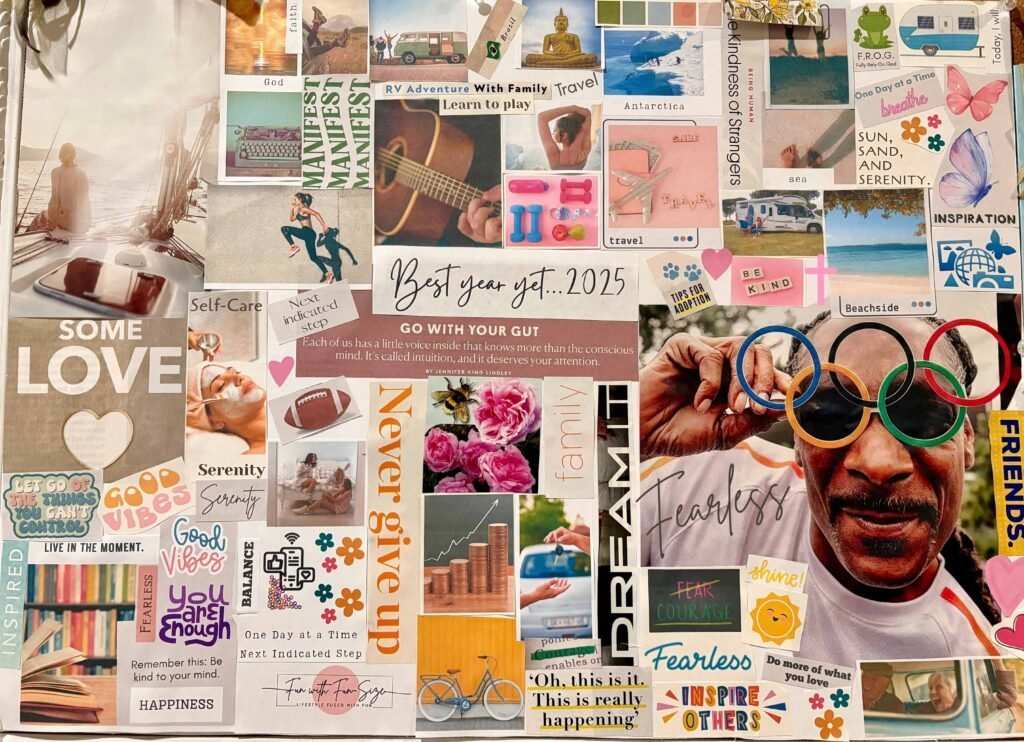
How Do I Create a Vision Board That Actually Works? (Beyond Pretty Pictures)
Wondering how do I create a vision board that actually works, instead of a pretty collage you ignore by February? Here’s the honest truth: vision boards don’t work by magic. They work (when they work) through psychology — clarifying what you want, keeping goals visible, and priming your brain to notice opportunities. The pretty pictures are just the delivery mechanism.
Most vision boards fail because they’re vague aspiration collections: a mansion, a beach, the word “abundance.” Your brain can’t act on vague. It can act on specific, emotional, and visible.
Here’s the method that actually moves the needle.
Step 1: Get Specific Before You Cut Anything
Before touching a magazine, answer in writing: what do I actually want more of next year? Push past generic: not “travel more” but “two trips, one with my sister, one solo, both under $2k.” Not “be healthier” but “hike weekly and cook dinner 4x a week.” The board can only reflect clarity you already have — it can’t create it.
Divide your life into 4–6 areas (career, health, relationships, home, growth, fun) and write one specific intention per area. These sentences are the board’s foundation; the images illustrate them.
Step 2: Choose Images for Emotion, Not Just Aesthetics
- Pick images that make you feel something. The photo should spark a physical response — excitement, calm, longing. Pretty-but-numb images are decoration, not motivation.
- Include yourself. Photos of you at your best, or images with people who look like your life (not a celebrity’s). Relatability beats aspiration.
- Words matter. Short phrases and quotes that hit you — your intentions from Step 1, condensed. “Weekly hikes.” “Say yes to the trip.”
- Show process, not just outcomes. The mansion alone is fantasy; add the hiking boots, the savings chart, the course certificate. Your brain needs the path, not just the destination.
How Do I Create a Vision Board That Actually Works? Link It to Action.
This is the step everyone skips, and it’s the entire difference between a board that works and wall art:
- One next action per goal. Next to each image cluster, write the single next step: “Research hiking groups Saturday.” The board becomes a launchpad, not a daydream.
- Monthly check-ins. Ten minutes monthly: what’s moving, what’s stuck, what needs a new next action. Boards die from neglect, not from bad images.
- Update it. Achieved something? Mark it — visibly. Goals evolve; let the board evolve. A small-wins celebration on the board itself reinforces the whole system.
Physical vs. Digital: Which Works Better?
- Physical boards win on visibility and ritual — the act of making it is clarifying, and seeing it daily (bedroom wall, office) keeps goals present. Best for tactile, visual people.
- Digital boards (phone wallpaper, Pinterest, Canva) win on portability — your goals travel with you. Set the board as your phone background and you’ll see it 100+ times daily.
- The hybrid: physical board at home + photo of it as phone wallpaper. Best of both.
Whichever you choose, placement is everything: somewhere you’ll actually see it daily. A board in a closet is a craft project, not a vision tool.
The Realistic Expectations Part
A vision board won’t manifest a mansion through vibes. What it does, per the actual psychology: keeps goals salient (you notice relevant opportunities), clarifies priorities (making the board forces choices), and sustains motivation (visible progress markers). It’s a focus tool, not a magic ritual — and as a focus tool, used with action links and check-ins, it’s genuinely effective.
Pair it with reflective habits: journaling for beginners gives you the monthly check-in space, and our simple daily habits are the small actions that compound toward the big visions.
Vision Board Mistakes That Kill the Magic
- Vague aspiration soup. Mansion + yacht + “abundance” with no connection to your actual life. Your brain can’t act on fantasy — it needs the bridge.
- Only outcomes, no process. The marathon medal without the running shoes. Include the path, not just the prize.
- Someone else’s dreams. The influencer’s life, not yours. If the images don’t spark YOUR emotion, they’re decoration.
- Hidden in a closet. A board you never see is a craft project. Visibility is the mechanism — bedroom wall, office, phone background.
- Set and forget. Made in January, ignored by March. The monthly 10-minute check-in is what separates working boards from wall art.
- No action links. The fatal flaw — beautiful board, zero next steps. Every goal needs its one next action, written on the board.
Psychology Today’s coverage of visualization research draws the key distinction: visualizing outcomes alone can actually reduce motivation (your brain feels like it’s already achieved it), while visualizing the process increases it. That’s the science behind the “show the path” rule — and why the action-linked board works when the dream-collage doesn’t.
Digital Vision Boards: The Phone Wallpaper Method
The highest-visibility board is the one you see 100+ times daily: your phone background. Build it in Canva (free vision-board templates), sized for your screen: 3–4 key images, your one-word theme for the year, and the single most important goal. Every glance at your screen is a micro-reminder of direction.
Refresh it quarterly — swap achieved goals for new ones, update images that stopped resonating. The wallpaper board evolves with you, always current, always visible. Pair it with a physical board at home for the deep version and the phone version for the daily version. Two boards, one vision, constant gentle steering.
Vision Boards for Couples and Families
A shared vision board is a relationship tool disguised as a craft project. Each person contributes images for shared goals (the trip, the house, the lifestyle) plus one personal panel. The making-of is the real value — you discover what your partner actually wants, which is often surprising. Revisit it together yearly on New Year’s Day: what came true, what changed, what’s next. Kids can have their own mini-boards too — it’s goal-setting in a form they’ll actually enjoy.
The Bottom Line
A vision board that actually works starts with specific written intentions (not vague dreams), uses emotional and relatable images plus process shots, links every goal to one next action, gets monthly check-ins, and lives where you’ll see it daily. It’s a focus and clarity tool — and used that way, with real action attached, it genuinely helps steer your year.


