
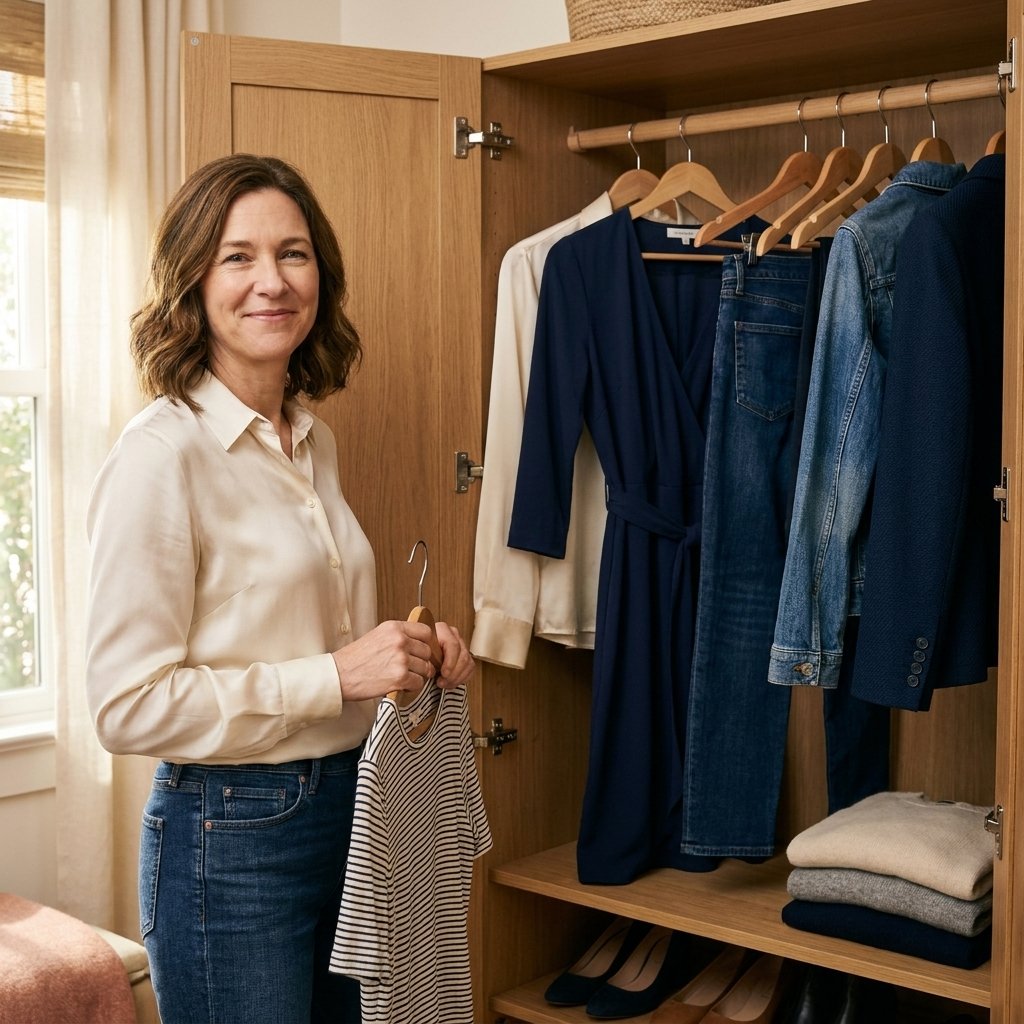
That “I have nothing to wear” feeling in front of a full closet is one of fashion’s great paradoxes — and the solution usually isn’t shopping. It’s seeing what you own with fresh eyes. How can I refresh my wardrobe without buying new clothes? Through restyling, repairing, reimagining, and reorganizing — fifteen specific strategies that make your existing closet feel brand new.
See It Fresh: The Reset
- 1. The full closet audit. Take everything out. Try it all on. You’ll rediscover forgotten pieces, identify what actually fits, and see combinations that were hidden in the clutter. Most “nothing to wear” crises are organization crises — our closet organization guide is the system.
- 2. Shop your own closet. Pull out the 10 least-worn pieces and style three outfits around each. The constraint forces creativity — you’ll invent combinations you’d never have tried.
- 3. Photograph your outfits. For two weeks, photo every outfit. Patterns emerge: what you actually wear, what flatters, what’s missing. Data beats vague dissatisfaction.
Restyle What You Own
- 4. Try unexpected pairings. The dress as a skirt (sweater over it), the blazer with joggers, the “fancy” top with jeans. Breaking your own pairing habits creates genuinely new outfits — our one-dress-multiple-events guide is the masterclass in this.
- 5. Change the tuck. Full tuck, French tuck, untucked — the same top and pants read differently with each. Free, instant, transformative.
- 6. Belt everything. A belt over a dress, blazer, cardigan, or coat creates new silhouettes from old pieces. Different belt, different outfit.
- 7. Layer in new ways. Turtleneck under the slip dress, shirt under the sweater, dress over pants. Layering multiplies a wardrobe exponentially — see layering without bulk.
- 8. Restyle with accessories. Different jewelry, scarves, bags, and shoes transform the same base completely. Accessories are the cheapest refresh vector — our accessories guide is the toolkit.
Repair and Renew
- 9. Fix what’s broken. The pile of “needs a button / has a loose hem / missing a clasp” clothes is a free shopping trip waiting to happen. An afternoon of repairs returns 5-10 pieces to rotation.
- 10. Deep-clean everything. De-pill sweaters, whiten whites, polish shoes, steam wrinkles — our make old clothes look new guide covers the full restoration. Clean clothes feel new.
- 11. Tailor the almost-right. That dress that’s slightly too long, those pants that need taking in — tailoring converts “meh” into “favorite.” The highest-ROI refresh there is.
- 12. Dye faded pieces. Faded black jeans, dull navy tops — fabric dye restores them for dollars. It genuinely feels like new clothes.
Bring in “New” Without Buying
- 13. Clothing swap. Organize one with friends — everyone brings pieces they don’t wear, everyone leaves with “new” clothes. Zero cost, zero production, genuinely fun.
- 14. Borrow and lend. The friend with the great occasion-wear collection, the sibling with the complementary size — formalize the sharing. Occasion pieces especially make sense shared.
- 15. Seasonal rotation. Store off-season clothes properly (see storing winter coats for the method), then “shop” your stored boxes each season change. Absence makes the wardrobe grow fonder — stored clothes feel new on return.
The Mindset That Makes It Stick
The refresh-without-buying approach isn’t deprivation — it’s the core of sustainable fashion thinking and, frankly, better style. Constraints breed creativity; the most interesting outfits often come from limited wardrobes, not endless ones. And there’s a financial freedom in knowing your closet already contains everything you need — shopping becomes choice, not compulsion.
If after all this you still want a few additions, our capsule wardrobe on a budget guide shows how to add strategically rather than impulsively.
How Can I Refresh My Wardrobe Without Buying New Clothes? Your Questions Answered
How often should I declutter my closet?
A light audit each season (when you swap seasonal pieces) plus one deep annual review is the sustainable rhythm. The seasonal audit catches the obvious (didn’t wear it this season → candidate for removal); the annual review handles the harder decisions with fresh eyes. But the real system is continuous: the one-in-one-out rule prevents accumulation between audits, and the “would I buy this again today?” test (applied when you notice a neglected piece) keeps the wardrobe honest. Decluttering isn’t an event — it’s a habit with seasonal checkpoints. And be honest about the “maybe” pile: it’s usually “no” with guilt attached.
What do I do with clothes I don’t wear anymore?
The hierarchy, in order of preference: sell (consignment, Poshmark, Depop — recoups value for good-condition pieces), donate (charities, shelters — extends garment life to someone who needs it), swap (friends, swap events — social and free), repurpose (cleaning rags, craft projects — for worn-out items), recycle (textile recycling programs — the last resort before landfill). What not to do: trash wearable clothes (textile waste is enormous), or “donate” garbage (torn, stained items burden charities with disposal costs). And the pre-step: make sure you actually won’t wear it — store questionable pieces for a season first; absence clarifies desire.
Can accessories really make old outfits feel new?
They’re the highest-leverage refresh tool precisely because they’re the smallest change with the biggest visual impact. A new-to-you scarf, different jewelry, a belt worn a new way, different shoes — each transforms the same base outfit because accessories are what the eye notices first. The psychology: your brain habituates to the base garments (you’ve seen them a hundred times) but registers the accessories as novel. Strategic accessory rotation — even just wearing your existing accessories in new combinations — creates genuine “new outfit” feeling. It’s not self-deception; it’s how visual perception works. Novelty lives in the details.
How do I stop feeling like I need new clothes constantly?
The urge is manufactured — by feeds, by marketing, by the dopamine of novelty — and recognizing that loosens its grip. Practical antidotes: unfollow accounts that trigger shopping urges (curate your inputs), practice the 30-day list (want something? wait 30 days — most urges evaporate), calculate cost-per-wear before buying (the math sobers), and redirect the energy into styling (the creative satisfaction of new combinations rivals the shopping high). The deeper shift: separating identity from acquisition. Your style is expressed through how you wear clothes, not how many you buy. The capsule wardrobe philosophy is essentially this insight systematized: fewer, better, worn with intention.
The Bottom Line
Refreshing your wardrobe without buying means auditing and reorganizing, restyling through new pairings and accessories, repairing and renewing what you own, and swapping or borrowing for genuine novelty. Fifteen strategies, zero dollars required. The closet you have is better than you think — it just needs fresh eyes.


