
Nobody starts a business dreaming of expense tracking. But here’s what separates owners who thrive from owners who drown at tax time: a boring little daily habit. The best way to track business expenses daily isn’t a complicated system — it’s a simple one you’ll actually do at 9pm when you’re tired. Let’s build yours.
What Is the Best Way to Track Business Expenses Daily? Why Daily Beats Monthly
Waiting until month-end to log expenses is how receipts vanish, amounts get guessed, and deductible spending gets forgotten. Memory is a terrible bookkeeper. Daily tracking takes about five minutes and captures everything while it’s fresh: what it was, why it was business, and the receipt to prove it.
The payoff compounds. Clean daily records mean you always know your real profit — not a vibe, a number. They make claiming every tax deduction you’re entitled to straightforward instead of stressful. And if the IRS recordkeeping requirements ever come knocking, you’ll hand over organized records instead of a panicked apology. Five minutes a day buys an enormous amount of peace.
Pick Your Method (Simplest First)
Option 1: An app that does the heavy lifting. For most small businesses, this is the answer. Wave (free), QuickBooks Self-Employed, or Xero connect to your bank and credit cards, auto-import transactions, and let you snap receipt photos. You just categorize — which takes seconds per transaction once the app learns your patterns. If you’re still choosing software, our guide to accounting software for small businesses compares the options properly.
Option 2: A spreadsheet with discipline. Date, vendor, amount, category, business purpose, receipt photo linked. Free and fully in your control. Works fine under ~30 transactions a month; above that, the manual entry becomes its own part-time job.
Option 3: The envelope method, digitized. One credit card used only for business, statements as your log, receipt photos in a cloud folder organized by month. Minimalist and surprisingly effective — the dedicated card does half the tracking for you.
Whichever you pick, the non-negotiable foundation is keeping business and personal money separate. No tracking system survives mixed accounts.
The 10-Minute Daily Routine
Do this at the same time every day — end of workday works best:
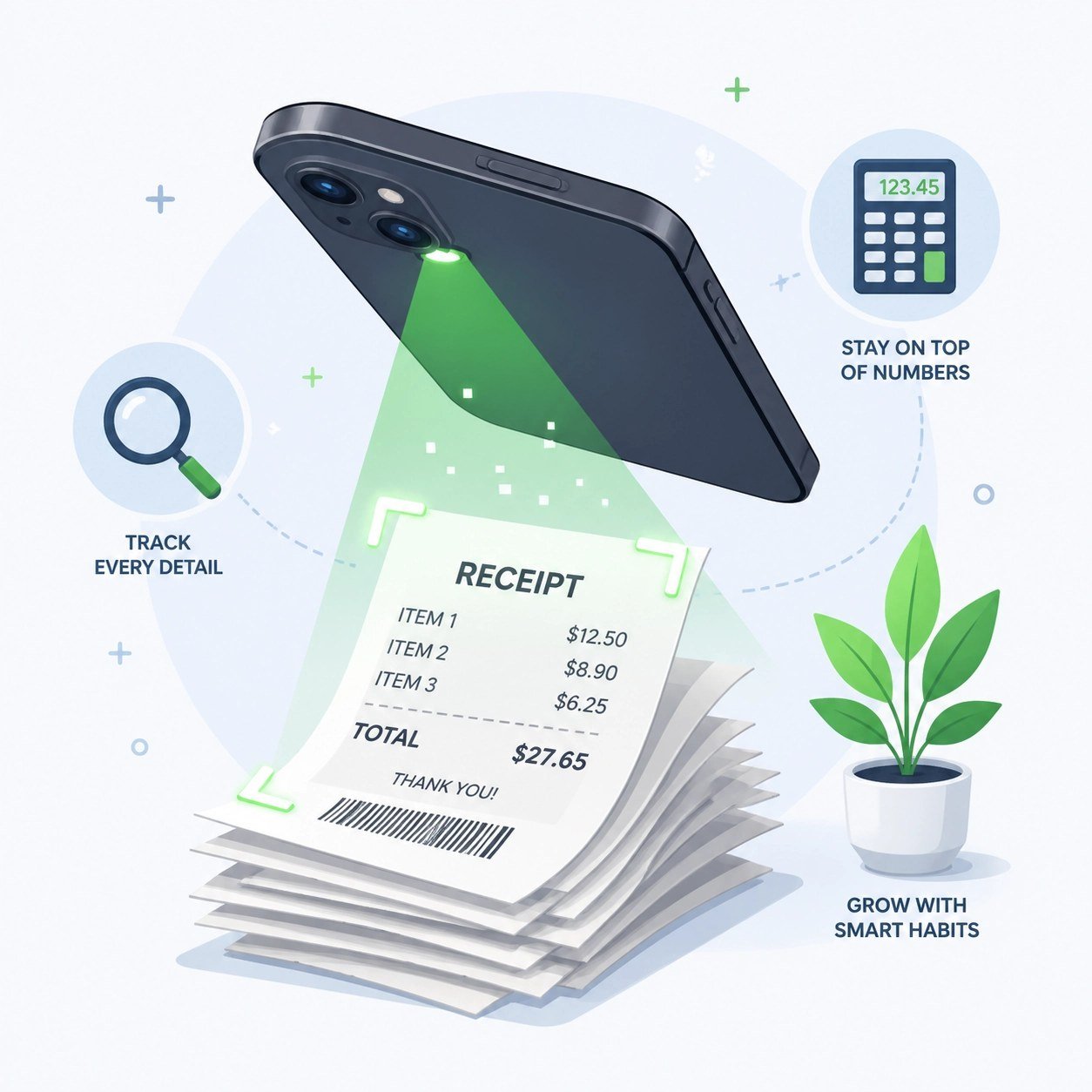
- Photograph today’s receipts (2 min). Every paper receipt gets snapped before it fades or vanishes. Digital receipts get forwarded to a dedicated email folder.
- Review and categorize new transactions (5 min). Open the app, confirm the auto-categorized items, fix the ones it got wrong. Add the business purpose to anything ambiguous — “lunch with supplier re: Q3 order,” not just “restaurant.”
- Log cash spending immediately (1 min). Cash is the black hole of expense tracking. If you spent cash, record it on the spot or it didn’t happen.
- Glance at the week’s totals (2 min). Not a deep analysis — just awareness. Are you on pace? Anything surprising? Awareness prevents the end-of-month shock.
Then weekly (15 minutes, pick a day): reconcile accounts, chase any missing receipts, and review spending against your budget. Monthly (30 minutes): review the P&L, note trends, and file everything where tax-time-you can find it.
Expense Categories Every Small Business Needs
Good tracking starts with good categories — too few and your reports are useless, too many and you’ll never categorize consistently. Here’s the Goldilocks set for most small businesses.
The essential categories: Advertising & Marketing, Office Supplies, Software & Subscriptions, Professional Services (accountant, lawyer), Insurance, Rent/Lease, Utilities, Travel, Meals (business), Vehicle/Mileage, Equipment, Inventory/COGS, Contractor Payments, Bank & Processing Fees, Taxes & Licenses, Education & Training, and Owner’s Draw (separate — this isn’t an expense, it’s equity movement, and mixing it up corrupts your profit picture).
Category discipline rules: One transaction, one category — no splitting hairs. When unsure, pick the closest and move on; consistency beats precision. Review categories quarterly: if “Miscellaneous” exceeds 5% of spending, you need a new category. If a category has three transactions a year, merge it somewhere.
The categories people get wrong: Meals vs. entertainment (different rules — know them), personal vs. business travel (the conference is business; the extra vacation days aren’t), and improvements vs. repairs (improvements may need capitalizing, not expensing — ask your accountant for big items).
Make it automatic: In your bookkeeping app, set bank rules: “every charge from Adobe → Software,” “every Shell charge → Vehicle.” After a month of training, 80%+ categorizes itself and your daily 10 minutes becomes a 3-minute review. The category list isn’t bureaucracy — it’s the lens that turns raw transactions into decisions. “We’re spending how much on subscriptions?” is a question you can only ask if the data exists. Build the categories once, maintain them daily, and your books become a management tool instead of a tax-time chore.
Expense Tracking FAQs
What if I hate apps and prefer paper?
Then use paper — consistently. A notebook with date, amount, vendor, and purpose, plus a monthly envelope of receipts, beats a fancy app you never open. The best system is the one you’ll actually maintain. That said, revisit apps yearly; the 5-minute photo-receipt workflow converts most paper holdouts eventually.
How long should I keep business receipts?
The IRS generally recommends keeping records for 3 years from filing (6 if you underreported income significantly, 7 for bad debt/loss claims). Digital copies are fine — the IRS accepts scanned receipts. Keep them organized by year in cloud storage and you’ll never think about it again until you need them.
Do I need to track expenses if my business is tiny?
Especially then. Small businesses feel every dollar, and the deductions matter proportionally more. Ten minutes a week on a side hustle’s expenses is the difference between guessing at tax time and knowing. Start the habit while it’s easy — it’s much harder to impose on a bigger, messier business later.
Make It Stick
Systems fail at the friction points, so remove them. Keep the receipt app on your home screen. Use one business card for everything so transactions auto-import. Set a daily phone reminder until the habit is automatic — usually three weeks. And if you have a team, make expense submission dead simple with a clear policy; complicated policies just produce non-compliance.
Pair this with the broader toolkit: free tools for managing a small business keep the cost at zero, and clean expense data feeds directly into smarter decisions about pricing, hiring, and growth. Expense tracking will never be fun. But done daily, it’s ten painless minutes that protect your deductions, reveal your real numbers, and turn tax season from a crisis into a chore. That’s a trade worth making.


