Ryan Reynolds — The Actor Who Bought the Companies: A Fortune Counted
Written by admin
Published November 24, 2026
Reading time 8 minutes
The Numbers Born first, net worth second — the full record sits in the “By the Numbers” table after the career section.
Ryan Reynolds — The Actor Who Bought the Companies: A Fortune Counted
The Road from Vancouver to Deadpool
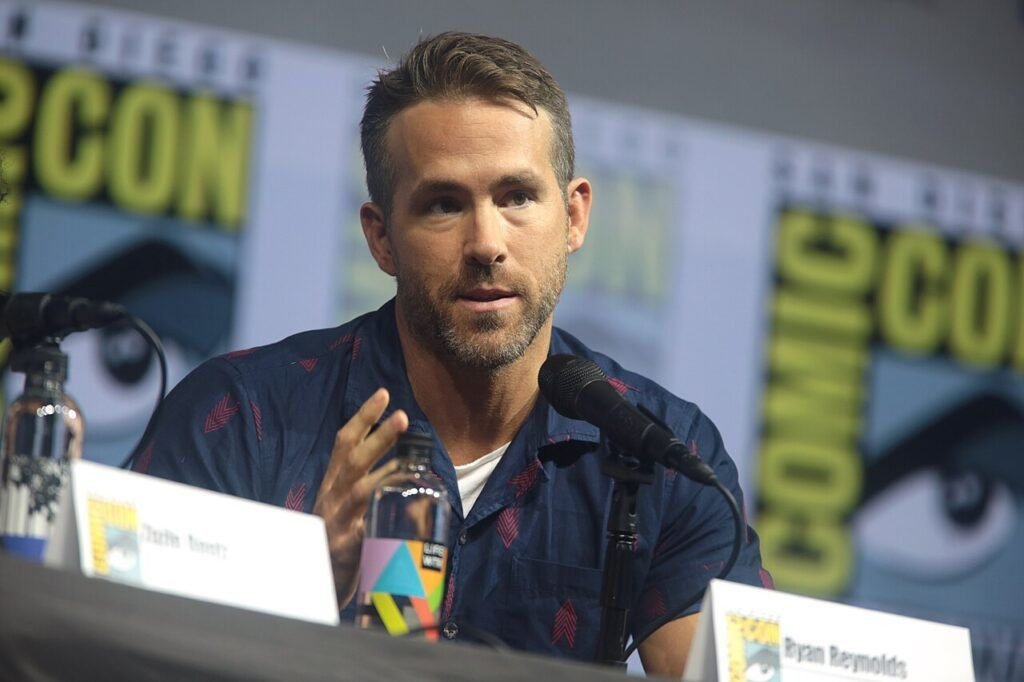
Ryan Reynolds is the Vancouver-born actor who spent a decade as Hollywood’s nearly man — the charming lead of comedies that almost worked — and then converted a single superhero role into something no actor had built before: a portfolio of companies whose sales, in aggregate, rival the grosses of his films. Deadpool made him a star of the first rank at thirty-nine. Aviation Gin and Mint Mobile made him a case study at business schools.
He is 50, married to Blake Lively since 2012, and the father of four children. In accordance with this profile’s pattern set, this profile uses no nationality label anywhere in it: it gives his birthplace as a place, names his companies, and leaves the descriptive adjectives out — the record speaks in facts. This profile attributes the fortune in this profile, and records the famous company sales at their true status: whole-company prices, of which his stakes were a fraction.
Life at Home with Blake Lively
Reynolds married Blake Lively on 9 September 2012 in South Carolina, having met her on the set of his 2011 superhero film — the failure that produced the marriage, as he tells it. His first marriage, to Scarlett Johansson, ran from 2008 to a divorce the courts finalised in 2011; this profile records it as history. He and Lively have four children: James, born in December 2014; Inez, born in September 2016; Betty, born in October 2019; and Olin, born in early 2023, whose name and sex Reynolds confirmed publicly in July 2024. The children’s names became public on the family’s own schedule — two of them announced, memorably, through a friend’s music — and the family’s privacy rules since are a matter of their own stated policy.
His father’s death in 2015, after twenty years with Parkinson’s, is the family’s public cause: Reynolds serves the research foundation named for another actor with the disease and has raised funds in his father’s name. The Vancouver roots remain active — the handle in the table is the city’s nickname, worn as a badge through thirty years elsewhere.
Childhood in Vancouver and the Turn Towards the Spotlight
Ryan Rodney Reynolds entered the world on 23 October 1976 in Vancouver, and grew up there in the Kitsilano neighbourhood. His father, James Chester Reynolds, worked as a wholesale food distributor and had earlier served as a mounted policeman; he died in October 2015 after a long illness with Parkinson’s disease, a loss his son has marked publicly and through fundraising. His mother, Tamara Lee Reynolds, worked in retail sales. The household was, in his own repeated description, a working one in which comedy was the currency — his impressions and timing were the family act before they were a profession.
He began acting at thirteen in a teen soap filmed in Florida, worked through his teens in television, and moved to Los Angeles at nineteen with the standard equipment of the hopeful: a Jeep, savings measured in months, and — the detail every account keeps — a period of working the graveyard shift at a supermarket while auditioning. The decade of near-misses that followed is the foundation the later success is always measured against, by him first of all.
Every Key Fact About Ryan, Side by Side
| Every Key Fact About Ryan, Side by Side | The Record |
|---|---|
| Born | 23 October 1976, Vancouver |
| Net Worth | $350 million — Celebrity Net Worth |
| Age | 50 |
| Height | 6 ft 2 in (1.88 m) |
| Weight | No reliable published figure exists |
| Wife | Blake Lively (married 9 September 2012) |
| Children | Four — James, Inez, Betty and Olin |
| Parents | James Chester Reynolds (died 2015); Tamara Lee Reynolds |
| @vancityreynolds |
Roles, Records and Deadpool
The career divides into the long apprenticeship, the conversion, and the portfolio era.
2002 — Van Wilder and the Nearly Years
Van Wilder (2002) made him a campus-comedy star and typecast him in the same gesture. The decade that followed — Blade: Trinity (2004), Waiting… (2005), Definitely, Maybe (2008), The Proposal (2009), a first superhero failure in 2011 that he has turned into a running joke at his own expense, Buried (2010) as the critics’ counter-example — is the most instructive apprenticeship in modern stardom: every skill the later career uses, acquired in films the culture has half-forgotten. The Proposal, a genuine hit, proved the audience was there; the material kept missing it.
2016 — Deadpool
Deadpool (2016) — a film he fought for a decade to get made, on the strength of leaked test footage the internet demanded Fox complete — became the highest-grossing R-rated film of its era and rewrote his price entirely. Deadpool 2 (2018) repeated it. The role’s voice — his voice, unfiltered — became the template for his marketing company, his brand persona and the films that followed: The Hitman’s Bodyguard (2017), Free Guy (2021) and The Adam Project (2022) all run on the same engine.
2024 — Deadpool & Wolverine
The third Deadpool film (2024), pairing him with Hugh Jackman’s Wolverine, grossed more than $1.3 billion and became the highest-grossing R-rated film ever released. It is the commercial summit of the acting career to date, and it arrived in the same years as the portfolio’s largest events — the two careers now running at full scale simultaneously, which is the condition the fortune section counts.
2009 — The First Deadpool and the Lesson
Reynolds first played Wade Wilson in a 2009 X-Men film, and the production sewed the character’s mouth shut — silencing, literally, the fastest comic voice in the business. He tells the story on himself constantly, because it contains the whole apprenticeship: the industry handed him the right role and the wrong script, and he spent seven years forcing the correction. The leaked test footage of 2014, which fans demanded Fox complete, did what agents could not; the studio green-lit the film within days of the leak’s reception.
2019 — Detective Pikachu and Red Notice
The voice work extended the range: Detective Pikachu (2019) put his timing inside a family blockbuster that grossed more than $400 million, and Netflix built its early blockbuster strategy partly on him — 6 Underground (2019), Red Notice (2021), which the service reported as its most-watched film on release, and The Adam Project (2022). The streaming era paid him at the very top of its scale, and the salaries of those years supplied the capital the portfolio then multiplied.
2021 — Wrexham
In 2021 Reynolds and Rob McElhenney bought Wrexham, a Welsh football club then playing in the fifth tier, for a reported £2 million, and filmed everything. The documentary series turned a small industrial town into a global story, and the club climbed: promotion in 2023, again in 2024, and a third consecutive promotion in 2025 that carried Wrexham into the Championship, English football’s second tier — a rise without precedent in the league’s history. The club’s value has multiplied far beyond the purchase price on every published estimate; it remains a co-owned asset, and this profile counts it as context, not as his net worth.
Closing the File on Ryan — For Now
At 50, Reynolds occupies the position his twenties made unimaginable: the films gross billions, the companies sell for billions — at company level, with his fractions his own — and the football club climbs. The nearly man became the era’s defining example of the actor as founder, and the model is now copied by every star with a brand deal and a cap table.
This profile prints the fortune, $350 million attributed, here with its two famous numbers corrected to their fractions — which is to say, honestly, and still enormous.
The Fortune of Ryan in Full, With Every Source Named
Celebrity Net Worth puts Ryan Reynolds’s net worth at $350 million, in an update of 4 November 2026. Forbes publishes earnings for him — $71.5 million counted in 2020 — and no wealth total. The fortune’s structure is this batch’s most modern: a film salary line at the top band since 2016, and beneath it the portfolio, whose two famous exits this profile must state precisely. Diageo acquired Aviation Gin in 2020 in a deal worth up to $610 million; T-Mobile acquired Mint Mobile in 2023 in a deal worth up to $1.35 billion. Both figures are whole-company prices. Reports put Reynolds’s stakes at roughly a fifth to a quarter in each case, he never published his exact proceeds, and this profile counts neither headline figure here as his money.
His marketing company, Maximum Effort, and the Wrexham football club — bought with Rob McElhenney in 2021 and carried up the leagues in a documentary-documented rise — complete the portfolio; the club’s valuation is a co-owned asset’s, not his net worth. The co-star whose return opposite him made the biggest of the films has his own ledger, set out in Hugh Jackman’s net worth profile: two fortunes built on the same franchise, one of them diversified into an empire.
Pound Ridge, Tribeca and a House in Marford
The family’s principal documented property is the estate at Pound Ridge, New York, bought in 2012 for a reported $5.7 million; an apartment in Tribeca is also documented. In 2023 British coverage reported the purchase of a property in Marford, Wales — the village beside the football club — as the family’s base for club visits. This profile gives prices as reported; no source has published a verified full inventory.
A Lamborghini, a Tesla and Two Classic Motorcycles
Motoring coverage documents his vehicles without a verified inventory: the cars and motorcycles reports name most consistently are a Lamborghini Aventador, an Audi R8, a Mercedes-Benz 190 SL, a Cadillac Escalade, a Tesla Model S, and motorcycles including a custom Triumph Thruxton and a 1975 Honda CB750. No source has published a reliable total value, and this profile states none here.
Maximum Effort, his marketing company, deserves its sentence in the count: the agency built the advertising voices of Aviation and Mint in his own comic register, and brands now hire the company — and the register — independently of his face. The joke became an agency; the agency became an asset. That sentence, more than any salary figure, explains the shape of the $350 million.
The Vancouver thread stays live in the record: he funds the city’s food bank and hospital causes, films in the city when productions allow, and keeps the childhood nickname as his public handle — the Kitsilano kid’s name for the place, worn at fifty in front of a hundred million followers. Roots, in his case, function as both biography and brand, and he manages the overlap without apology.
The nearly years taught the skills; the Deadpool years priced them; the portfolio years compounded them. Three decades, three gears, one driver — and the machine he built now runs at a scale that neither the supermarket night shifts nor the sewn-shut first Deadpool ever hinted at.
The count continues, in every single currency he now trades in.