Robbie Williams by the Numbers: Sixteen Number Ones and a $300 Million Fortune
Written by admin
Published November 24, 2026
Reading time 8 minutes
The Numbers Born first, net worth second — the full record sits in the “By the Numbers” table after the career section.
Robbie Williams by the Numbers: Sixteen Number Ones and a $300 Million Fortune
Take That and the Stoke-on-Trent Singer Who Made It
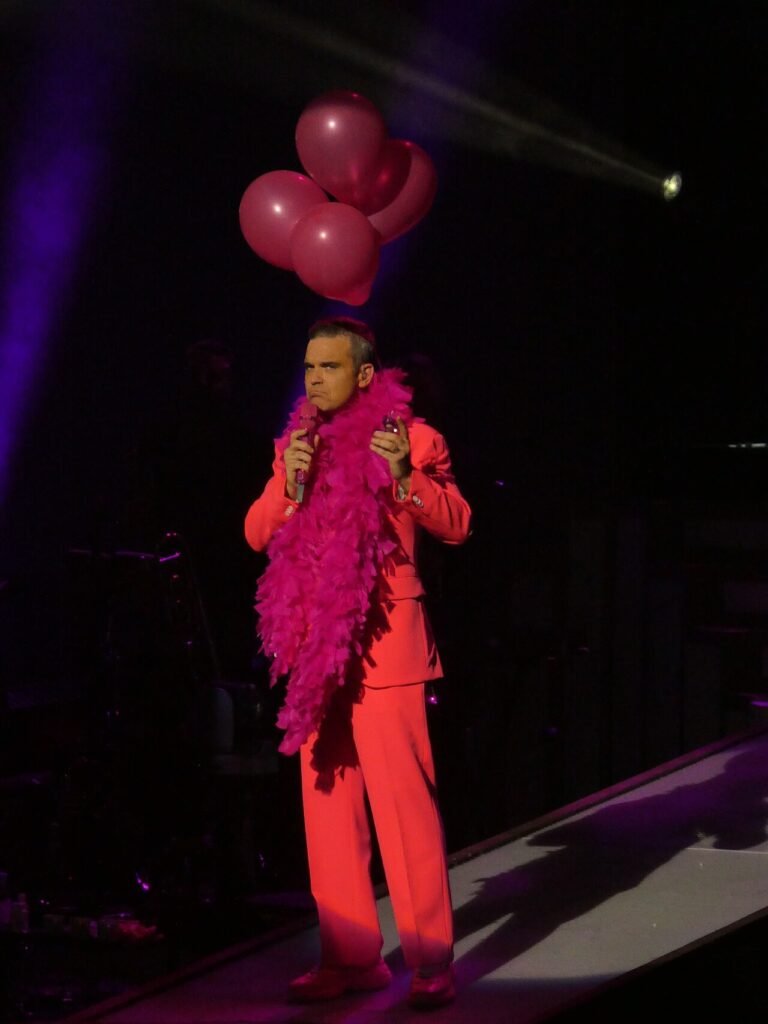
Robbie Williams is the Stoke-on-Trent entertainer who left the biggest boy band in Britain, became the biggest solo star in the country, broke its chart records, lost years to addiction and comeback cycles, and then — in January 2026, at 51 — released the album that gave him his sixteenth number-one album in Britain, passing the record he had shared with the Beatles. BRITPOP, the album, arrived early and unannounced in the small hours of 16 January 2026, and the tour that takes its name is running as this profile goes to press.
He is 52, married to Ayda Field since 2010, and the father of four children. His fortune, counted in this profile, rests on the largest record deal of its era, three decades of stadium touring, and a catalogue that has never stopped selling. This profile attributes the figure; the record documents the deal that built it; and this profile observes the distinction between a contract’s headline value and the money anyone actually pays, as it does throughout this batch.
The Facts on Robbie Williams, in One Place
| The Facts on Robbie Williams, in One Place | The Record |
|---|---|
| Born | 13 February 1974, Stoke-on-Trent, Staffordshire |
| Net Worth | $300 million — Celebrity Net Worth |
| Age | 52 |
| Height | 5 ft 11 in (1.80 m); some listings give 6 ft 1 in |
| Weight | No reliable published figure exists |
| Wife | Ayda Field (married 7 August 2010) |
| Children | Four — Theodora Rose, Charlton Valentine, Colette Josephine and Beau Benedict |
| Parents | Peter Williams (performed as Pete Conway); Janet Farrell |
| @robbiewilliams |
Home with Ayda Field: The Family Side of the Story
Williams married Ayda Field, the American actor, on 7 August 2010 at his home in Los Angeles; the couple renewed their vows in 2024. They have four children: Theodora Rose, born in 2012; Charlton Valentine, born in 2014; Colette Josephine, born in 2018 via surrogacy; and Beau Benedict, born in 2020, also via surrogacy. The family guards the children’s privacy in its public presentation — faces withheld, names public — a balance the family has described as deliberate.
His parents’ separation and his father’s second career as Pete Conway are part of the act’s own mythology, told in his stage shows; his mother Janet remains in Stoke-on-Trent, where his public attachment to the city — its football club, its accent, its name checked in songs — has never weakened across thirty years of living elsewhere. He worked out the addiction and recovery that run through the middle career in public and in treatment, in Los Angeles and London, and his sobriety of the later years is a documented fact of the record, which he states himself.
The Early Years in Stoke-on-Trent
Robert Peter Williams entered the world on 13 February 1974 in Stoke-on-Trent, Staffordshire. His father, Peter Williams, performed as a comedian and singer under the name Pete Conway; his mother, Janet Farrell, ran a pub and later worked in the pottery industry. His parents separated during his early years, and his mother raised him principally in Stoke, attending local schools and leaving without qualifications — a biography he has never disguised and has mined, with his father’s stage name kept in the family story, for thirty years of material about class, fame and escape.
The escape route was an advertisement his mother answered: auditions for a new boy band. At sixteen he was the youngest member of the five assembled by manager Nigel Martin-Smith — the joker of the group, by every account including his own, and the one whose frustrations with its regime would end the first chapter.
How Robbie Worked, From the Start to Take That
The solo career divides into the imperial decade, the wobble and recovery, and the heritage-era consolidation that produced the record of 2026.
1995 — The Departure and Life Thru a Lens
Williams left Take That in July 1995, at the height of the group’s fame, in circumstances — a missed rehearsal, an ultimatum, a departure announced mid-tour — that became pop legend in Britain. His solo debut Life Thru a Lens (1997) started slowly and then, on the strength of “Angels”, became a phenomenon: the single never topped the chart and never left the culture, and the album spent weeks at number one. I’ve Been Expecting You (1998), with “Millennium” and “She’s the One”, confirmed the position.
2000 — Sing When You’re Winning and the Stadium Years
Sing When You’re Winning (2000) and Swing When You’re Winning (2001) — the latter a standards album that became one of his biggest sellers — made him the dominant act of the period in Britain, and Escapology (2002) carried the success across Europe. His three nights at Knebworth in 2003 played to 375,000 people, a record for a solo artist in Britain. Reports valued the 2002 deal with EMI that framed the era at £80 million — a contract value, encompassing advances, commitments and the label’s investment across multiple albums, not a single payment; this profile records it here in those terms and never as cash received.
2006 — Rudebox and the Wilderness
Rudebox (2006) was the commercial and critical stumble, and his own accounts document the years around it — addiction, retreat to Los Angeles, a public withdrawal. Reality Killed the Video Star (2009) began the recovery; Take the Crown (2012) restored the number ones; and the Take That reunion of 2010–11, on the album Progress and its record-breaking tour, closed the oldest open chapter of the story.
2026 — BRITPOP
The Swings albums, The Heavy Entertainment Show (2016) and a steady heritage-era run led to BRITPOP: released ahead of schedule on 16 January 2026, it became his sixteenth number-one album in Britain, breaking the tie with the Beatles that had stood in the record books. The accompanying tour, running through November 2026, plays the stadiums the catalogue has filled for twenty-five years. Sixteen number-one albums is the statistic of the career — no solo artist in the country has more — and it is the foundation under the fortune in this profile.
1990 — Take That
The group’s five years made him famous and miserable in the documented sequence: assembled in 1990, dominant in Britain by 1993 with “Pray”, “Relight My Fire” and “Back for Good”, and a machine whose schedule and image discipline he chafed under from the start. His departure in 1995 — after a final warning over a missed rehearsal — was the decade’s biggest pop story in Britain, and the solo career that followed was, for its first year, widely expected to fail. The fortune’s foundation is the failure’s refusal to happen.
2003 — Knebworth
The three Knebworth nights of August 2003, before 375,000 people, remain the largest live statement by a solo artist of his era in Britain, and the live album and concert recording of the shows fixed the image of the solo career at its peak: one man, a park in Hertfordshire, and the biggest audience in the country. The touring operation built in those years — stadiums across Europe, where his following exceeded even his following at home — is the fortune’s steadiest engine, still running on the 2026 tour.
2010 — Progress and the Reconciliation
The Take That reunion album Progress (2010) became the fastest-selling album in Britain of the century to that point, and its 2011 tour broke the country’s box-office records — the five men, Williams included, out-grossing their own legend. The reconciliation matters to the count as well as the story: the reunion’s earnings were the largest single touring payday of his career, arriving fifteen years after he walked out of the group that generated it.
The Fortune of Robbie in Full, With Every Source Named
Celebrity Net Worth puts Robbie Williams’s net worth at $300 million. A Sunday Times Rich List-derived figure of about £230 million — roughly $290 million — has circulated for him and is broadly comparable, which in the world of celebrity estimates counts as corroboration. No audited figure exists; the two independent estimates agree on the order of magnitude, and this profile prints both.
The build-up: the EMI era’s advances and royalties on one of Europe’s biggest catalogues; Knebworth-scale touring across three decades; the Take That reunion’s record grosses, shared five ways; publishing on songs he co-wrote with Guy Chambers and others; and property, below. The bandmate who led the group he left — whose own solo fortune, built on the writing, Gary Barlow’s net worth profile traces — is the natural comparison: two men, one band, two fortunes of the same order reached by opposite routes, performance and authorship.
The Houses Robbie Owns, on Record
The property record runs fullest at the top end: Woodland House in Kensington, London, bought in 2016 for a reported £17 million and the subject of a long-running, much-reported planning dispute with a neighbour; Compton Bassett House in Wiltshire, bought in 2009 for a reported £8.5 million and sold about a year later; a Beverly Crest mansion sold to the rapper Drake in 2022 for a reported $75 million; and a Holmby Hills property sold in 2024 for a reported $65 million. This profile gives prices as reported.
The vow renewal of 2024 and the family’s public presentation complete the personal record: the performer whose twenties were a tabloid serial now presents, deliberately, as pop’s contented elder — a reinvention as complete, in its way, as the solo career itself, and one the BRITPOP album’s reception suggests the audience has fully accepted.
The European dimension is the last piece of the count: Williams’s following in Germany, the Netherlands, Scandinavia and Australia has at times exceeded his following at home, and the touring and catalogue income of those markets — where “Angels” is a standard and the stadiums sell out as reliably as at home — is a structural part of the fortune that accounts focused on Britain understate. He is, by the numbers, a continental star who happens to come from Stoke.
The BRITPOP tour running through November 2026 is the present tense of that position: a 52-year-old with a record-breaking sixteenth number-one album, playing the largest rooms in the country he has filled for a quarter of a century, under a title that claims the era he helped define. The claim, on the chart evidence, is fair.
The count, in the end, is Stoke’s as much as his: the town’s most famous son, still singing its name.
Summing Up Robbie, a Stoke-on-Trent-Born Singer
At 52, Williams holds the chart record at home that defines his career’s second act, a tour running under the album’s name, and a public position — elder statesman of pop, candid about every stage of the journey — that the 1995 departure made unimaginable. The Stoke lad who left school with nothing has the most number-one albums of any solo artist in the country’s history.
The fortune, $300 million attributed with a comparable Rich List figure beside it, is the count of that journey. This profile prints it here as an estimate two sources agree on in scale — the strongest form of evidence this batch’s numbers ever achieve.