Shakira — Barranquilla’s Voice and the Miami Reset
Written by admin
Published November 24, 2026
Reading time 9 minutes
The Numbers Born first, net worth second — the full record sits in the “By the Numbers” table after the career section.
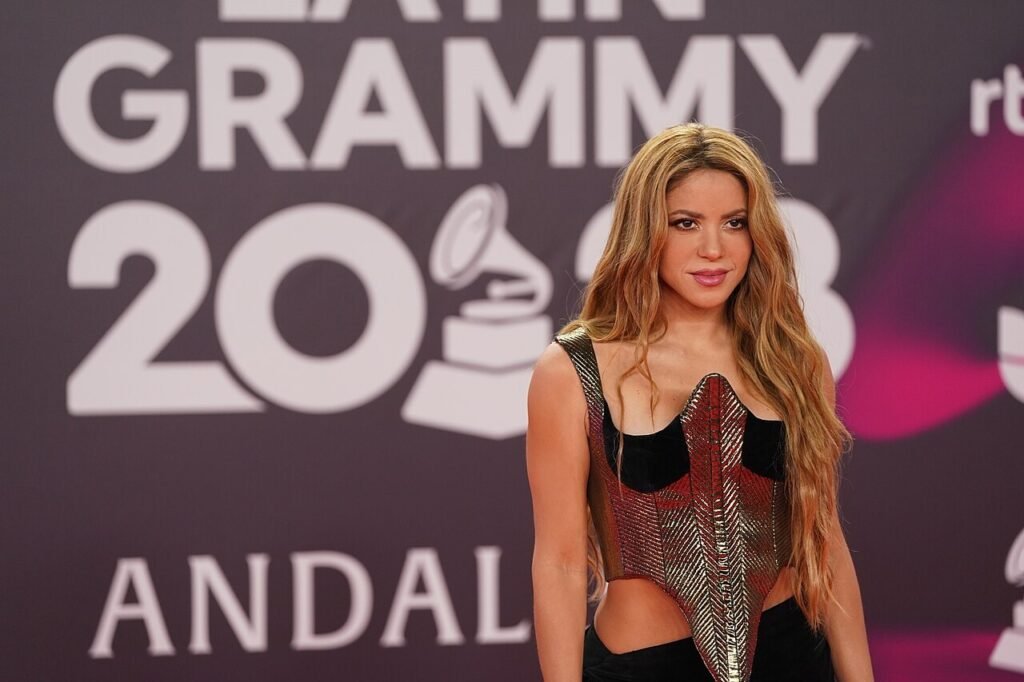
Shakira — Barranquilla’s Voice and the Miami Reset
One Singer from Barranquilla, One Career That Refused to Sit Still
Shakira is the best-selling Colombian artist in history and one of the few performers to have conquered two language markets completely: the Latin world first, in Spanish, on her own songwriting terms, and then the Anglophone world in 2001 without surrendering the first. The voice — unmistakable in a single note — the songwriting, which she has controlled since her teens, and a live act built on the dance vocabulary of her Lebanese-Colombian inheritance made her a global star of the durable kind, still filling stadiums in her late forties.
At 49 she bases herself in Miami again, after a decade in Barcelona that ended with a public separation and a tax case she settled; she is a mother of two sons, in no confirmed relationship, and touring behind a 2024 album that returned her to the top of the Latin charts. This profile follows the verified record: the Barranquilla roots, the career in years, the family, and the fortune, whose two published totals this profile prints side by side.
Shakira in Numbers and Dates
| Shakira in Numbers and Dates | The Record |
|---|---|
| Born | 2 February 1977, Barranquilla, Colombia |
| Net Worth | $350 million — Celebrity Net Worth; $300 million long listed by the same source and still cited by Parade in 2026 (see The Fortune, Counted) |
| Age | 49 |
| Height | 5 ft 2 in (157 cm) |
| Weight | No reliable published figure exists |
| Partner | No confirmed current partner |
| Children | Two sons: Milan (born 2013) and Sasha (born 2015) |
| Parents | William Mebarak Chadid and Nidia Ripoll Torrado |
| Nationality | Colombian |
| @shakira |
The Credits That Count: Magia and the Rest
1991 — Magia
The debut album, recorded at fourteen, sold little; its follow-up fared no better, and she spent two years acting in a Colombian telenovela while the label decided whether the contract had a future. The songs from this period are juvenilia she has never disowned and rarely performs.
1995 — Pies Descalzos
The album she controlled — rock-inflected, self-written, in Spanish — sold millions across Latin America and Brazil and established the pattern of the whole career: the songwriting is the asset, and she keeps it.
1998 — Dónde Están los Ladrones?
Produced with Emilio Estefan, the second self-directed album deepened the rock direction and carried “Ojos Así”, the Arabic-Colombian fusion that remains a signature. It is the album critics of the Spanish-language catalogue rank first.
2001 — Laundry Service
She engineered the English-language crossover carefully: she learned English well enough to write in it, kept the Spanish versions for her first market, and produced “Whenever, Wherever” and “Underneath Your Clothes”. The album sold more than thirteen million copies and made her a star in the markets that had never heard the Spanish records.
2005 — Fijación Oral, Vol. 1 and Oral Fixation, Vol. 2
The two-volume project — one album in Spanish, one in English — carried “Hips Don’t Lie”, the Wyclef Jean collaboration that became one of the best-selling singles of the century and the song most identified with her worldwide.
2010 — Sale el Sol and the World Cup
“Waka Waka (This Time for Africa)”, the 2010 World Cup anthem, became one of the most-watched music videos ever made and attached her name to the tournament permanently; she performed at three World Cup finals ceremonies across her career, a record for a popular artist. Sale el Sol returned her to Spanish-language rock and balladry to critical approval.
2017 — El Dorado
El Dorado, made after a vocal haemorrhage that threatened the voice itself, won the Grammy for Best Latin Pop Album; its tour, delayed by the injury, became one of the highest-grossing Latin tours by a woman to that date.
2020 — The Super Bowl LIV Halftime Show
On her forty-third birthday she co-headlined the Super Bowl halftime show in Miami — the performance treated fully in the fortune section’s connection in this profile — a booking that confirmed her American standing two decades after the crossover.
2021 — The Catalogue Sale
In 2021 she sold her publishing catalogue of 145 songs to the Hipgnosis fund. The parties kept the price undisclosed; the fortune account in this profile records the sale as a transaction, not a valuation.
2024 — Las Mujeres Ya No Lloran
Her twelfth studio album, released in March 2024 after the separation and the move to Miami, rode in on the record-breaking diss track she aimed at her former partner that became the most-watched Latin video of its year — the personal and commercial accounts, in her career, have never been separable. The accompanying stadium tour has played across the Americas and beyond.
Growing Up in Barranquilla
Shakira Isabel Mebarak Ripoll’s life began on 2 February 1977 in Barranquilla, Colombia, the Caribbean port city that remains the fixed point of her identity. Her father, William Mebarak Chadid, a jeweller and writer of Lebanese descent who was himself born in New York, gave her the Arabic musical inheritance audible in her earliest songs; her mother, Nidia Ripoll Torrado, is of Spanish — Catalan — and Italian descent. Shakira is their only child together, a formulation this profile uses exactly, because it is the accurate one. She wrote poems at four, was composing songs by eight, and Sony Colombia signed her at thirteen after the local theatre producer who discovered her arranged an audition in Bogotá.
The early albums failed commercially, and the biography’s decisive fact is what she did next: at eighteen she took creative control, wrote Pies Descalzos herself, and became a star across Latin America on her own material. Her nationality is Colombian, held alongside an identity formed by two diasporas — Lebanese and Mediterranean — that her music has always carried openly. Her birthday, 2 February, makes her 49.
Who Raised Shakira, and Who Stands Beside Shakira Now
The partner keyword resolves, at present, to none confirmed. Her former partner was Gerard Piqué, the Spanish footballer, with whom she was in a relationship from 2011 until their separation in 2022; they never married, and he is not described as her husband anywhere in this profile, because he was not. Press links reported since 2023 — including 2026 reports naming the actor Lucien Laviscount — remain unconfirmed, and this profile names no one as her current partner.
Her sons are Milan Piqué Mebarak, born on 22 January 2013, and Sasha Piqué Mebarak, born on 29 January 2015, both born in Barcelona during the relationship with Piqué. Under the separation arrangements the boys moved with her to Miami in April 2023, the relocation that closed the Barcelona decade. Her Instagram, @shakira, is among the most-followed accounts held by any musician and serves as the channel for the family’s chosen public moments, rationed around the boys’ schooling and privacy.
From Magia to the Bank: Shakira’s Money
Celebrity Net Worth currently estimates Shakira’s net worth at $350 million. The same source listed $300 million for years, and Parade was still citing $300 million in 2026; this profile prints the disagreement here rather than resolving it, with the current CNW figure given first as the more recent. Forbes publishes no net-worth total for her; its figure of about $105 million in pre-tax earnings for 2025 is an earnings number — a very large one, driven by the stadium tour — and this profile labels it as such, never confusing it with wealth. The composition is the career’s: thirty years of self-written catalogue (partly realised in the 2021 sale), touring at stadium scale in two languages, and the brand and television income of the Barcelona and Miami years.
The halftime show supplies the fortune section’s connection: in February 2020 she co-headlined Super Bowl LIV with Jennifer Lopez, her co-headliner in the Miami halftime show — a pairing of the two defining Latina pop stars of their generations that grossed nothing directly and was worth, in catalogue and touring terms afterwards, more than either could have billed for it. Both careers’ earnings curves bend visibly at that night.
The North Bay Road House Since 2001
Her main home since the April 2023 move is the Miami Beach waterfront house on North Bay Road bought in September 2001 for a reported $3.38 million — about 8,400 to 9,125 square feet, built in 1951, with more than a hundred feet of Biscayne Bay frontage and a private dock. Agents listed it at a reported $11.648 million in 2018 and $15.9 million in 2021, then took it off the market; online estimates of its current value range from about $12 to $20 million, and no confirmed figure exists. Architects designed the former Barcelona family home, in Esplugues de Llobregat, in 2012 on a plot of about 3,800 square metres with a recording studio; reporting — hedged here as reporting — says the footballer Lamine Yamal bought it in late 2025 for around €11 million. She bought her first Miami house, on La Gorce Island, in 2001 for $1.075 million and sold it in 2005 for $1.8 million.
The songwriting discipline deserves its paragraph, because it separates her fortune from almost every contemporary’s. She insisted on creative control at eighteen, before she had hits to bargain with, and she has written or co-written virtually her entire catalogue since — in Spanish first, always, with the English versions following her own translations of her own ideas rather than a label’s local-market rewrites. Publishing therefore flows to her across two language markets and three decades of hits, and the 145 songs she sold to Hipgnosis in 2021 represented an asset she had spent twenty-five years deliberately accumulating. The voice made her famous; the pen made her durable; the pen’s ownership made her rich. Young Latin artists cite the sequence as instruction, and the industry’s standard advice to new signings now includes the sentence her career proved: keep your publishing. She kept hers at eighteen, in Barranquilla, against the advice of everyone who then held power over her.
The touring operation in her late forties now supplies the earnings Forbes counted, and its scale deserves a plain sentence. The Las Mujeres Ya No Lloran tour has played stadiums across Latin America and North America with productions sized for the biggest rooms in each market, and its grosses rank among the largest ever achieved by a Latin artist. She performs for two hours with the dance intensity that defined her videos a quarter-century ago — a physical standard her audience treats as part of the contract. Promoters price that reliability into guarantees that younger stars cannot command. The catalogue sale banked the past; the road, improbably, still funds the present at career-peak rates. Few artists in this series earn their largest annual income at 49. She does, in two languages, on two continents, with a band she has led for decades.
Shakira Today: The Singer at Work
Shakira at 49 has completed the reset the last four years demanded: a separation closed, a tax dispute settled, a continent moved, an album and a stadium tour delivered, and earnings in 2025 that Forbes counted among the highest in music. The fortune — $350 million on the current tracker figure, $300 million on the older one — rests on the asset she protected at eighteen: her own songs, in two languages, for two hemispheres.
Barranquilla keeps the statue and the airport murals; Miami has the house on North Bay Road again. The biography’s pattern is continuity through upheaval, and the record at 49 shows it intact: the voice, the catalogue and the audience all survived the decade in Spain, and the numbers came home with her.