
How to Become a Medical Courier: Step-by-Step Guide (2026)
To become a medical courier, you need a valid driver’s license, a reliable vehicle, a clean driving record, and to pass a background check and drug screening — then apply to medical courier companies, hospital systems, or labs in your area. Most medical couriers earn $16–$25 per hour (roughly $35,000–$55,000 per year), with independent contractors earning more per delivery. No medical degree is required. The full breakdown is below.
What Does a Medical Courier Do?
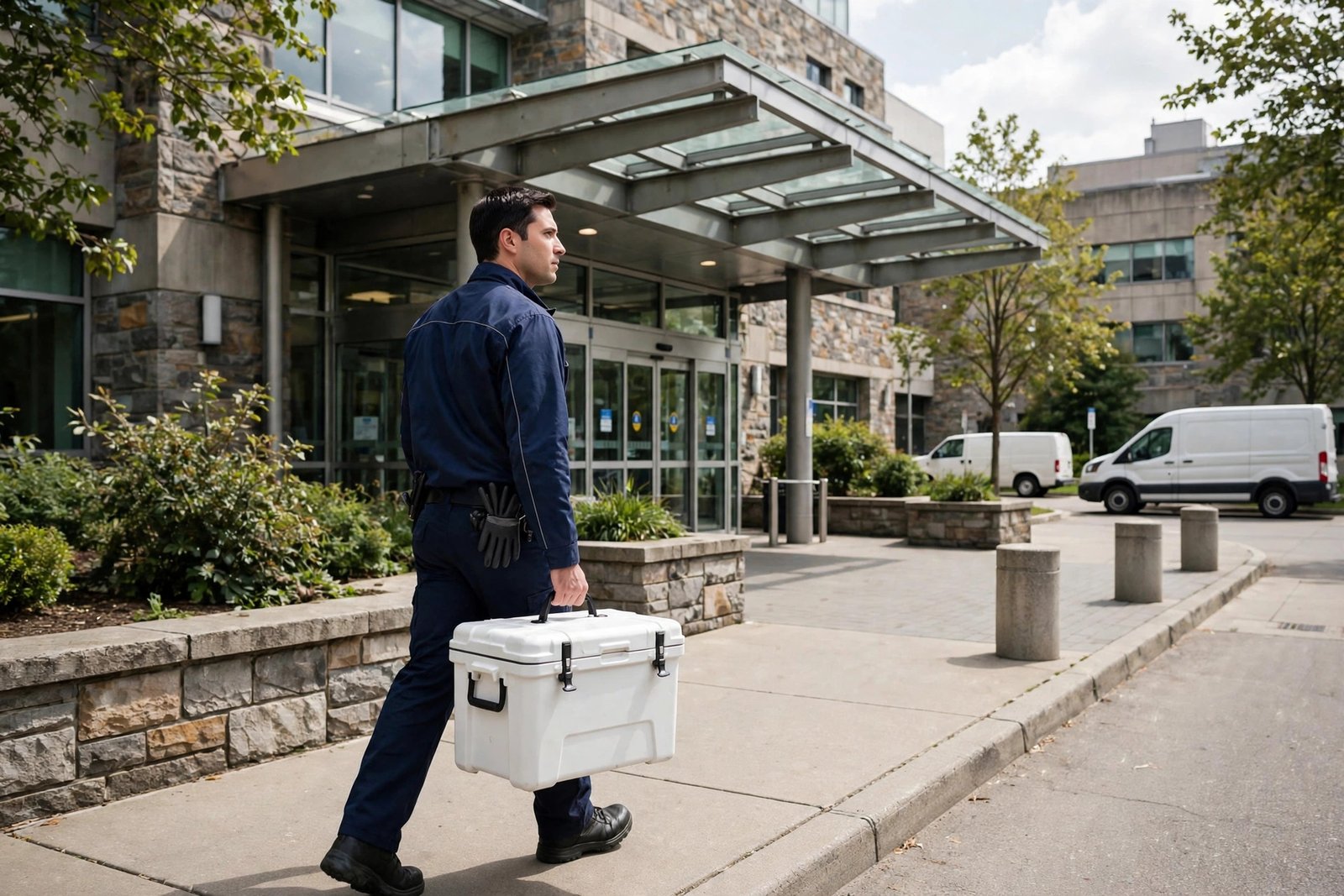
Medical couriers transport time-sensitive medical materials between healthcare facilities: lab specimens (blood, tissue, pathology samples), pharmaceuticals, medical records and X-rays, surgical supplies, and sometimes organs for transplant. It’s logistics with higher stakes than a food delivery app — a delayed specimen can mean a delayed diagnosis.
A typical day involves a scheduled route: pick up specimens from clinics and nursing homes, deliver them to diagnostic labs, transport prescriptions from pharmacies to patients, and handle STAT (rush) deliveries. Routes are often regional — in the NYC metro area, that might mean a loop through Manhattan hospitals, Queens clinics, and New Jersey labs. Shifts include days, nights, weekends, and on-call rotations, since healthcare never sleeps.
Requirements to Become a Medical Courier
- Valid driver’s license — a standard license is enough for car/van routes. Some positions driving larger vehicles may require a CDL, but most don’t.
- Clean driving record — companies check this closely since you’re driving their reputation (and liability).
- Reliable vehicle — for independent contractors, your own car, SUV, or van. Employee positions usually provide company vehicles.
- Background check and drug screening — standard across the industry given access to controlled substances and patient areas.
- High school diploma or GED — the typical minimum education requirement.
- HipAA awareness — you’ll handle materials linked to patient information. Employers train you, but understanding patient privacy basics upfront helps.
- Physical ability — lifting up to 40–50 lbs (coolers, supply boxes), lots of in-and-out of the vehicle, and long hours on the road.
Certifications that help (not always required): OSHA bloodborne pathogens training, DOT hazardous materials awareness, and defensive driving courses. Some employers require them; all of them make your application stronger.
Step-by-Step: Getting Started
Step 1: Make sure you qualify
Check the boxes above — license, clean record, vehicle (if going independent), and ability to pass background and drug screening. If your driving record has recent violations, focus on employee positions with company vehicles first, or wait until older violations age off.
Step 2: Get any useful training
Complete an online HIPAA awareness course and OSHA bloodborne pathogens training — both are inexpensive, take a few hours, and go straight on your resume. A defensive driving course can also lower your insurance rates, which matters if you’re driving your own vehicle.
Step 3: Decide: employee vs. independent contractor
- Employee: Steady hourly pay, benefits, company vehicle, set schedule. Lower ceiling, higher stability. Best for getting started.
- Independent contractor: Higher per-delivery pay, flexible schedule, but you cover your own vehicle, gas, insurance, maintenance, and taxes. Better once you know the routes and the business.
Step 4: Apply to courier companies and healthcare systems
Target medical courier companies (search “medical courier jobs” plus your city), hospital systems with in-house logistics, diagnostic lab chains (Quest, Labcorp, and regional labs run huge courier networks), pharmacies with delivery services, and blood banks. In the NYC area, the density of hospitals, labs, and nursing homes means more openings than almost anywhere in the country — but also more competition.
Step 5: Nail the interview
Employers care about three things: reliability, discretion, and safe driving. Emphasize punctuality, your clean driving record, comfort with early/late shifts, and understanding that specimens are irreplaceable — you can’t “re-make” a biopsy sample. Any logistics, delivery, or healthcare-adjacent experience goes to the top of your resume.
Step 6: Complete onboarding and start running routes
Expect training on chain-of-custody procedures (documenting every handoff), specimen handling and temperature requirements, route software, and facility protocols. Take chain-of-custody seriously from day one — a broken chain can invalidate lab results.
How Much Do Medical Couriers Make?
- Employee couriers: $16–$25/hour, or roughly $35,000–$55,000/year. Major metro areas like NYC trend toward the higher end.
- Independent contractors: $0.50–$1.50+ per mile or $25–$60+ per delivery depending on distance and urgency. High-volume contractors can clear $60,000–$80,000/year before vehicle expenses.
- STAT/on-call premiums: Rush and overnight deliveries pay more — some contractors build their whole schedule around premium runs.
- Factors that raise pay: CDL, hazmat endorsement, willingness to work nights/weekends, and serving high-density medical corridors.
Be realistic about contractor math: higher gross pay minus gas, insurance, maintenance, depreciation, and self-employment tax. Track every mile — the IRS mileage deduction is a contractor’s best friend.
Pros and Cons
Pros: No degree required; steady demand (healthcare logistics grows every year); independent work without a boss hovering; meaningful work — you’re part of the diagnostic chain; clear path to higher pay via contracting or dispatch roles.
Cons: Irregular hours including nights, weekends, and holidays; vehicle wear-and-tear (contractors); exposure to biohazards (mitigated by training and PPE); time pressure on STAT deliveries; and in big cities, traffic is your eternal adversary.
Career Growth
Medical courier work opens doors: dispatcher or route manager roles, operations management at courier companies, pharmaceutical sales delivery, or starting your own courier service. Some couriers use the healthcare exposure as a stepping stone into EMT, phlebotomy, or nursing programs — you’re already comfortable in medical environments, which is half the battle.
Mistakes to Avoid
- Skipping the contractor math. $1.25/mile sounds great until you subtract gas, insurance, and maintenance. Calculate true net pay before going independent.
- Neglecting chain of custody. Every pickup and drop-off must be documented. Sloppy paperwork is a firing offense in this industry.
- Ignoring temperature requirements. Some specimens must stay refrigerated or at room temperature. A cooler left in a hot car can ruin irreplaceable samples.
- Underinsuring your vehicle. Personal auto policies often exclude commercial delivery use. Contractors need commercial or rideshare-style delivery coverage.
- Treating it like food delivery. The pace and independence feel similar, but the compliance, documentation, and consequences are in a different league.
A Day in the Life of a Medical Courier
A typical shift starts with loading up: coolers with temperature-sensitive specimens, locked bags of pharmaceuticals, and a route manifest on your phone or a company app. Morning runs hit clinics and nursing homes for scheduled pickups; midday is lab drop-offs and pharmacy deliveries; afternoons bring the second pickup wave. STAT calls interrupt the routine — a rush specimen from an ER to a lab across town, with the clock ticking. You end the day reconciling your chain-of-custody log, which must account for every single item. It’s independent, fast-paced work — great if you like driving and hate sitting at a desk, less great if you want a predictable 9-to-5.
FAQs
Do you need a medical background to be a medical courier?
No. Employers provide training on specimen handling, HIPAA, and safety protocols. A clean driving record and reliability matter far more than medical knowledge.
How much does a medical courier make in NYC?
Employee couriers in the NYC metro area typically earn $20–$28/hour given the higher cost of living and dense hospital network. Independent contractors can earn more per delivery, especially on STAT hospital runs.
Do medical couriers need their own car?
It depends on the position. Employee roles usually provide company vehicles; independent contractor roles require your own reliable car, SUV, or van. The job listing will specify which arrangement applies.
Is being a medical courier dangerous?
The main risks are road accidents (you drive a lot), exposure to biohazards (managed with training, PPE, and sealed containers), and occasional late-night driving. It’s statistically comparable to other delivery driving jobs, with added compliance training.
What’s the difference between a medical courier and a regular courier?
Medical couriers handle regulated materials — lab specimens, pharmaceuticals, and medical records — under chain-of-custody documentation, HIPAA privacy rules, and temperature controls. Regular couriers move general packages without those requirements. The pay and responsibility are both higher.


