How to Tune a Guitar Without a Tuner App: 5 Methods
How to tune a guitar without a tuner app: the 5th-fret method, harmonics, tuning forks, reference songs, and ear-training drills that make you tuner-independent.
Written by admin
Published November 2, 2026
Reading time 6 minutes
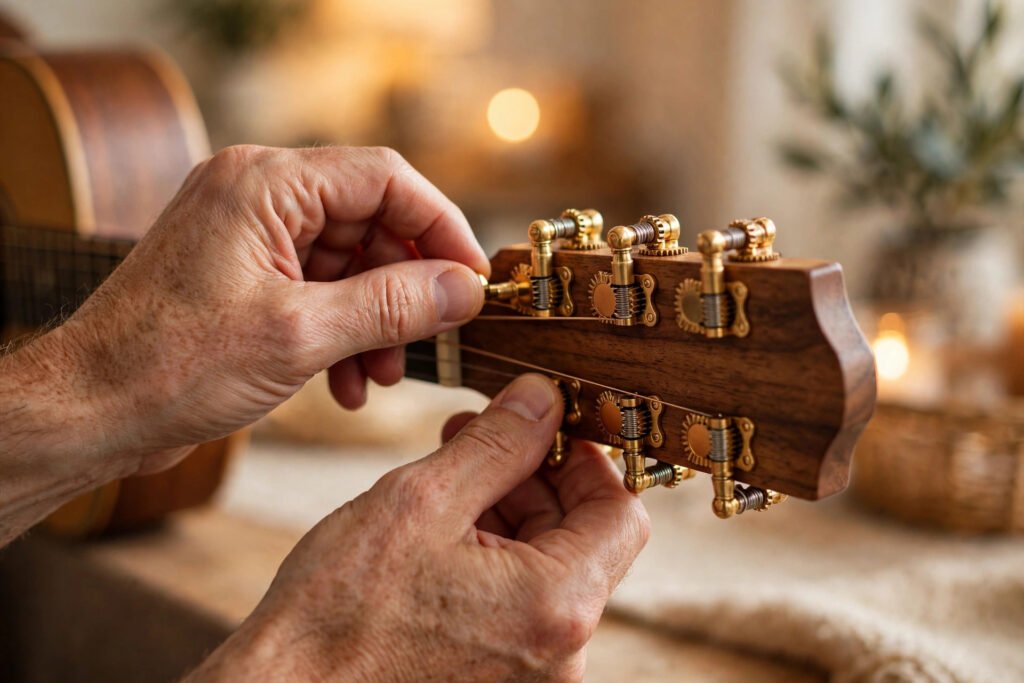
Your tuner app died mid-rehearsal. Your pedal tuner is at home. The gig starts in ten minutes. Every guitarist faces this moment eventually — and the players who handle it calmly are the ones who learned to tune by ear. Tuning a guitar without a tuner app is not some mystical old-school skill; it is a set of practical methods anyone can learn, and it will make you a better musician in ways a tuner never will.
Here are five reliable methods, from simplest to most sophisticated.
Method 1: The 5th-Fret Method (Relative Tuning)
This is the classic every guitarist should know. It tunes each string relative to the one before it:
Play the 5th fret of the low E string — that note is A, the same pitch as the open A string. Adjust the A string until the two match. Then play the 5th fret of the A string (that is D) and match the open D string. Continue: 5th fret of D matches open G. Here is the exception: play the 4th fret of the G string to match the open B string (because of the guitar’s tuning quirk between G and B). Then 5th fret of B matches the open high E.
The key skill is hearing “beats” — the wah-wah-wah pulsation you hear when two notes are slightly out of tune with each other. As you adjust toward the correct pitch, the beats slow down; when they disappear entirely, the strings are in unison. Learning to hear beats is ear training disguised as a practical skill.
Caveat: this method tunes strings to each other, not to concert pitch. Your guitar will be in tune with itself — fine for solo playing and practice, but if you are playing with others, you need one reference pitch first (see Method 4).
Method 2: Harmonics Tuning (More Precise)
Harmonics — the bell-like tones produced by lightly touching a string at specific points — give you purer reference pitches than fretted notes, making this method more accurate than the 5th-fret approach:
Touch (do not press) the low E string directly above the 5th fret wire and pluck — you get a harmonic one octave above the open E. Now touch the A string above the 7th fret and pluck — that harmonic is also E, the same pitch. Match them by listening for beats. Repeat the pattern: 5th-fret harmonic on A matches 7th-fret harmonic on D; 5th-fret harmonic on D matches 7th-fret harmonic on G. For the G-to-B pair: play the 7th-fret harmonic on the low E string (that is B) and match the open B string to it. Then 5th-fret harmonic on B matches 7th-fret harmonic on high E… actually, simpler: 7th-fret harmonic on B matches the open high E.
Harmonics ring longer and purer than fretted notes, giving your ear more time to detect beats. This is the method many professional guitarists use on stage — fast, accurate, and it looks cool.
Method 3: The Reference Song Trick
Every experienced musician carries pitch references in their memory. If you know any song’s starting note cold — the opening of a favorite track you have heard a thousand times — you can sing or hum it to get a reference pitch, then tune one string to your voice and use relative tuning for the rest.
Common reference points guitarists use: the low E string matched to a remembered pitch, or tuning the A string to a tuning fork’s A (440 Hz) if you carry one — many players keep a fork in their case as the ultimate no-battery backup. Building this skill takes time, but it is worth developing: the ability to produce a reference A from memory is a genuine musician’s party trick with real practical value.
This is also excellent ear training that transfers to everything else you play — discovering new music you will actually like becomes a deeper experience when your ear is this engaged.
Method 4: Tune to Another Instrument or Recording
The most practical real-world method: borrow a reference pitch from your environment. Tune your A string to a piano, another guitarist’s tuned instrument, a pitch pipe, or even a song playing on the venue’s speakers (find an A or E in the music). Then use the 5th-fret method for the remaining strings.
In band settings, everyone should tune to the same reference — usually the keyboardist’s A or the bassist’s tuned instrument. Bands that tune to each other sound unified; bands where everyone tunes to their own slightly-off reference sound subtly wrong all night. Designate one reference and stick to it.
Method 5: The “Good Enough” Emergency Check
Sometimes you just need to verify quickly: strum an open E major chord, then an open A major chord, then a G chord. If they all sound clean and in tune with each other, you are fine. Play a few chords up the neck — if barre chords sound in tune at multiple positions, your intonation is solid. This is not a tuning method but a confidence check, and experienced players do it instinctively every time they pick up a guitar.
Training Your Ear: The Long Game
The meta-skill beneath all these methods is pitch discrimination — hearing small differences accurately. Develop it deliberately:
Daily beats practice: Deliberately detune one string slightly, then tune it back by ear, focusing on the beats slowing and disappearing. Five minutes daily builds remarkable precision within weeks.
Sing what you play: Sing notes before you play them, then check. This connects your inner ear to the instrument — the foundation of all musicianship.
Test yourself: Have a friend detune your guitar randomly, then tune it by ear and check with a tuner afterward. Track your accuracy over time; most players get within a few cents (hundredths of a semitone) with practice.
Fender’s tuning guides and Sweetwater’s setup resources both emphasize that ear tuning is a core skill, not an archaic one — and musictheory.net offers free ear-training exercises that accelerate the whole process. If you are building your skills systematically, the best YouTube channels for learning guitar include several with dedicated ear-training series.
Conclusion
Tuning without a tuner is not about rejecting technology — tuners are great tools. It is about independence and musicianship: the confidence of knowing you can get in tune anywhere, anytime, and the sharper ear that comes from the practice. Learn the 5th-fret method this week, add harmonics next month, and start training your ear daily. The next time your tuner app dies mid-rehearsal, you will smile, tune by ear in sixty seconds, and keep playing while everyone else panics.
Frequently Asked Questions
Can you really tune a guitar accurately without a tuner?
Yes. Experienced players routinely tune within a few cents of concert pitch by ear. Relative tuning (strings in tune with each other) is easy; absolute concert pitch requires a reference note from memory, a fork, or another instrument.
What are “beats” in tuning?
When two nearly-identical pitches play together, you hear a pulsating wah-wah sound — beats. The closer the pitches, the slower the beats; when beats disappear, the notes match. It is the fundamental phenomenon behind all ear tuning.
Why is the B string tuned from the 4th fret of G?
Standard guitar tuning has a major third interval between G and B (instead of the perfect fourths between other adjacent strings). The 4th fret of G produces B, so that is the matching point.
Should beginners learn to tune by ear?
Yes, alongside using a tuner. Use the tuner for accuracy while practicing ear-tuning methods — check your ear’s work against the tuner. The two approaches reinforce each other.
What is the fastest ear-tuning method on stage?
Harmonics tuning — it is quick, accurate, and audible over moderate stage noise. Many professionals tune silently with harmonics between songs in under 30 seconds.