Homeschooling in New York: How It Works (2026 Guide)
What is homeschooling and how does it work in New York? The legal requirements, the IHIP, quarterly reports, testing, curriculum choices, and daily life.
Written by admin
Published October 23, 2026
Reading time 6 minutes

Homeschooling in New York is legal, well-established, and more popular than most people realize — tens of thousands of New York families educate at home. But New York also has some of the most detailed homeschool regulations in the country, and the paperwork surprises many newcomers. This guide explains exactly how homeschooling works in New York State: the legal requirements, the forms, the curriculum rules, testing, and what daily life actually looks like for NYC homeschoolers.
Is homeschooling legal in New York? (Yes — with rules)
Homeschooling is fully legal in New York State under Part 100.10 of the Commissioner’s Regulations. You do not need a teaching certificate, you do not need to join a program, and you do not need permission — but you do need to follow the state’s reporting requirements, which are more specific than in most states. Families who skip the paperwork can face truancy inquiries, so understanding the process upfront is essential. The authoritative source is the NY State Education Department’s home instruction page, which publishes the regulations and required forms; the HSLDA’s New York page translates the law into plain English.
The four-step compliance process
Step 1: File a Letter of Intent
When you begin homeschooling (or at the start of each school year, by July 1 or within 14 days of starting), send a Letter of Intent to your local school district superintendent stating that you will provide home instruction. In NYC, this goes to the Department of Education’s homeschooling office. Keep proof of delivery — email with read receipt or certified mail.
Step 2: Submit the Individualized Home Instruction Plan (IHIP)
Due by August 15 (or within four weeks of filing your Letter of Intent if you start mid-year), the IHIP lists the subjects you will teach, the materials and textbooks you will use, the instructor(s), and your planned quarterly report dates. New York requires specific subjects by grade band: grades 1–6 must cover arithmetic, reading, spelling, writing, English, geography, US history, science, health, music, visual arts, and physical education; grades 7–8 add more; grades 9–12 require 4 units each of English and social studies, 2 of math and science, plus art/music, health, and electives. This sounds daunting, but “covering” a subject can be as simple as a library book list and a weekly activity — the IHIP is a plan, not a minute-by-minute schedule.
Step 3: File quarterly reports
Four times a year, you submit a report showing hours of instruction (or a description of material covered) and a narrative evaluation or grade for each subject. Required hours: 900/year for grades 1–6, 990/year for grades 7–12. That averages to about 5 hours a day over 180 days — but hours include field trips, educational outings, music practice, and hands-on projects, not just desk work. Most families find the hours accumulate naturally.
Step 4: Annual assessment
Each year you must submit either standardized test results (grades 4–8 in alternate years, annually in grades 9–12) or a written narrative evaluation. Approved tests include the Iowa, Stanford, CAT, and PASS tests; many families order them through testing services that administer them at home. Scores must show adequate progress (above the 33rd percentile, or a narrative showing a year of growth).
What homeschooling actually looks like day-to-day
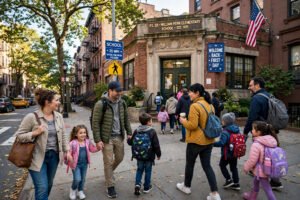
Forget the image of a child at a desk for six hours. Real NYC homeschooling is eclectic: morning math and reading at the kitchen table, afternoon at the American Museum of Natural History (free with library passes), park meetups with other homeschoolers, co-op classes in Brooklyn and Queens for science labs and group projects, library programs, and part-time enrollment in activities like 92NY or YMCA sports. The city’s cultural institutions are a homeschooler’s superpower — where else can “school” include the Met, the Bronx Zoo, and a Broadway matinee in the same month? Families typically spend 2–4 focused hours on core academics daily, with the rest filled by activities, reading, and exploration. For keeping learning rich at home, our ideas for fun indoor activities for kids on rainy days double as easy homeschool enrichment.
Curriculum choices: structured to unschooling
New York homeschoolers use every approach imaginable: complete boxed curricula (Sonlight, Oak National Academy-style programs), eclectic mixes of library books and online courses (Khan Academy is free and excellent for math), co-op classes for group subjects, and unschooling (child-led learning). The regulations do not mandate a specific curriculum — only that you cover the required subjects and document it. Most families evolve: starting structured for confidence, then relaxing into what works. Budget realistically: homeschooling can cost anywhere from nearly free (library + free online resources) to several thousand dollars a year (co-ops, tutors, materials). Teaching financial literacy at home is a natural fit too — teaching kids about money early is easier when you control the schedule.
Socialization: the question everyone asks
It is the first question every homeschooler hears, and the data is reassuring: studies consistently find homeschooled children score as well or better on social development measures, largely because their social lives are multi-age and activity-based rather than confined to same-age classrooms. NYC makes this easy — homeschool co-ops, park days, sports leagues, scouting, church and community groups, and classes at museums and cultural centers provide abundant peer interaction. The real socialization risk is parental isolation, not the child’s — joining a local homeschool group (NYCHEA and borough-level groups are active) solves both. If you are weighing homeschooling partly because of school-culture concerns, our piece on how teachers feel about students using AI for homework offers useful perspective on what is happening inside classrooms right now.
High school, diplomas, and college
New York does not issue homeschool diplomas — parents issue their own, and colleges accept them routinely. Homeschoolers apply to college with parent-generated transcripts, test scores, and portfolios; selective colleges actively recruit homeschoolers, who often stand out for self-direction. For students who want a state credential, the TASC/GED pathway (New York’s High School Equivalency exam) is available. The key: keep meticulous records from 9th grade on — course descriptions, grades, reading lists, and work samples. Your transcript is your diploma’s evidence.
Conclusion
Homeschooling in New York requires more paperwork than in most states, but thousands of NYC families manage it successfully every year — and the city’s museums, parks, co-ops, and cultural riches make it one of the best places in America to do it. File your Letter of Intent, write a reasonable IHIP, keep up with quarterly reports, and document your hours. The bureaucracy is front-loaded; the freedom is daily. If the traditional classroom is not serving your child, New York gives you a legal, well-trodden path to do it yourself.
Frequently Asked Questions
Do I need to be a certified teacher to homeschool in New York?
No. New York requires no teaching certification for homeschooling parents — only compliance with the Part 100.10 reporting requirements (Letter of Intent, IHIP, quarterly reports, annual assessment).
How many hours of homeschooling are required in NY?
900 hours per year for grades 1–6 and 990 hours for grades 7–12. Hours include field trips, projects, and educational activities — not just desk work.
Can homeschooled students in NY play public school sports?
Generally no — New York does not guarantee homeschoolers access to public school extracurriculars, though some districts allow it case by case. Most homeschoolers use club sports, YMCAs, and community leagues instead.
Do NY homeschoolers have to take standardized tests?
Yes, in alternating years for grades 4–8 and annually for grades 9–12 — or you may submit a written narrative evaluation instead of test scores.
Can homeschoolers go to college in New York?
Yes. Colleges routinely accept homeschoolers with parent-issued transcripts and diplomas. Keep detailed records from 9th grade onward, including course descriptions and work samples.