How to Buy Your First Home in NYC on a Budget
How to buy your first home in NYC on a budget: programs that slash your down payment, co-op strategy, a savings plan, and mistakes to avoid. Your keys await.
Written by admin
Published October 24, 2026
Reading time 6 minutes
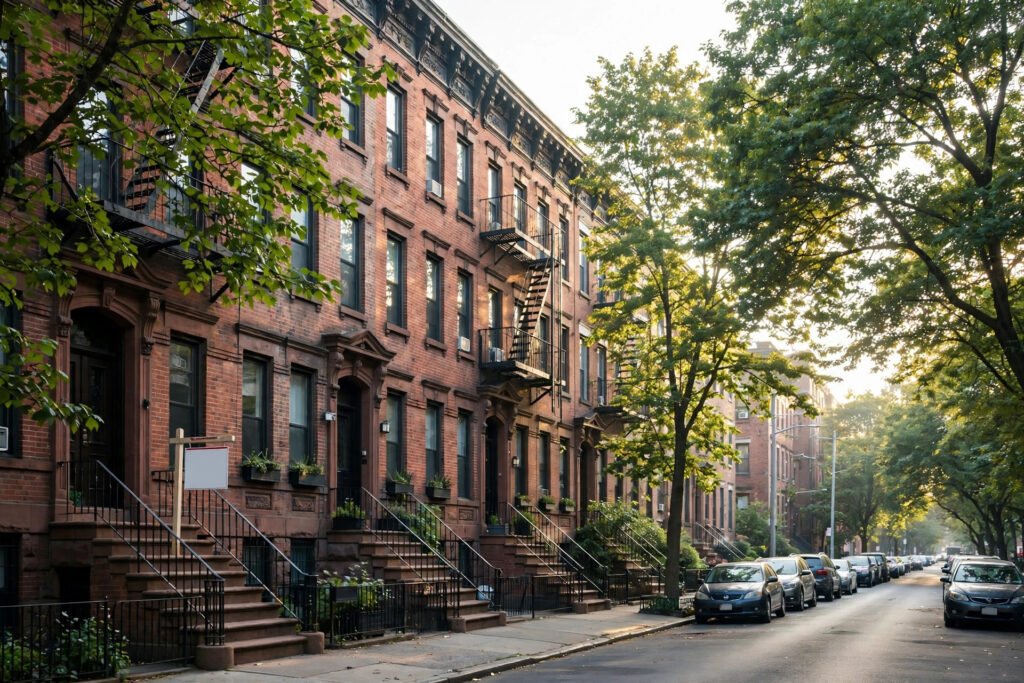
Buying your first home in New York City on a budget sounds like a contradiction — the city where studios rent for $3,000 a month is supposed to be where homeownership dreams go to die. And yes, the obstacles are real: eye-watering prices, fierce competition, co-op boards that scrutinize your finances like a job interview, and down payments that look like phone numbers. But every year, thousands of first-time buyers — teachers, nurses, junior analysts, freelancers — manage to buy in the five boroughs without family money or lottery luck. They do it with strategy: the right programs, the right neighborhoods, realistic budgets, and patience. Here’s the complete playbook.
Reset your expectations (in a good way)
First, forget the Manhattan fantasy. First-time NYC buyers on a budget succeed in the outer boroughs and specific neighborhoods: parts of the Bronx, eastern Queens, southern Brooklyn, and Staten Island, where one-bedrooms and even some two-bedrooms trade at prices within reach of middle-class incomes. Condos and co-ops dominate the affordable landscape — small co-ops in particular often list below comparable condos because of stricter board requirements and higher monthly maintenance, which scares off competition and creates opportunity for prepared buyers.
Second, understand the true monthly cost. In NYC, the mortgage is only part of it: co-op maintenance or condo common charges plus property taxes can add $800–$2,000+ monthly. A $350,000 co-op with $1,200/month maintenance costs more monthly than you’d think — always calculate the all-in number. The Consumer Financial Protection Bureau’s homebuying tools help you model total costs beyond the sticker price.
Programs that make it possible
This is the section most first-time buyers skip, and it’s the most important. FHA loans allow down payments as low as 3.5% — on a $400,000 purchase, that’s $14,000 instead of $80,000. New York State’s housing finance agency (SONYMA) offers down-payment assistance and below-market rates for qualifying first-time buyers, and NYC’s own HomeFirst program provides counseling and assistance. Many buyers don’t realize they qualify: income limits are often higher than assumed, especially for larger households.
Also investigate: Fannie Mae’s HomeReady and Freddie Mac’s Home Possible programs (3% down for qualified buyers), employer-assisted housing programs (several NYC hospitals and universities offer them), and first-time buyer tax benefits — the IRS guidance for first-time homebuyers covers credits and deductions that reduce your effective cost. Stack these programs correctly and the cash-to-close number shrinks dramatically.
The money plan: saving on a NYC budget
Saving a down payment while paying NYC rent is the hard part, so treat it like a project with a deadline. Open a separate high-yield savings account labeled for the down payment — money with a name gets spent less. Automate transfers on payday before you can touch the cash. Audit the big three expenses: housing (a roommate for two years can redirect $12,000+ annually toward your goal), transportation, and food. Saving money on groceries every month sounds small until it compounds to thousands over a two-year savings sprint.
Just as important: protect your credit score like it’s part of the down payment, because it effectively is. A higher score means a lower rate, which means tens of thousands less over the loan’s life. And keep building an emergency fund alongside your down payment savings — buying a home with zero reserves turns every repair into a crisis.
Navigating co-ops (NYC’s special boss level)
Co-ops are NYC’s affordable secret and its bureaucratic gauntlet. The board application — financial statements, tax returns, reference letters, interviews — intimidates buyers, but it’s navigable with preparation. Boards mainly want assurance you can pay maintenance reliably; strong finances and a clean application get approved far more often than horror stories suggest. Work with an agent experienced in co-op transactions specifically — the process differs enormously from condo or house purchases, and a generalist agent is a liability here.
Watch for co-ops with low purchase prices but punishing monthly maintenance, upcoming assessments for building repairs, or restrictive sublet and renovation policies. Request building financials and board meeting minutes before committing; a “cheap” co-op in a building facing a $50,000-per-unit assessment is no bargain.
Winning as a budget buyer in a competitive market
Budget buyers win with preparation, not overbidding. Get fully pre-approved (not just pre-qualified) before touring — sellers take you seriously and you can move fast. Target properties with longer days-on-market, estate sales, and units needing cosmetic updates; lipstick renovations (paint, fixtures, floors) are cheap, while other buyers overpay for turnkey. Consider new-development buildings offering concessions in softer submarkets. And don’t skip the inspection or waive contingencies out of desperation — the cheapest purchase is the one without hidden disasters.
Check HUD’s homebuying resources for approved housing counseling agencies in NYC — many offer free or low-cost guidance specifically for first-time buyers, and some assistance programs require completing counseling anyway.
Mistakes budget buyers keep making
A few traps catch first-time NYC buyers repeatedly. The biggest: falling in love with the purchase price while ignoring monthly carrying costs — a “cheap” co-op with brutal maintenance can cost more per month than a pricier condo with low charges. Second: draining every dollar for the down payment and closing with zero reserves; the first leaking pipe or special assessment then becomes a credit-card emergency. Third: skipping the attorney review to save $2,000 on a $400,000 purchase — in New York, where real estate attorneys are standard, this is false economy at its finest. Fourth: buying at the absolute top of your pre-approval amount. Pre-approval is a ceiling, not a target; buying 15–20% below it leaves room for life to happen. Avoid these four mistakes and you’re already ahead of most first-time buyers in the city.
Conclusion
Buying your first home in NYC on a budget isn’t easy, but it’s absolutely achievable with the right strategy: target affordable neighborhoods and co-ops, stack first-time buyer programs to minimize cash needed, save aggressively with a dedicated plan, protect your credit, and buy with patience rather than panic. Thousands of ordinary New Yorkers do this every year — not because they got lucky, but because they treated homeownership as a project and worked the plan. Start the savings account this week, talk to a lender next month, and you’ll be shocked how quickly “impossible” becomes “in progress.”
Frequently Asked Questions
What is the cheapest way to buy a home in NYC?
Target affordable co-ops in the outer boroughs (Bronx, eastern Queens, southern Brooklyn, Staten Island), use FHA or SONYMA low-down-payment programs, and consider units needing cosmetic updates that scare off less handy buyers.
How much do I need for a down payment on a first NYC home?
With FHA loans (3.5% down) or HomeReady/Home Possible (3% down), a $400,000 purchase needs roughly $12,000–$14,000 down plus closing costs — far less than the 20% myth suggests. Budget 3–6% extra for closing costs.
Are co-ops harder to buy than condos?
The purchase process involves a board application with financial disclosures and sometimes an interview, which adds weeks and scrutiny. In exchange, co-ops often list at lower prices than comparable condos — the hassle is the discount.
What credit score do I need to buy in NYC?
FHA loans go down to 580 (with 3.5% down at 580+), conventional loans generally want 620+, and the best rates start around 740. Co-op boards often impose their own higher expectations, commonly 700+.