
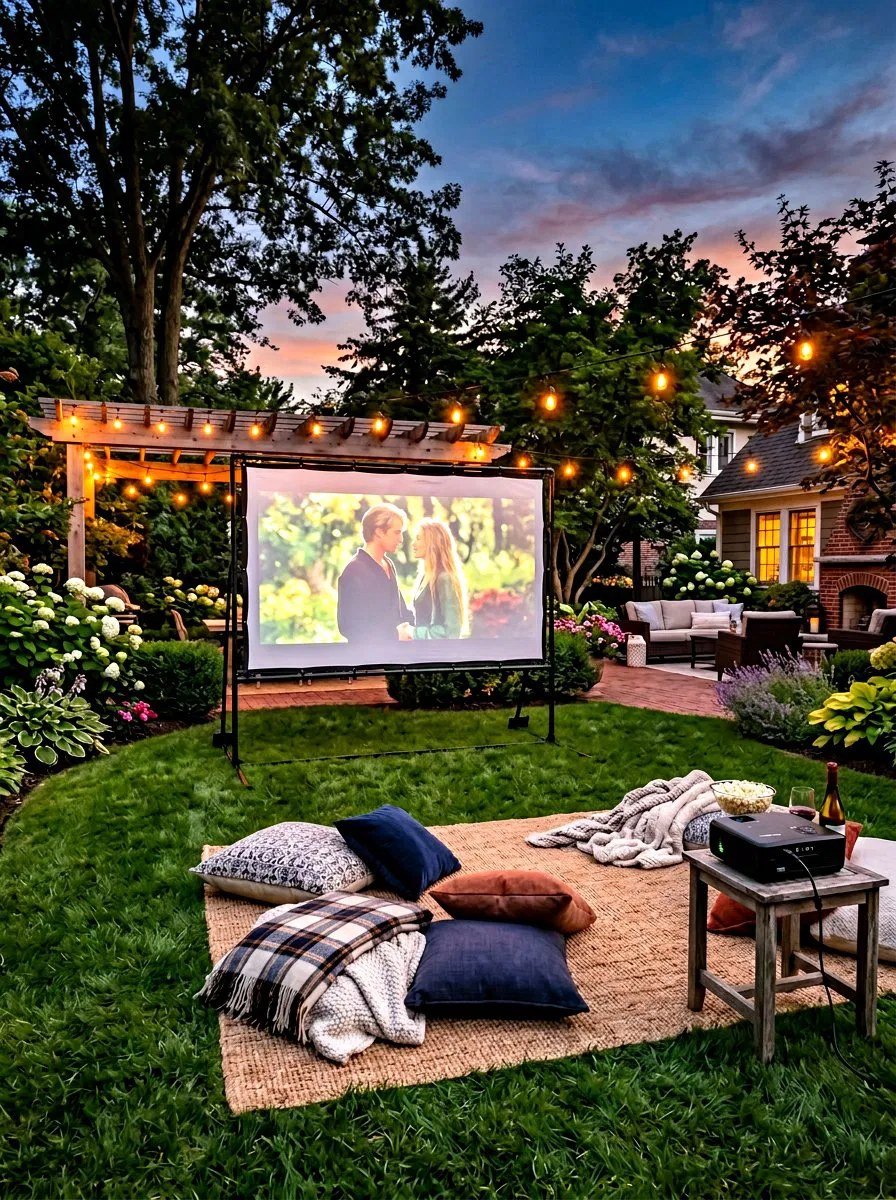
There’s something magical about watching a movie under the stars — the breeze, the crickets, the giant image glowing in the dark. Backyard movie nights are one of those experiences that sound complicated but are actually simple, and they create the kind of memories kids talk about for years. If you’re wondering how to watch movies outdoors in your backyard, here’s everything you need: the equipment, the setup, and the pro tips that separate a great night from a frustrating one.
How to Watch Movies Outdoors in Your Backyard: The Equipment
The projector (the big decision)
You have three tiers:
- Budget ($80–150): Basic 1080p-supported (not native 1080p — read the fine print) LED projectors. Fine for casual use in full darkness. Don’t expect daytime or twilight performance.
- Mid-range ($300–600): Native 1080p, brighter (3000+ lumens), better contrast. This is the sweet spot for regular backyard use — genuinely good image quality that holds up with some ambient light.
- Premium ($800+): 4K, high brightness, excellent contrast. Only worth it if you’re doing this weekly or also want indoor home theater use.
Key specs that matter outdoors: brightness (lumens) — more is better, aim for 3000+ for anything before full dark; throw distance — check how far back the projector needs to sit for your desired screen size; built-in speakers are universally terrible — plan for external audio regardless.
The screen
Options ranked by effort: a white sheet (free, works, wrinkles show — iron it or stretch it tight), a dedicated projector screen ($30–80, much better image, grommets for hanging), an inflatable screen ($100–200, the full experience, sets up in minutes, looks incredible), or a painted wall/fence (projector screen paint on a smooth garage wall — the permanent setup). For most people, a $50 pull-down screen hung between two posts or from the deck is the sweet spot.
The sound (don’t skip this)
Projector speakers are useless outdoors. Your options: a Bluetooth speaker (a good portable speaker is surprisingly adequate for a backyard), a soundbar (better, needs power), or wired outdoor speakers (the permanent setup). Connect via Bluetooth or aux — test the audio sync before guests arrive, since Bluetooth can introduce lag. Dialogue clarity matters more than bass outdoors; wind and distance eat low frequencies anyway.
The source
A laptop (HDMI to projector) is simplest and most reliable. Streaming sticks work if your WiFi reaches the backyard reliably — test this beforehand, because buffering ruins the night. For zero-dependency reliability, download the movie offline beforehand. Bring extension cords and a power strip — you’ll need power for projector, speakers, and maybe string lights.
The Setup: Step by Step
- Pick your spot: flat ground for seating, a surface for the screen (fence, wall, posts), proximity to power, minimal ambient light (turn off porch lights, ask neighbors about theirs).
- Hang the screen: taut and level — wrinkles and sag distort the image. The bottom of the screen should be 2–3 feet off the ground so back rows can see.
- Position the projector: centered with the screen, at the right throw distance, on a stable table. Slight tilt is fine; extreme angles cause keystone distortion (most projectors have keystone correction — use it).
- Set up audio: speaker near the seating, not near the projector. Test sync with dialogue.
- Arrange seating: blankets and pillows on the ground (classic), lawn chairs, bean bags, or a mix. Leave aisles for bathroom trips.
- Wait for dark: start 30+ minutes after sunset. Twilight washout is the #1 rookie mistake — the image looks faded and disappointing until it’s truly dark.
- Bug defense: citronella candles (away from the screen — bugs are attracted to the light anyway), bug spray available, fans blowing across the seating area (mosquitoes are weak fliers).
Snacks and Atmosphere
Go full concession stand: stovetop popcorn in paper bags, theater candy boxes, hot dogs, nachos. String lights around the seating area (not near the screen — light pollution) create the vibe. Blankets for everyone — it gets chilly after dark even in summer. For the full movie-night playbook including the theater rituals, see my indoor theater night guide — the principles transfer directly.
Picking the Movie
Outdoor movies want crowd-pleasers: adventure, comedy, animation — films that work with a little ambient distraction. Great picks: Jurassic Park, The Goonies, Back to the Future, Moana, Top Gun: Maverick, any superhero blockbuster. Avoid quiet, subtle dramas — whispered dialogue doesn’t survive the outdoors. For family options, my family movie guide has the full list. Horror movies outdoors hit different (in the best way) for adult groups — the darkness is already there.
Logistics and Neighbor Relations
Sound: keep volume reasonable — your epic bass is your neighbor’s 11 PM headache. End by 10–11 PM as a courtesy. Give neighbors a heads-up (or invite them — instant goodwill). Weather backup: have an indoor plan; projectors and rain don’t mix. Permits: rarely needed for private backyards, but check local noise ordinances if you’re going big. Power: one heavy-duty outdoor extension cord on a GFCI outlet handles projector + speakers safely.
The Practical Takeaway
Backyard movies = a decent projector (3000+ lumens) + a real screen + external audio + laptop source + seating and bug defense + start after full dark + crowd-pleaser movie + reasonable volume. Total startup cost: $200–400 for a setup you’ll use all summer.
Do it once and you’ll understand — there’s no theater on earth like your own backyard under the stars.
Troubleshooting Common Backyard Movie Problems
Image looks washed out: it’s not dark enough — wait longer after sunset, kill more ambient light, or upgrade projector brightness. Audio out of sync: Bluetooth lag — switch to a wired aux connection, which has near-zero latency. Wind moving the screen: stake down the bottom corners or add weights; a rippling screen is unwatchable. Projector overheating: give it ventilation space on all sides — don’t enclose it. WiFi won’t reach: download the movie offline beforehand, or run a long Ethernet cable. Every one of these has bitten a first-timer; now they won’t bite you. Do a full test run the night before the real event — 20 minutes of testing saves the party.
When comparing projector specs like lumens and throw distance, ProjectorCentral has the most complete database of models with real-world measurements.


