
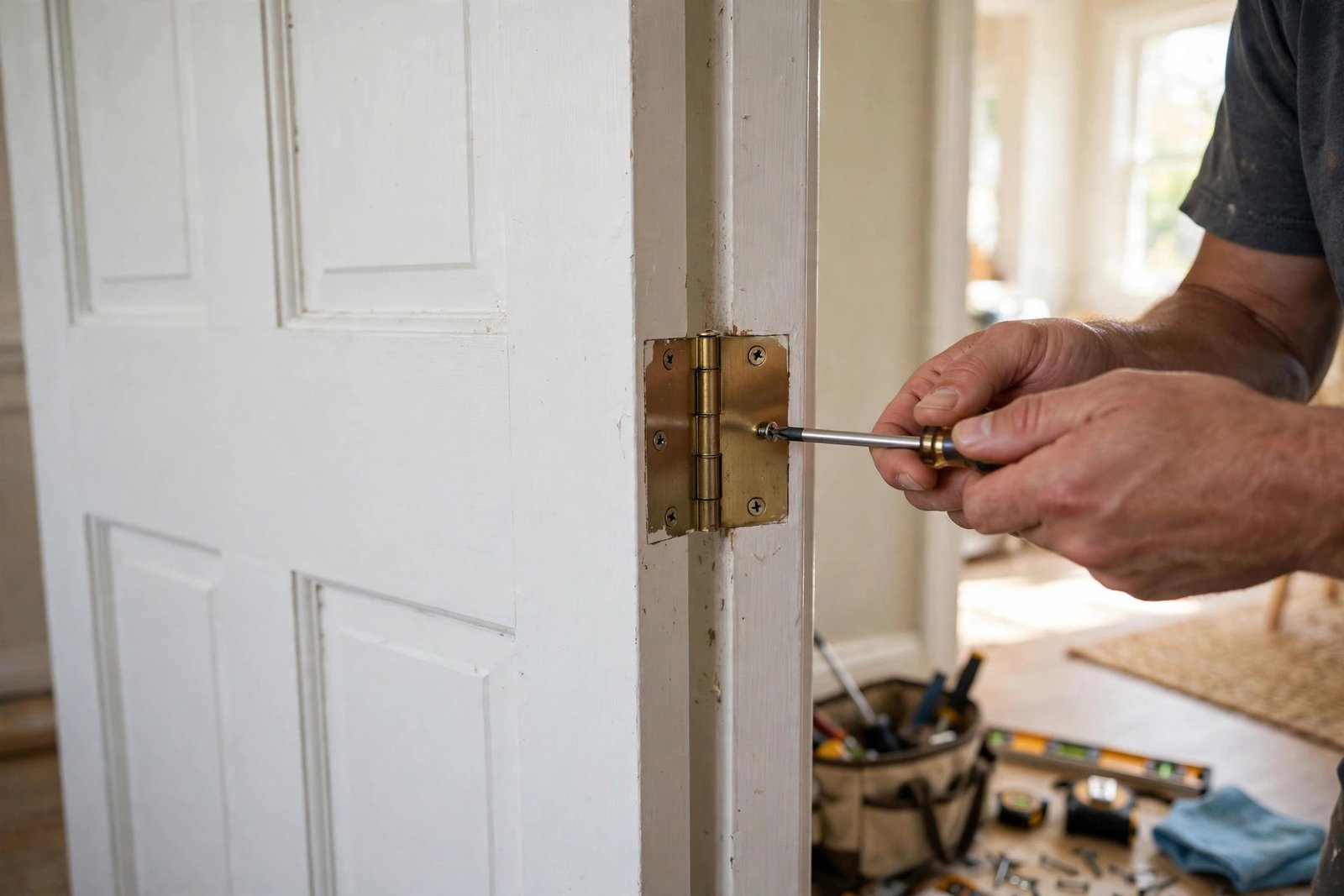
A door that won’t latch, sticks every time it rains, or swings open on its own — small annoyance, but it nags you daily. The good news: doors are simple mechanisms, and most problems have simple fixes. So how can I fix a door that won’t close properly? Diagnose first (the symptom tells you the cause), then apply the right fix. Here are the five most common problems, ranked from easiest to hardest.
Diagnose First: What Exactly Is Wrong?
- Won’t latch (closes but doesn’t catch): strike plate misalignment — the latch bolt misses the strike plate hole.
- Sticks/rubs in the frame: door or frame swelled, or hinges sagging. Check where it rubs — top, bottom, or latch side tells you what’s shifted.
- Sags (gap at top on handle side, rubs at bottom): loose hinges, usually the top one pulling away from the frame.
- Swings open/closed on its own: the frame isn’t plumb — the door follows gravity.
- Rattles when closed: too much gap between door and stop — weatherstripping or strike adjustment needed.
The lipstick test: smear lipstick (or chalk) on the latch bolt, close the door, and see where it marks the strike plate. Instant, precise diagnosis of misalignment. For sticking doors, slide paper around the closed door’s perimeter — where it binds is where it rubs.
How Can I Fix a Door That Won’t Close Properly? The 5 Fixes
Fix 1: Tighten the hinges (fixes most sagging)
Open the door and try wiggling it — if the hinges move, that’s your problem. Tighten all screws. If screws spin without gripping (stripped holes — very common), remove the screw, push in a wooden golf tee or matchsticks coated with wood glue, let dry, trim flush, and re-drive the screw. For the top hinge (which bears the weight), replace one short screw with a 3″ screw driven into the framing behind the jamb — this single screw fixes an enormous percentage of sagging doors permanently.
Fix 2: Adjust the strike plate (fixes latch misses)
If the lipstick test shows the bolt hitting above/below the strike hole: remove the strike plate, enlarge the mortise slightly with a chisel in the needed direction, and reposition. For small misalignments (1/8″ or less), just file the strike plate opening wider with a metal file — five minutes, no chisel needed. If the door shifted a lot, move the plate and fill old screw holes with glued dowels first.
Fix 3: Plane the sticky spot (fixes swelling/rubbing)
Mark the rub area (pencil or the paper test), remove the door from hinges (tap hinge pins up with a nail and hammer), and shave the marked area with a hand plane or belt sander — take off tiny amounts (1/16″ at a time) and test-fit. Seal the planed edge with paint or polyurethane immediately — raw wood absorbs moisture and swells again, which is likely how you got here. Humid-climate sticking often resolves itself in dry months; if it’s seasonal and minor, waiting is legitimate.
Fix 4: Shim the hinges (fixes twist and uneven gaps)
If the gap is wide at the top on the handle side but tight at the bottom (or vice versa), the door is twisted in the frame. Remove one hinge leaf and add thin cardboard shims behind it to push that corner out. Behind the bottom hinge pushes the bottom out (fixing top rub); behind the top hinge pushes the top out. Small adjustments, big results — this is the fiddly precision fix.
Fix 5: Rehang or replace (the nuclear options)
If the frame itself is warped, rotted, or badly out of square, adjustments won’t hold — the frame needs shimming/re-securing (remove trim, shim the jamb plumb, re-secure) or the door needs replacing. A pre-hung door replacement ($150–$400 + installation) is the clean solution for a truly wrecked frame. Bob Vila’s door guides walk through full rehangs if you’re tackling it.
Quick Fixes for Specific Annoyances
- Squeaky hinges: a drop of 3-in-1 oil or silicone spray on each pin. (WD-40 works short-term; proper oil lasts.)
- Door slams: adhesive felt bumpers on the stop, or adjust the closer tension on storm doors.
- Draft under the door: door sweep or draft stopper — also helps with energy efficiency.
- Lock doesn’t align after seasonal shift: often resolves when humidity normalizes; adjust the strike plate if it persists.
Prevention
- Seal all six sides of exterior doors (including top and bottom edges — the forgotten ones that absorb moisture and swell).
- Don’t slam doors — it loosens hinges progressively.
- Check hinge screws yearly; the 3″ top-hinge screw trick as preventive maintenance.
- Control indoor humidity (30–50%) — wild swings swell and shrink wood doors seasonally.
Seasonal Door Problems: Why Doors Act Up in Cycles
Notice the sticking started in July and vanished by October? You’re not imagining it — doors are seasonal creatures:
- Summer sticking: humidity swells wood. Interior doors absorb moisture from humid air; exterior doors get it from both sides. The swelling is real but temporary — aggressive planing in August removes wood you’ll miss in January when it shrinks back.
- Winter gaps: dry heated air shrinks wood, opening gaps that whistle. Drafts around doors peak in winter for exactly this reason — sealing air leaks (doors included) is a fall ritual for a reason.
- The patient approach: for mild seasonal sticking, wait. If it resolves when the season changes, the door is fine — it’s the climate. Only plane when the problem persists across seasons or prevents latching.
- Humidity control helps everything. Keeping indoor humidity 30–50% year-round (humidifier in winter, dehumidifier or AC in summer) minimizes the swell-shrink cycle for doors, floors, and furniture alike.
- New doors in old houses: replacement doors need a full year to acclimate — don’t judge the fit until it’s seen all four seasons. Pros expect to adjust new doors after the first year; it’s normal, not defective.
Document the pattern. Note when sticking starts and stops — a door that sticks every humid summer and frees every dry winter is telling you about your home’s humidity, not its carpentry. Fix the humidity and the door fixes itself. And fold door checks into routine home maintenance: hinge screws tightened yearly, seals inspected each fall, and the 3-inch top-hinge screw as preventive medicine. Doors are simple machines — a little seasonal attention keeps them clicking shut properly for decades.
The Practical Takeaway
Fixing a door that won’t close properly starts with diagnosis: tighten/replace hinge screws (with the 3″ screw trick for sagging), adjust or file the strike plate for latch misses, plane small amounts for swelling, shim hinges for twists. Most door problems are hinge problems in disguise — start there before reaching for the plane. Work in small increments, seal any bare wood immediately, and remember that seasonal sticking often cures itself. A door that clicks shut properly is one of those small daily satisfactions you stop noticing — which is exactly the point.


